E-Paper



‘Emotionally overpowering’: President Murmu visits her alma mater in Odisha
In a post on Twitter, President Murmu said it was a “nostalgic moment today when I visited my alma mater Government Girls High School and Kuntalakumari Sabat Adivasi Girls Hostel in Bhubaneswar


Shortly after a rousing welcome at Capital Girl’s High School in Bhubaneswar on Friday morning where she studied for four years, President Droupadi Murmu strolled to the room in Kuntala Kumari Sabat hostel and sat on the wooden cot that was her private corner during the early years of adulthood.
It was the second day of Murmu’s visit to Odisha after she became President in July this year. On Thursday, she walked around 2km on the main road of the temple town Puri leading to the 12th-century Jagannath temple.
On Friday morning, she visited the school and the hostel room where she spent her formative years after completing her primary education at her native village of Uparbeda in Mayurbhanj district, 280km away, more than five decades ago.
Droupadi Murmu, then Droupadi Tudu, was 12 years old when she came to study at the Capital Girl’s High School determined to be the first matriculate woman from her village. Back in the early 1970s, the Mayurbhanj district’s literacy rate was just about 12%. For tribal women, it was way lower.
“She sat on the cot for a minute trying to savour the moment in her room where she stayed during her high school days. She then went around the room and looked at the old photographs of her with classmates as well as the photograph of then assistant superintendent of the hostel, Shantilata Gochhayat,” said Labang Nayak, warden of the hostel.
Her hostel room has been turned into a worship room. For her visit, the school had given it a fresh coat of paint and decorated it. There were bouquets on the walls and a large photograph of Murmu with a chair and a table on one end of the room. She also went to the hostel dining room and spoke about how she used to have lunch and dinner sitting on the floor.
Murmu, who spent about half an hour in the school, later wrote about her visit in the school register describing the moment as “emotionally overpowering”.
“The hostel visit rekindled several old memories of my student days. I was overwhelmed with emotion while talking to hostel inmates and teachers. I am happy that the inmates here are getting a safe, clean and homely environment in the hostel,” she wrote in the register. She planted a Bakul sapling on the premises of hostel.
She also wrote about her visit on Twitter. “It was a nostalgic moment today when I visited my alma mater Government Girls High School and Kuntalakumari Sabat Adivasi Girls Hostel in Bhubaneswar. The visit brought back many fond memories of my student life”.
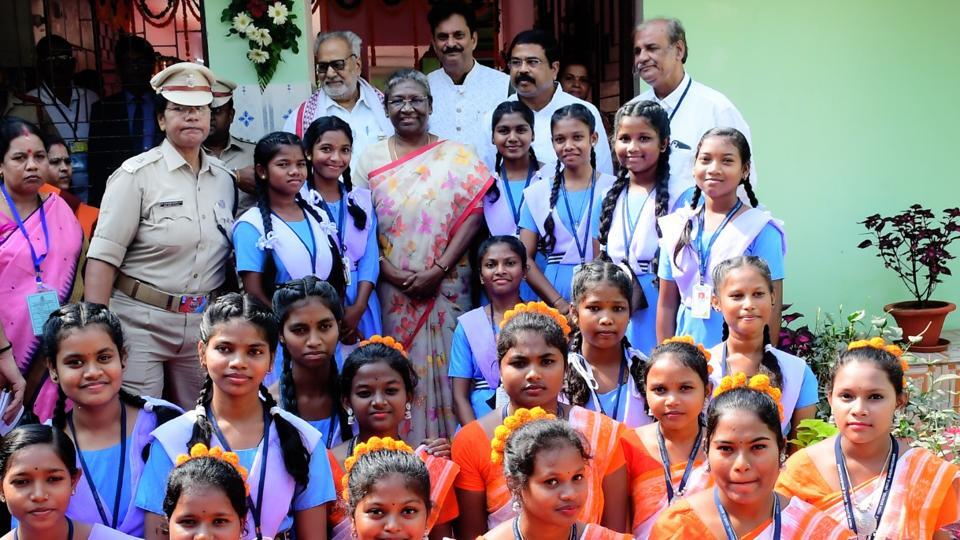
“She seemed more like our class teacher than a President,” said Ankita Nayak, a class 10 student at the government-run school where the President studied for four years.
President Murmu also met the teachers and some of her former classmates and posed with them for a group photograph.
“where is Chunni,” she asked Tanmayee Bisioi as soon as she saw her. Bisioi was her classmate.
“My twin sister Chinamayee (Chunni), I and Droupadi were very close as we stayed in the hostel. Unfortunately, my sister had left for Puttaparthi by the time President arrived in Bhubaneswar. As my late mother Shantilata Gochhayat was the assistant superintendent of the hostel and took very good care of her, she used to call my mother her Jasoda maa,” said Bisoi.
“Both of us have attended several NCC camps together where she used to sing. When I was awarded best cadet in NCC, Droupadi was the first to congratulate me,” said Anshumala Ajita.
Dangi Murmu, whose old photograph with the President adorned the wall of the hostel room, said: “She is the same Droupadi that I knew 50 years ago, calm, quiet and very friendly. Today when she met, she gave a wide smile and rushed towards me”. They later caught up again at Raj Bhawan.
A little before she came to her alma mater, President Murmu visited Bhubaneswar’s Tapoban High school, a state-run school for ST/SC students, where most of her cousins and people from Mayurbhanj used to study.
Describing the difficulties she faced in her primary school days, Murmu said the current generation of students were fortunate to have been exposed to newer modes of education through Internet and television. “At Uparbeda primary school, the school building then had tiled roofs. Part of the floor used to be cemented, but we would smear the floor with cow dung to make it smooth once a week. We used to sweep the school floor every day,” she said.
She added: “Staying in a remote village, I had no idea as to what was happening in the country and outside. I did not have any role models then. My grandmother, who used to help people, particularly women in our area, was my role model. She was mentally very strong and I learnt a lot from her life.”
To the students who had come to hear her, President Murmu had just one advice.
“Never allow the circumstances to define you. You should aim to be what you want to be. I appeal to you to work hard and concentrate on your studies.”
Later, she launched books for engineering students in Odia and e-KUMBH (Knowledge Unleashed in Multiple Bharatiya Languages) portal at a separate function, Murmu emphasised that education is a tool for empowerment.
“We must ensure that each and every child in our country has access to education at every level. We have to do our best to make education available to all without any discrimination. There is no doubt that the mother tongue helps intellectual development in students. She expressed confidence that learning in mother tongue would develop creative thinking and analytical skills among students and it would also provide equal opportunities to urban and rural students. Language should be an enabling factor, not a hindrance in educating children. The introduction of learning in regional and local languages would go a long way towards building a well-educated, aware and vibrant society,” she said.