
 E-Paper



‘Entire machinery was behind him’: Harvinder Singh Phoolka on Sajjan Kumar’s conviction
Senior advocate Harvinder Singh Phoolka has steadfastly pursued the anti-Sikh riot cases across forms and courts for decades. He quit as the leader of the opposition in the Punjab Assembly last year when the Delhi Bar Council objected to his continuing with his practice citing conflict of interest.

 Prefer HTon Google


“It is late, but definitely not too little,” senior advocate Harvinder Singh Phoolka said on the conviction of Congress politician and former member of Parliament Sajjan Kumar in a 1984 anti-Sikh riots case.
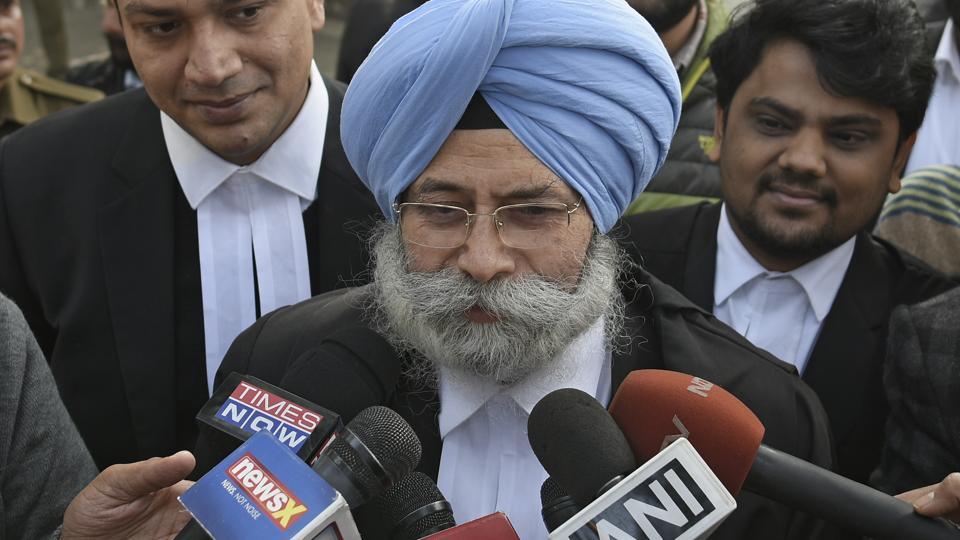
“I agree we cannot say justice has been done... it is symbolic only, but nonetheless, the conviction of Sajjan Kumar is not a small issue. The entire machinery was behind him,” Phoolka said, explaining the significance of Monday’s verdict.
Phoolka has steadfastly pursued the anti-Sikh riot cases across forms and courts for decades. He quit as the leader of the opposition in the Punjab Assembly last year when the Delhi Bar Council objected to his continuing with his practice citing conflict of interest. “This (pursuing the cases) was more important to me,” he said.
Across the country, thousands of Sikhs were massacred after security personnel assassinated the then Prime Minister Indira Gandhi. Sajjan Kumar’s conviction comes after 34 years, 1 month and 17 days, he said.
“The challenges we faced were huge,” Phoolka said flanked by the riot victims who had gathered at the Punjab Bhavan to congratulate him. “But this judgment is historic ... it details how law and processes were subverted at every stage. The charge sheet for this case was buried in the files since 1992,” Phoolka said. “This is the kind of influence that was brought to bear to save Sajjan Kumar Efforts to scuttle the case was made at every level.”
Read | Delhi high court judgment will serve as much needed balm for victims of 1984 anti-Sikh riots
Since the massacre, there have been dozens of commissions and committees formed to investigate the 1984 riots. Months after the carnage, the Ved Marwah Commission was appointed to look into it. It was, however, wound up mid-way and replaced with the Ranganath Mishra Commission. Subsequently, the R C Shrivaastaav Committee was set up to look into the police mechanism and how to prevent a repeat of such an incident. Some of the other committees and commissions that were set-up to investigate the riots include the R K Ahuja Committee, the Kapoor-Mittal Committee, the Jain-Banerjee Committee and Jain-Aggarwal Committee that recommended registration of cases against politicians like HKL Bhagat, Sajjan Kumar and others.
“We are going to approach the Special Investigation Team, using this judgment as a building block” to reinvestigate the involvement of other politicians, said Phoolka. “There is need for new law to deal with mass killings/ genocides.”


