New Delhi: The State is within its jurisdiction to order that apparent symbols of religious beliefs cannot be carried to a school maintained from the public funds, justice Hemant Gupta said in his judgment on Thursday, adding a “sectarian approach would be the antithesis” of renouncing sectional diversities and to cultivate scientific and secular outlook.
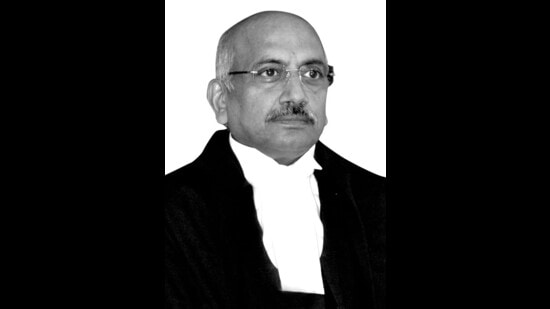
Penning the 133-page judgment two days before he is set to retire, justice Gupta framed 11 questions that he said arose for adjudication, and answered
New Delhi: The State is within its jurisdiction to order that apparent symbols of religious beliefs cannot be carried to a school maintained from the public funds, justice Hemant Gupta said in his judgment on Thursday, adding a “sectarian approach would be the antithesis” of renouncing sectional diversities and to cultivate scientific and secular outlook.
Penning the 133-page judgment two days before he is set to retire, justice Gupta framed 11 questions that he said arose for adjudication, and answered all these questions in favour of ban on hijab in educational institutions, which he said, are entitled to deny entry to students who insist on wearing the headscarf or any other prominent religious symbol.
“If a particular student feels that she cannot compromise with the wearing of headscarf or of any other student to wear any outwardly religious symbol, the school would be justified not to allow such student, in the larger interest of treating all the students alike,” he said.
According to justice Gupta, if the students of one faith insist on a particular dress, there is no stopping others from carrying their faith and beliefs to the schools. “It would not be conducive to the pious atmosphere of the school, where students seek admission for education. In fact, uniform fosters a sense of ‘equality’ amongst students-- instills a sense of oneness, diminishes individual differences...” he added.
Affirming the executive power of the state under the Karnataka Education Act to ensure that the students come in the uniform prescribed by the concerned committee, the judge maintained that “the sectarian approach that certain students will carry their religious beliefs to secular schools run by the State would be antithesis of the mandate of the statute”.
“All students need to act and follow the discipline of the school. Out of the many steps required to ensure uniformity while imparting education, one of them is to wear the uniform dress without any addition or subtraction to the same. Any modification to the uniform would cease to be the uniform,” he said.
Dismissing the petitioners’ argument that the prohibition trampled upon Muslim girls’ freedom of conscience and religion, justice Gupta held that the restriction was to promote uniformity and encourage a secular environment in the schools, and thus, justifiable under Article 14 (equality) of the Constitution.
“Equality cannot be breached by the State on the basis of religious faith...Secularism is thus, more than a passive attitude of religious tolerance. It is a positive concept of equal treatment of all religions. The faith or belief of a person is immaterial from the point of view of the State. For the State, all are equal and all are entitled to be treated equally,” he emphasised.
Steering clear of the determination whether the practice of wearing of hijab is an essential religious practice or not, justice Gupta underlined that it is undoubtedly the belief or faith of an individual.
“The religious belief cannot be carried to a secular school maintained out of State funds. It is open to the students to carry their faith in a school which permits them to wear hijab or any other mark, may be tilak, which can be identified to a person holding a particular religious belief but the State is within its jurisdiction to direct that the apparent symbols of religious beliefs cannot be carried to school maintained by the State from the State funds,” he said.
On the aspect of denial of the right to education, justice Gupta said that the State cannot be blamed when girl students, “by choice” do not attend schools since hijab has been banned.
“If they choose not to attend classes due to the uniform that has been prescribed, it is a voluntary act of such students...The student is not expected to put a condition that unless she is permitted to come to a secular school wearing a headscarf, she would not attend the school. The decision is of the student and not of school when the student opts not to adhere to the uniform rules...A student, thus, cannot claim the right to wear a headscarf to a secular school as a matter of right,” maintained the judge.
The students, justice Gupta said, have many years ahead of them where they can carry on their religious faith but the government order mandating wearing of uniform cannot be faulted with since the object is in tune with the principles of the Constitution.
“Schools are to prepare the students for their future endeavors in life. Discipline is one of the attributes which the students learn in schools. Defiance to rules of the school would in fact be antithesis of discipline which cannot be accepted from the students who are yet to attain adulthood,” he said.
Calling the uniform an equaliser of inequalities, justice Gupta asserted that prescribing uniform for children at an impressionable age is not only important but has a salutary effect on the mental development of the child to grow in the “environment of oneness”.
One Subscription.
Get 360° coverage—from daily headlines
to 100 year archives.
Archives
HT App & Website