Former IIT Delhi director V Ramgopal Rao has backed IIT Bombay professor Suryanarayana Doolla amid the controversy surrounding the death of BTech student, saying he was “disturbed” to see Doolla being “vilified” and calling for a fair examination of the concerns raised against him.
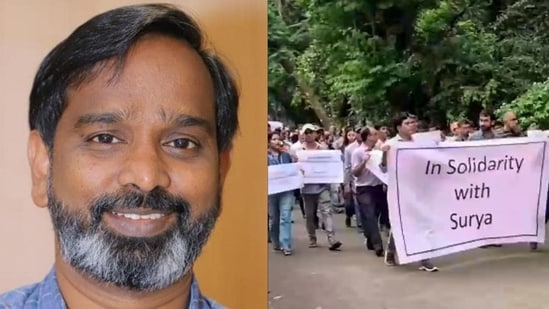
In a post on X, Rao said he knew Doolla personally and described him as “one of the finest faculty members” he had known in the IIT system and “a gentleman of the highest integrity”. He said a public campaign against an individual “serves no one”.
Also Read: IIT Bombay’s 10-member committee begins probe into student’s death
Deep Dive
What were the circumstances surrounding the death of the IIT Bombay student?
Why is Professor Suryanarayana Doolla being investigated in this case?
How is IIT Bombay addressing the allegations of caste-based discrimination on campus?
Rao’s comments came as Doolla, who was removed as IIT Bombay’s Dean of Administrative Affairs following protests over the student’s death, was sent on leave to facilitate an impartial probe, according to sources. The Mumbai Crime Branch is investigating the case.
{{/usCountry}}Rao’s comments came as Doolla, who was removed as IIT Bombay’s Dean of Administrative Affairs following protests over the student’s death, was sent on leave to facilitate an impartial probe, according to sources. The Mumbai Crime Branch is investigating the case.
{{/usCountry}}A second-year BTech student in IIT Bombay’s Department of Energy Science and Engineering, was found dead in his hostel room on September 18, hours after he was allegedly caught using a mobile phone to access ChatGPT during a mid-semester examination, according to officials.
A case of abetment to suicide and caste discrimination has been registered against Doolla. The student's mother has alleged that her son told the family he was tortured, abused and humiliated because of his caste.
'One size fits all' approach
Rao, who has more than 25 years of experience at IIT Bombay and IIT Delhi, said the controversy also highlighted a broader issue with the “one size fits all” approach in IITs.
He argued that classrooms have become highly heterogeneous, with students entering through an intensive coaching culture and having widely different JEE Advanced ranks and academic backgrounds. Language differences, he added, can further complicate teaching and learning.
“Can we expect every student to learn at the same pace?” Rao asked, arguing that the challenge was not confined to any particular admission category.
Rao suggests five-year BTech programme
Rao proposed that IITs consider extending their BTech programmes to five years, while allowing students who meet the required credits to finish in four years or potentially three-and-a-half years.
Under the model, students who need more time could spread their courses over five years and receive additional academic support, including recorded lectures, online material and language assistance where required.
Rao said making five years the standard programme would also have a “psychological advantage”, as students needing an additional year would simply be following the programme as designed rather than being singled out for taking longer.
“We must uphold academic standards,” Rao said, while adding that students do not all arrive at the same point or learn at the same pace. He said giving them the time and support needed to meet those standards was the responsibility of the system.
(With PTI inputs)