An expert committee advising India’s drugs regulator has recommended Biological E-made coronavirus vaccine Corbevax be approved for emergency use in children aged five and above, officials said on Thursday, making it the second shot to be backed for use in the under-12 age group although a final decision will need to be taken by the regulator and then the government.
The subject expert committee (SEC) also approved Zydus Cadila’s application for the ZyCoV-D vaccine to be used in a two-dose formulation, the people added.
The recommendations have been made to the Drugs Controller General of India (DCGI), who will take the final call on both matters.
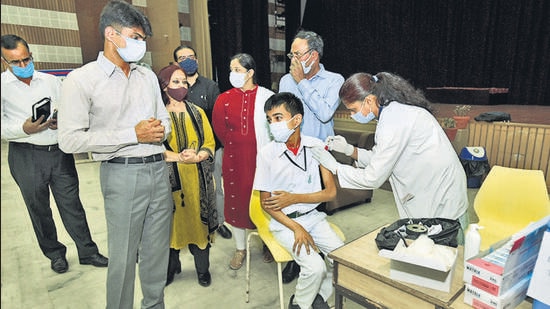
Corbevax is currently being administered to children aged 12 and above under the national Covid immunisation programme. While Zydus vaccine received emergency use authroisation last year for population aged 12 years and above, the world’s first plasmid DNA vaccine could not be introduced in the programme because of the production issues.
“Due processes have to be followed; they have the data that satisfied the experts, and now the recommendations will be deliberated over by the drug controller. Manufacturing is a secondary issue,” said a senior official aware of the matter, requesting anonymity.
The other vaccines approved for use in children are Bharat Biotech’s Covaxin and ZyCoV-D. India at present is allowing only children aged 12 and above to get the shots, with experts differing on whether to allow younger children to be covered since they anyway have a superior immune response against the coronavirus.
{{/usCountry}}The other vaccines approved for use in children are Bharat Biotech’s Covaxin and ZyCoV-D. India at present is allowing only children aged 12 and above to get the shots, with experts differing on whether to allow younger children to be covered since they anyway have a superior immune response against the coronavirus.
{{/usCountry}}Biological E collaborated with the Texas Children’s Hospital and the Baylor College to develop the recombinant protein sub-unit vaccine, which is a platform used for a number of pediatric inoculations and is considered safe for wide use.
The vaccine has been priced at ₹800 per dose for private market, announced the company in a statement in March, and that it has been proven to work in almost all existing variants of concern, although the company is yet to release data from its clinical trials.
“Corbevax is priced at ₹800 in the private market; if GST and administration cost is included then it would cost at ₹990,” announced Mahima Datla, managing director, of Hyderabad-based Biological E, in a media briefing on March 16. For the government, the vaccine is priced at ₹145.
Datla at the time said the company had the capacity to produce around 100 million doses in a month, and also to scale up production, if required. To date, at least 300 million vaccines have been produced as part of the commitment made to the Government of India.
“Fifty million doses have already been delivered to the government of India as part of the commitment, and 250 million is lying in our inventory. The shelf life of the vaccine is 12 months from the date of manufacturing,” said Datla.
According to the company statement, multiple Biological E facilities in Hyderabad are currently producing and will continue to produce the vaccine; and the group will leverage its robust pan India presence and partner with the state governments, hospitals and medical institutions for an uninterrupted supply of its vaccines.
The trial response shared by the company showed that the vaccine induced immune response indicative of over 90% effectiveness against the ancestral strain; while at least 80% in the case of the Delta variant based on the level of neutralizing antibody titers.
The vaccine is administered through intramuscular route with two doses scheduled 28 days apart and is stored at 2 to 8 degrees Celsius.
US-based Dynavax Inc supported the programme by providing the adjuvant and Translational Health Science and Technology Institute (THSTI) Delhi conducted key immunogenicity testing as part of a comprehensive clinical trial development plan.
Department of Biotechnology, Bill & Melinda Gates Foundation and Coalition for Epidemic Prevention and Innovation (CEPI) provided partial funding during clinical development, the company said.