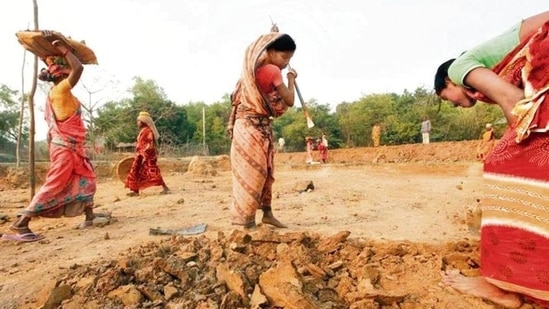
Women’s participation in India’s labour force is low and has been declining this century, official employment surveys have shown. However, these surveys – the Employment and Unemployment Survey (EUS), and the Periodic Labour Force Survey (PLFS) – do not sufficiently explain the reasons for this trend or offer clues on how this trend can be changed. A survey conducted by the Center for the Advanced Study of India (CASI) at the University of Pennsylvania has tried to solve this problem.
Official surveys offer some clues, but not definitive answer
The PLFS does offer some clues for these trends. Marriage, for example, significantly reduces women’s LFPR. In the 21-25 years and 26-30 years cohorts, unmarried women are twice as much likely to participate in the labour force as married women. This suggests that the expectation of household work after marriage negatively impacts women’s participation in the labour force.
However, the PLFS does not ask reasons for not working or not looking for work. It is possible that women are willing to work, but the available jobs are not suited to their requirements. Moreover, a working paper based on the PLFS published in October by Jyotirmoy Bhattacharya, who teaches economics at Ambedkar University, suggested that people could be misreporting their employment status (reported by HT on November 1: https://bit.ly/3rZAVdk). Unemployed people – those looking for work but not finding one – possibly report that they are simply not looking for work, and end up being misclassified as out of labour force. LFPR may not represent the true size of the labour force in that case.
Similarly, the PLFS also shows that for married women, agriculture is the most preferred sector for work. This explains why rural women’s LFPR is higher than urban women’s. Still, we can only hazard guesses on why agriculture is the preferred sector for married women.
In a published article detailing the survey’s results on LFPR, the researchers – Deepaboli Chatterjee and Neelanjan Sircar of the Centre for Policy Research (CPR) – suggest that the reason why women are engaged in agriculture is because such jobs fit these needs of flexibility and proximity. “As India urbanises, labour market opportunities fitting those criteria are in shorter supply, causing women to leave or become unwilling to enter the labour market,” they said, explaining the falling LFPR. Any attempts to fix the trend in women’s LFPR must, therefore, keep India’s urbanisation trends in mind. Moreover, that even help available with household work does not change women’s willingness to work suggests that societal expectations have a role in women’s need for flexible and proximate work.
Employment improves women’s role in decision-making, but not in financial decisions
Does employment change women’s role at home? Although not a jobs survey in itself, the National Family Health Survey (NFHS) tells us an important thing about this. Women’s decision-making power in the household is more if they are employed, according to its unit-level data for the 2015-16 NFHS analysed by HT. To be sure, this does not necessarily mean that employment improves women’s decision-making power. It is also possible that the converse it true: in households where women have decision-making power, women are more likely to be employed.
The CASI survey puts an important qualification on this trend. It shows that even when women are making the decision on a matter, they may not be involved in its finances, even if they are employed.