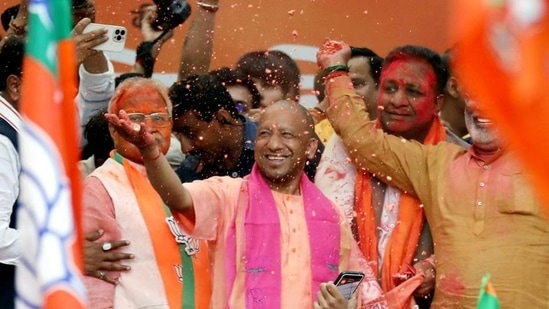
The Bharatiya Janata Party (BJP) achieved a comfortable victory over the Samajwadi Party (SP) in the recent Uttar Pradesh elections. The BJP and its allies managed a seat share of 67.7% with a vote share of 43.8%. These numbers are 31% and 36.5% for the SP led alliance. The BJP’s victory has been widely interpreted as the end of dominance of Mandal model of politics (see https://bit.ly/3qaftAl for example). To be sure, the SP did try mixing class with caste
What explains the exceptional support for the SP among government employees as seen in postal ballot trends in these elections? The likely answer is the popularity of the SP’s poll promise of restoring the old pension scheme (OPS) for government employees. If implemented, this promised significant post-retirement economic gains for government employees. SP is not the only party which has pushed the OPS agenda. Congress governments in Rajasthan and Chhattisgarh have also announced a restoration of the OPS (and are hoping to exploit its political benefits).
{{^htLoading}} {{/htLoading}} But government employee votes cannot win elections for a political party
To be sure, SP’s disproportionate support among government employees, was far from enough in helping its ambition of winning the 2022 elections. The reason is simple. Government employees are a miniscule proportion of overall voters in the state of Uttar Pradesh. This is best seen in the total number of postal ballots which were cast; just 442,341 which is 0.48% of the total number of electronic voting machine (EVM) votes polled in these elections.
While the comparison of postal ballot and EVM trends might appear irrelevant given the comprehensive victory of the BJP in these elections, they capture an important political economy dilemma facing the opposition in India.
Economic constituencies such as government employees are a numerically significant but relatively insignificant part of the overall voters in India. While they are the most well-protected section of the Indian workers in terms of job security and guaranteed wages, their interests have been under varying degrees of squeeze in the post-reform era. Discontinuation of OPS, outsourcing of erstwhile government jobs to private contractors and privatization of public sector units are some examples of this process. Data from the Centre for Monitoring Indian Economy (CMIE) shows that formal employment in public sector in India peaked in 1996-97 and then declined till 2011-12, the latest period for which this data is available. The CMIE numbers are from the Employment Review documents published by the Directorate General of Employment and Training under Ministry of Labour and includes employment in both central and state government.
{{^htLoading}} {{/htLoading}} Not all government employees are attracted by promises such as OPS
What might have added to the limits of such politics is the fact that even within government employees, not everyone is eligible for benefits such as pensions.
The Employment and Unemployment Surveys (EUS) and the Periodic Labour Force Surveys (PLFS) support this argument. Between 1993-94 and 2019-20, regular wage government/public sector jobs accounted for 5-6% of all jobs. While the share of such jobs actually increased from 5% to 6% after 2011-12, this rise was driven in large part by an increase in government jobs without contract or those with small-duration contracts. For example, regular wage public sector jobs with a written contract increased from 17.5 million in 2011-12 to 19.5 million in 2019-20. In the same period, such jobs without a contract increased from 6.98 million to 10.43 million, a bigger rise in both proportional and absolute terms.
{{^htLoading}} {{/htLoading}} These numbers suggest that a large amount of employment in the government sector is itself becoming contractual in nature. Anecdotal evidence for this is not very difficult to find. Almost all states see protests by employees such as Aasha workers, contractual teachers etc. demanding better wages and permanent employment. Permanent government employees enjoy benefits such as pensions are a far more privileged lot in the eyes of such workers. For a state faced with scarce resources, there is always going to be a choice in spending these on benefitting the already privileged giving the existing benefits to short-term poorly paid employees.
The political constituency for government employees, which has always been a large subset of formal sector trade union politics in India, has seen better days in terms of political power. Jyoti Basu, who was the chief minister of West Bengal from 1977 to 2001, first entered the West Bengal legislative assembly in 1946 from the Railway Employee’s Constituency in 1946. George Fernandes, as the president of the All India Railwaymen’s Federation, played a leading role in 1974 railway strike, which was among the most important political events preceding the emergency and which catapulted him to the big stage. He was among the key persons in the building of the first National Democratic Alliance. With trade-unionism among government employees losing strength such leaders have become a relic of the past.
{{^htLoading}} {{/htLoading}} To be sure, this need not mean the end of class-politics per se. One set of statistics from the Axis-My India exit poll is telling. The SP was almost neck-on-neck with the BJP – the estimated vote share of two alliances being 41% and 40% -- in terms of support among voters in the 18-25 age-group, most of whom can be considered as job aspirants rather than workers. The SP did make unemployment a big issue of its campaign was well, but its campaign was not enough to give as big a lead to it among the young aspiring workers like it has among the older ones working in government. This is an issue the opposition would do well to engage with.
{{^htLoading}} {{/htLoading}}