E-Paper



Number theory: Five charts which explain the Karnataka contest
The Election Commission of India (ECI) announced on Thursday that elections to the Karnataka state assembly will be held on May 10 and the results declared on May 13.

 Prefer HTon Google


The Election Commission of India (ECI) announced on Thursday that elections to the Karnataka state assembly will be held on May 10 and the results declared on May 13. Here are five charts which explain the nature of contest in detail.
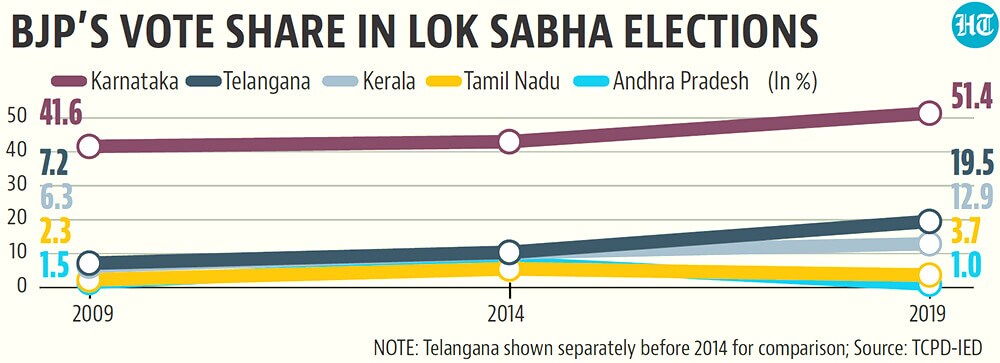
Karnataka is the BJP’s only stronghold in southern India
The Bhartiya Janta Party (BJP) first formed a government in Karnataka in 2008. Although it had been part of the government earlier, that was as junior partner of the JD(S). While it emerged as the single largest party in the 2018 assembly elections, a post-poll alliance between Congress and Janata Dal Secular or JD (S) kept it out of power until July 2019. But the BJP broke ground in Karnataka much earlier, as evident in a comparison of its vote shares in general elections across five major southern states.
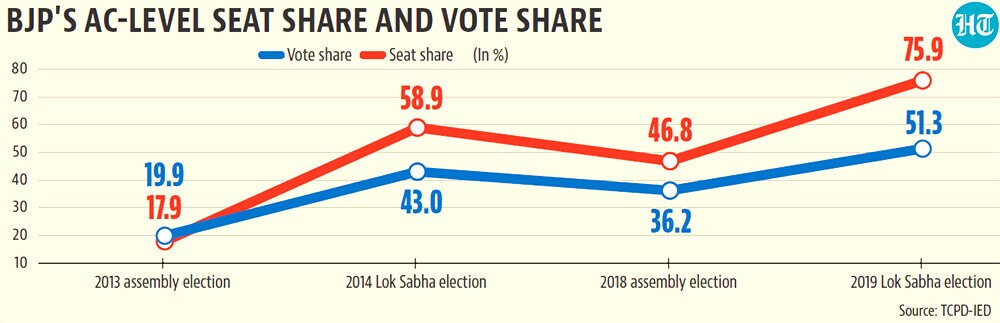
But its 2018 performance was relatively underwhelming
The BJP had a comfortable majority in the 28 Lok Sabha constituencies in the state in the 2014 and 2019 Lok Sabha elections. However, its 2018 assembly performance, where it fell short of a simple majority by nine MLAs, was, relatively speaking, underwhelming compared to its 2014 and 2019 performance. This suggests a marked difference in the BJP’s state and national election performance in Karnataka. Given the fact that the BJP will also be facing an anti-incumbency headwind this time, the 2023 contest could well be more difficult than the 2018 fight . To be sure, at least until now, the BJP has done well to prevent a repeat of a 2013 like situation when it faced desertions from two of its key leaders, B S Yeddyurappa and B S Sriramulu in the state, leading to a crushing loss.
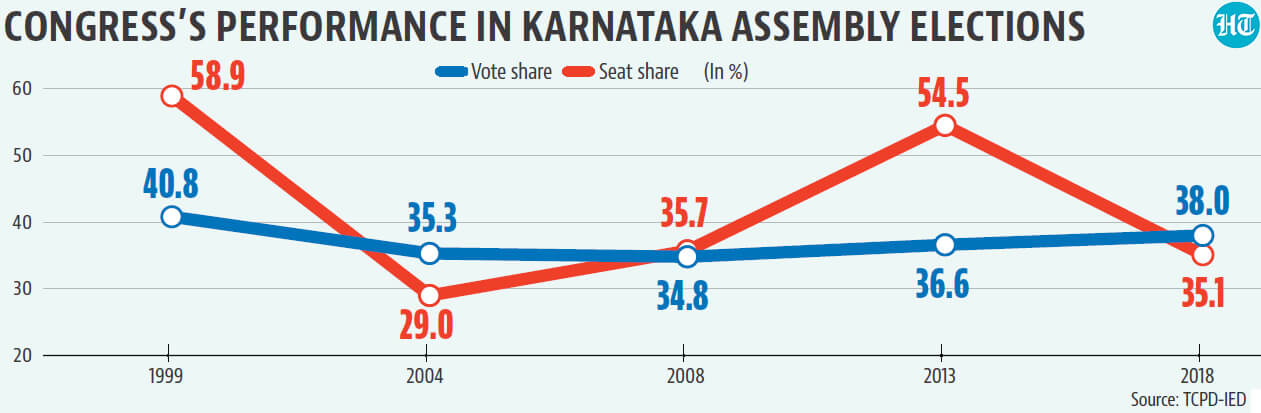
The Congress is always in striking distance of power in Karnataka
The Congress’s vote share in Karnataka has been close to or above the 35% mark for several decades. In a state where the wining party’s vote share has not crossed the 40% mark since 1999, this means that the Congress is always within striking distance of capturing power in the state. This state-level aggregate hides the fact that at the constituency-level, the contest may not be close when votes of other parties are regionally concentrated. For example, in the 2018 elections, the Congress finished first or second in 190 assembly constituencies (second in 112 ACs). The contest was close in 21 of these 190 ACs, as the victory margin was 2.5% or less in them. It finished first in 16 of these 21 ACs and second in only five. In almost half of the ACs where it finished second, it lost comprehensively, with the winner’s margin being 10% or more.
But JD (S)’s possible undoing could be an X-factor in these elections
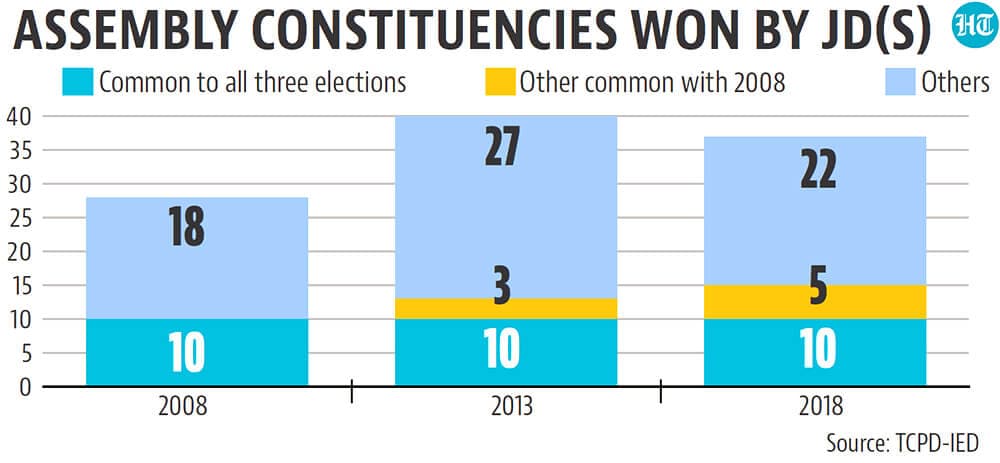
The Congress and JD (S) contested the 2019 Lok Sabha elections together with the latter contesting constituencies primarily located in its strongholds in southern Karnataka. While the BJP swept the polls winning 26 (including one BJP supported independent) out of the 28 constituencies, the JD (S) did particularly badly in the elections. The Lok Sabha shock led to a fall of the Congress-JD(S) government and the two parties have parted ways since . If the forthcoming assembly elections see a repeat of the BJP decimating the JD (S) in the latter’s traditional strongholds, the former could end up with a big advantage in the elections. If the Congress were to gain at the JD (S)’s expense it would also stand to make significant gains.
Headline social composition numbers underestimate the social fissures in Karnataka
If one were to look at Karnataka’s broad social composition almost half of the population belongs to the Other Backward Classes (OBCs), another 30% is Scheduled Caste (SC) or Scheduled Tribe (ST) and little over 10% is Muslim. However, Karnataka’s polity is driven by fissures which are not captured by these technical social composition numbers. Lingayata and Vokkaligas which have a share of more than 10% in the population are considered to be the core supporters of the BJP and the JD (S) respectively. The Congress, when it was at the peak of its success during the Devraj Urs years in Karnataka, successfully forged a coalition of minorities, backward classes and Dalits which was referred to as Ahinda. While the party tried to replicate this tactic in the 2018 elections, it clearly did not work on expected lines. With neither the Congress nor the BJP forging an invincible social coalition, the elections are likely to see efforts to win over the smallest of social groups, something which can be seen in the BJP government’s decision to tweak the reservation policy in the state days before the polls were announced.