The Narendra Modi government’s development model is based on “empowerment through saturation” to ensure that benefits of well-planned schemes reach everyone to make them independent, finance minister Nirmala Sitharaman said on Saturday.
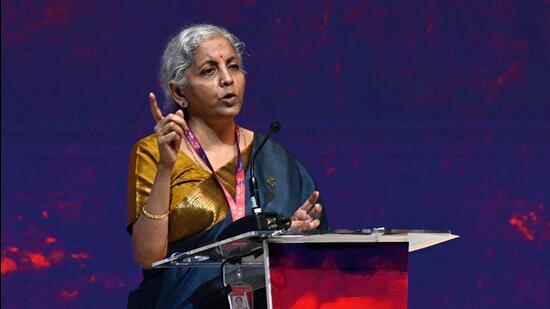
“Every Indian citizen deserves to have access to basic facilities without getting beholden to anybody. Our approach is one of empowerment through saturation of existing schemes rather than that of entitlement,” she said at the release of the 100th edition of Economic Newsletter of the Bharatiya Janata Party (BJP) in Karnataka.
Sitharaman’s remarks came amid a raging debate in the country on freebies to woo voters and welfare schemes for upliftment of the poor. Prime Minister Modi’s remarks on ‘revdi’ culture last month triggered the debate on freebies and has since led to a political slugfest between the BJP and Aam Aadmi Party.
The term “saturation” means effective implementation of welfare schemes which was missing before the Modi government first came to power in 2014, the finance minister said.
“Why do I start with talking about saturation? Because this country in 75 years have had several governments claiming ‘garibi hatao’ (eliminate poverty)... money should be there for everybody… there have been so many attempts to (uplift) the poor… give them drinking water… provide them houses,” she said.
{{/usCountry}}“Why do I start with talking about saturation? Because this country in 75 years have had several governments claiming ‘garibi hatao’ (eliminate poverty)... money should be there for everybody… there have been so many attempts to (uplift) the poor… give them drinking water… provide them houses,” she said.
{{/usCountry}}“All these existed. All these 75 years. What’s the difference between 2014 and today and all those years before? The difference is, we, in each one of these cases, under Prime Minister Modi’s leadership, attain saturation,” Sitharaman said, adding that the difference between ‘garibi hatao’ of earlier and now was felt by everybody.
A report on poverty by the United Nations Development Programme (UNDP) last month predicted that barring India, 71 million people in the developing world would sink into poverty as a result of the rippling effects of the Ukraine war and global inflation.
The report said targeted subsidies to the poor worked for countries like India, HT had reported it on July 13.
The basic distinction in approach is between the “entitlement perspective” of yesteryear and “empowerment principle” of the present government, Sitharaman said.
She cited the example of the Modi government’s financial inclusion scheme, the Pradhan Mantri Jan Dhan Yojana, that helped millions to open bank accounts and link them with their Aadhaar cards, creating an extensive telecom infrastructure to ensure access to all services through their mobile phones.
The integrated and well-planned model (Pradhan Mantri Jan Dhan Yojana) paved the way for transferring subsidies directly to eligible beneficiaries without any leakage, Sitharaman said.
The finance minister also claimed the Modi government has faced several legacy problems, one of which was to resolve hidden non-performing assets (NPAs) of banks.
The government took bold decisions in this regard and banks are now doing profitably good business, she said, adding that the government infused ₹3.36 lakh crore to restore public sector banks to health.
“We ensure that those who have cheated the banks and escaped are pursued relentlessly and their properties are auctioned and the money given back to the banks,” she said.
“That’s happening continuously and this is one of the very good principles of never letting go of people who have cheated the country’s banks. We have ensured that we’re getting the monies back and that is a continuing process,” she added.
Sitharaman’s remark came hours after the Aam Aadmi Party (AAP) accused the Centre of writing off loans worth ₹10 lakh crore of Modi’s “friends”.
On Saturday, Delhi deputy chief minister Manish Sisodia alleged Modi’s “dostvaad” had “completely ruined” the country’s economy and asked him to answer why his “friends” got tax exemptions and their loans worth crores waived.
A finance ministry official, who did not wish to be named, said: “There is a difference between waive-off and write-off. Write-offs are not waivers. Write-offs are technical requirements as per the central bank, and the recovery process doesn’t stop after that, it continues.”
According to data from Reserve Bank of India (RBI, out of 12,265 designated wilful defaulters as on March 31, 2022, a suit has been filed against 12,076, which is 98.5%, and FIRs have been lodged against 40.2%.
Banks have recovered over ₹8.60 lakh crore bad loans in the last eight years, the official said.