
 E-Paper



Forest fires vs shrubs: Archaic tools, no training exacerbate Uttarakhand crisis
For the past two months, as the temperature has soared, the mountains in Uttarakhand have been on fire, spirals of smoke visible in the day.


He is dangerously close to the flames. His face is drawn and tired, his eyes are squinting in the heat, his legs are trembling under the strain of fighting a losing battle on a steep slope. The enemy that faces his team of five bedraggled men is fierce and unrelenting — an uncontrolled forest fire that is spreading quickly in the Singtur range of Uttarakhand’s Uttarkashi district. An enemy that has singed the mountains of Uttarakhand for the past two months, and claimed the lives of men like him.
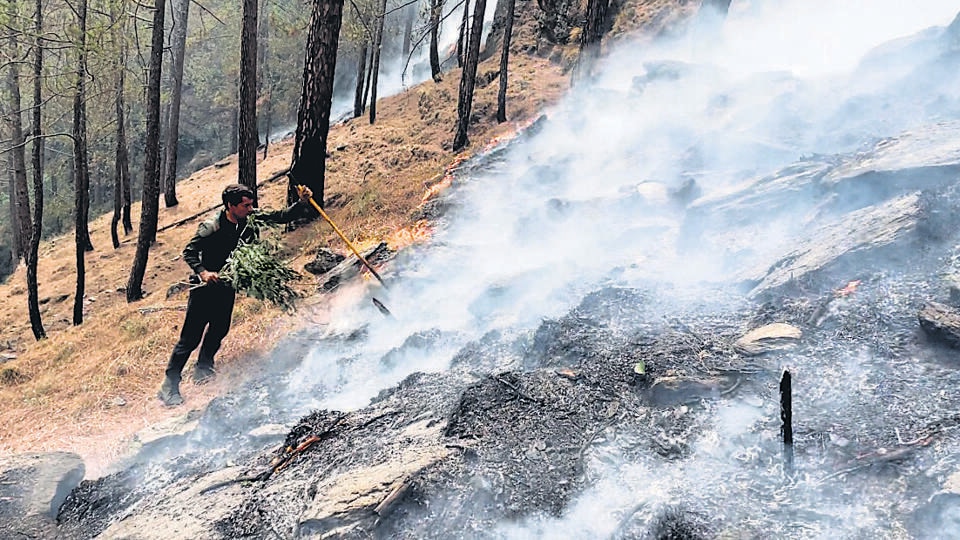
It is 1pm, and the 30-year-old forest guard, waves around the only instrument he has, a rudimentary tool barely worth its name. Tied by a loose string at the base, they call it a “jhapa” – a bundle of green twigs and leaves meant to beat the fire away. He coughs every times he slams the jhapa on the floor. The smoke has long entered his lungs. The sparks dance around the forest, singeing his skin, puncturing holes in his clothes. He is tired and hungry, and hopelessly outmatched. “Today, I left the crew station at 6am, patrolled for 10km, and since then have tried to fight this fire. All I have eaten is one banana. And I haven’t slept properly in weeks,” he said.
Uttarakhand: Death toll in Almora forest fire incident rises to 5
Suddenly, at 20 minutes past 1, the winds picks up, and with fear growing in his voice, the 30-year-old watches as the fire quickly begins travelling down the slope towards him. As he shouts for help, one other colleague rushes over to him, carrying another primitive tool – a rake. This he uses, with a grave sense of urgency, to clear the floor of pine needles in a desperate attempt to create a small buffer against the advancing fire. One week ago, in a fire just like this in Binsar, five forest guards were burnt to death. “We arrest the fire at one end, it spreads from the other. We are constantly surrounded,” the man says.
For the past two months, as the temperature has soared, the mountains in Uttarakhand have been on fire, spirals of smoke visible in the day, a bright orange blaze that lines the slopes lighting up the night.
Swathes of forest land have been destroyed. Popular hill stations such as Almora and Binsar have been choked, its residents afraid that the fires are desperately close to their homes. None of the ingredients that cause the crisis are particularly new — rising temperatures, erratic weather, inflammable pine nettle on the floor.
And yet, there is one clear reason why the fires rage ever more ferociously, last longer and kill more people, every year — the men in charge of combating forest fires when they break out, the first line of defence so to speak, are hopelessly undertrained and under-equipped, left at the mercy of outdated methods and their own devices to protect the forests and themselves.
The ill-equipped first line of defence
The Uttarakhand forest department has around 5,700 staff, almost all of whom are deployed by the state government in combating fires. The firefighters are based at the divisional or subdivisional headquarters, tasked with patrolling their respective jurisdictions, and responding to fires that have already broken out. And when they do, they are already at a hopeless disadvantage.
Swarupchand Ramola, president of the Sahayak Van Karamchari Sangh of Uttarakhand, a union that has 1,729 foresters, said that forest staff in the state have no fire-resistant suits, masks or helmets. “There are no training mechanisms in properly firefighting techniques, crucial for an effective response,” he said.
When most foresters are called to respond to a fire, Ramola said, all they carry is a jhapa, a sickle, and a fire rake. There is a bottle-green uniform, but the clothes are either tricot or nylon, and so easily flammable. “Only 20% of the staff has helmets, and the boots and shoes are all substandard, unable to withstand the conditions encountered during firefighting,” he said.
Once there is intimation of a fire, said an Uttarakhand forest ranger who requested anonymity, a small team of four to five forest staff depart to the spot, working as they travel.
“Most forest firefighters are forces to make a jhapa en route to the spot. This bundle of green leaves is then used to beat the fire to stop it from spreading. Some carry a sickle, which is used to create an emergency fire exit line by clearing the dry leaves, and the fire rake is used to collect the dry pine and separate it from the raging fire. But one jhapa, which is the primary tool despite being archaic, only lasts for 10 minutes. After that, the leaves become dry and catch fire themselves. So fresh ones have to be made on the go. This ridiculous system is what we are dependent on,” the ranger said.
The dangerous cocktail of factors means that response time is slower, the fires are more ferocious, spread faster, and kill with more ease. “Without proper equipment such as fire resistant clothing and firefighting tools, the staff is unable to suppress the flames quickly. For instance, if a fire can be doused in an hour, it takes us four to five hours, raising the chances of injuries and fatalities,” Ramola said.
On May 30, for instance, struggling to contain a fire that was dangerously close to engulfing the urban cluster of Uttarkashi town, the forest department issued an SOS to the National Disaster Relief Force. An officer from the central agency, who was at the spot on the day, said, “For a fire that had broken out in a 12 hectare patch of forest, there were only 12 to 13 forest department officials. We were asked to help because there was a threat to Uttarkashi town. We sent 16 NDRF forest fighters to the spot who had to climb the hills and work for 10 straight hours.”
One forest ranger, asking not to be named, said these delays were more norm than exception, and led to situations like on June 13 in Binsar, where five forest staffers were charred to dead. “In the jungle, the chir tree leaves and pine needles catch fire quickly. As it starts spreading, the pine cones catch fire and start falling, and then begin rolling like little balls of fire. Once they start rolling, they can block the path the forest staff used to arrive at the spot, encircling them. This is what happened in Binsar,” the ranger said.
DP Balooni, divisional forest officer, Tons, admitted that the clothes provided to forest staff are not fireproof. “We have been trying to introduce khadi jackets with reflective strips. But there are issues with the clothes that staff currently wear. We are doing all we can and recently held a meeting with district magistrate to discuss all these issues,” he said.
When contacted, Nishant Verma, additional principal chief conservator of forests and state nodal officer for forest fires, said he could not comment on these complaints about the lack of protective gear without “seeing figures and data”.
Uttarakhand also has 1,438 crew stations, several of which have leaf blowers and large fans, which run on petrol, that are used to change the direction of the wind. “But the problem is that most of these blowers weigh between 8kg and 12kg. How can a firefighter carry all these items and trek up a hill when there is no track? Further, carrying petrol to a place where fire has spread is the most dangerous thing anyone can do. So my men have to trek up and down hills just to refill the blowers with petrol. NDRF does have some blowers that are lighter, and do not depend on petrol as fuel. The Uttarakhand government needs to procure those,” one senior official said.
Senior Union government officials said that they had taken cognisance of the weaknesses in the response mechanisms of state administrations across India, assigning a new batch of forest fighters to NDRF in 2023.
147 personnel, graduates from Dehradun’s Forest Research Institute, were inducted into the unit last year, distributed across Assam, Andhra Pradesh and Uttarakhand. In Uttarakhand, the NDRF’s 15th battalion has been pressed into service. But one NDRF official said, “It is difficult to have more rescuers assigned as just forest fighters because the NDRF’s mandate is to deal with different types of disasters across the country. But what we should do is to hold a mass training of the state disaster response officials.”
Scale of the crisisData from the Forest Survey of India, a department under the Union ministry of forests and environment, shows that Uttarakhand has recorded 1,309 forest fires from January 1 to June 19,2024. This means it is the state worst afflicted by forest fires this year, followed by Andhra Pradesh(1,132), Odisha (1,127), Madhya Pradesh (982) and Chhattisgarh (964). This also means that not only are the numbers higher than the 241 forest fires recorded in Uttarakhand in the corresponding dates last year, but it has already surpassed the 733 forest fires that took place in all of 2023. “1,747 hectares of land has been lost to forest fires in 2024,” said Nishant Verma, nodal officer for forest fires.
A large majority of these forest fires have spread in the last three months — 451 in April, 457 in May and 268 in the first 19 days of June. And this year, 11 people have died, the deadliest toll since 2021 when eight people lost their lives.
One senior official from the Uttarakhand forest department said that one of the reasons behind the forest fires was that a large proportion of them this year have been reported in high-altitude areas, above 2,500 metres.
“The terrain makes it difficult. Even if the fire spot is just a kilometre from the main road, it takes at least an hour to trek towards the hill. Further, if a fire happens near the road, it can be doused easily — blowers can be used and fire tenders can arrive. But when this happens on top of a hill, fire watchers take time to reach the spot and act,” a senior official said.
An internal Uttarakhand government report on forest fires in Pithoragarh division, where there were at least 108 forest fires between February 15 and May 11, has laid some blame at an 1981 order issued by the then undivided Uttar Pradesh government that banned the felling of trees in areas which are above 1,000 metres above sea level. This, the report said, adversely affects the maintenance of fire exit lines — a bare man-made channel dug into the ground which prevents fires from spreading. “In areas above 1,000 metres, trees have grown over the forest lines in these 40 years, and there is therefore, no impediment to the fire spreading. There is an absolute need to review the existing fire lines in our forest divisions,” a second official said.
But this same report, authored by senior forest service officials, also highlights present-day crises affecting any mitigation operations.
In Pithoragarh, for example, across 539,880 hectares of forest land (5,398 square kilometres), the forest department has all of four vehicles, impeding their ability to reach forest fires quickly. “Forest staff must be given the availability of latest equipment such as protective gear and fire goggles,” the report said. In 2021, in the same division, another report had flagged exactly the same problems. “Most of the firefighters only use fire rakes and jhapa without adequate protective gear,” the report said then.
The more things change, the more they remain the same. Just ask the forest guards.
What can be done?OP Singh, former NDRF director general who also served as Uttar Pradesh DGP, said that just like India was bettering its response plans for landslides and cyclones, there was a clear need to treat forest fires just as seriously. “Using drones, satellites and other forms of technology, we must be prepared in advance to deal with forest fires. We should be identifying vulnerable places and deploying our resources even before the summer,” he said.
OP Singh said that there was also an urgent need to better coordination with multiple agencies — the forest department, villagers, Indian Air Force, NDRF, state police and the NDMA. “It is not easy to douse a fire in that terrain, so we must focus on prevention. Rope in civilians to act as forest watchers, and incentivise them to act as informers,” he added.
BK Singh, a retired Indian Forest Service officer, who was former principal chief conservator of forests in Karnataka and also headed the state’s forest force, said, “If you look at the recent deaths in Uttarakhand, the fighters died of inhaling carbon monoxide, not burn injuries. Before entering the forest, they should be given oxygen cylinders and the best protective gear that will protect them from the fire.”
In the face of these challenges, one part of any path forward, experts said, is to involve village communities that live in the hills. Vishal Singh, director at the Centre for Ecology Development and Research, said that forest fires were changing, becoming longer, more intense, and more difficult to counter, because the environment in the hills is being altered year on year.
“There is human-induced climate change which increases the length of the fire seasons; there are prolonged periods of drought and the temperatures provide conducive conditions for forest fires. The only way forward towards mitigation is to involve the community in forest conservation,” Vishal Singh said.
Heatwave, dry conditions push Uttarakhand forest fires to new high
Back in the mountains of Singtur, it is now late afternoon, and with the wind blowing, fire spreading, and panic now setting in, the 30-year-old forest guard reaches into his tattered trousers and pulls out his mobile phone. His fingers punch in the wrong numbers first; his eyes are constantly flitting to the flames that surge around him. He calls a senior forester for backup; any backup. There is nobody else, the forester tells him, but says he will arrive himself. In the next few minutes, the helpful forester leaves from Bingsari, a packet of biscuits and a water bottle in hand, trekking up a treacherous 4km.
He arrives a full two-and-a-half hours later, and for a while the team steps away from the fire to rest, pouncing on the biscuits and the water. When they resume, it the forester that takes the lead. There are ebbs and flows. At one point, they think they have gained control. But a pine cone that rolls down the hill ablaze stymies their progress, creating new zones of danger. It is only by sunset that the fire is out, the floor still smouldering.
The 30-year-old forest guard is exhausted, and yet cracks into a smile. He has survived today, and this will be his tomorrow. “My family is constantly worried. But what can we do. This is our duty, protective equipment or no protective equipment. The army serves on the borders. We are the jawans of the forests.”
 ABOUT THE AUTHORPrawesh Lama
Prawesh Lama, an Associate Editor at Hindustan Times with nearly two decades of frontline reporting experience across India’s conflict zones, border regions, and disaster-hit areas. He writes on internal security, insurgency, the Northeast, and Left-wing extremism and has reported from India’s hinterland and some of the most sensitive and strategically critical regions.Read More


