E-Paper



Fresh effort to revive a turtle species considered ‘extinct in wild’
The black softshell turtle is native to major rivers and their tributaries in India and neighbouring Bangladesh.

 Prefer HTon Google


A new home was found on Friday for 25 hatchlings of the endangered black softshell turtle, or, as they are biologically called Nissonia nigricans, a species listed as extinct in the wild by the International Union for Conservation of Nature (IUCN), in a bid to boost their population in the wilderness.
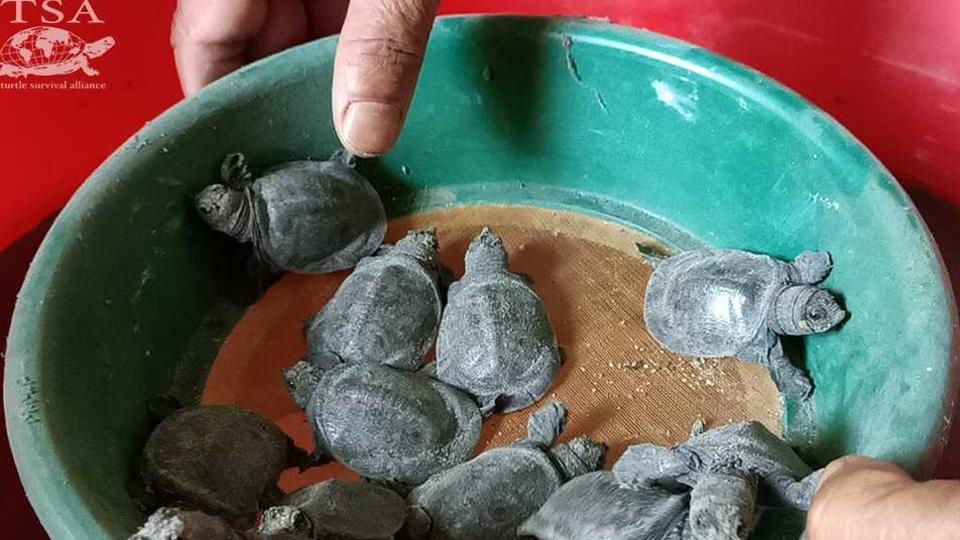
The month-old hatchlings were shifted from the pond at Nagshankar temple in Assam’s Sonitpur district to a facility run by Turtle Survival Alliance (TSA) in Biswanath district, where they will be reared for nearly a year before their release into the wild.
“Earlier, there have been attempts at taking hatchlings straight from the pond and releasing them directly into the wild. But since they were very small, chances of their survival were rather slim,” said Shailendra Singh, TSA, chief, India.
“Friday’s relocation is the first time that individuals of the species have been transferred from the temple pond to a specialised turtle facility in Assam’s Biswanath district for their conservation,” he added.
The black softshell turtle is native to major rivers and their tributaries in India and neighbouring Bangladesh.
The majority of this species’ population, however, lives in sacred temple ponds.
The Nagshankar temple pond, which has around 250-300 such turtles, has one of the biggest captive population of the species.
Though the IUCN list mentions the species as extinct in the wild, in the past 10-15 years few black softshell turtles have been spotted in the Brahmaputra river basin in Assam.
Unfortunately, the turtles’ presence was not documented.
“We collected the turtle eggs in April and incubated them artificially in the Nagshankar temple premises. The hatchlings were born in July. We will raise them until they weigh around 1 kilogram (kg), which should take about one year. This will reduce the possibility of predation and increase their survival chances in the wild,” said Parimal Ray, project coordinator, TSA.
The organisation has been working with Nagshankar temple authorities and other temple management committees in Assam since 2013 by looking after the upkeep of the ponds and their turtle population.
Simultaneously, TSA has been working on a strategy to rebuild the turtle’s wild population in the Brahmaputra river basin.
“This is an encouraging initiative, as the numbers of the species seen in the wild are low and not meticulously documented. Rearing them in a facility until they are a bit bigger will increase their chances of survival in the wild,” said Mukut Chandra Das, divisional forest officer (DFO), Biswanath.