Kochi: Vellikkakathu Sankaran Achuthanandan, Kerala’s former chief minister and one of CPI(M)’s founding leaders who galvanised party workers with his acerbic oratory and became a darling of the masses for his bold anti-corruption crusades, passed away at a private hospital in Thiruvananthapuram on Monday. He was 101.
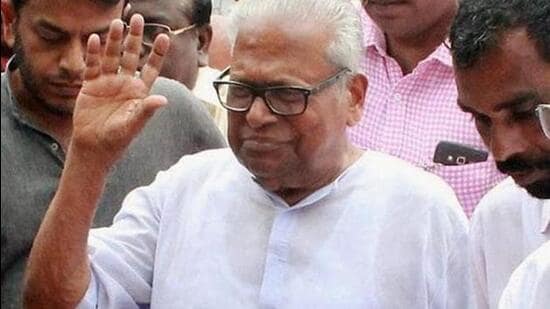
Achuthanandan was admitted to Thiruvananthapuram’s SUT Hospital on June 23 following a cardiac arrest, and was later put on a ventilator after his kidney function deteriorated. There had been some improvement over the past week but it deteriorated rapidly on Monday, leading to his death at 3.20 pm, a hospital bulletin said.
CPI (M) state secretary MV Govindan said the former CM’s body would be taken to the AKG study centre in Thiruvananthapuram.
“Tomorrow, the remains would be placed for public tributes at the Durbar hall and later taken by procession along the national highway to Alappuzha for the cremation on Wednesday,” said Govindan.
Fondly called ‘VS’ by his legion of supporters and party colleagues, Achuthanandan stepped away from public life in 2021 and shifted to his son Arun Kumar’s residence in Thiruvananthapuram.
He was the oldest to assume the office of chief minister in Kerala in 2006, at the age of 82, and went on to serve his single full five-year term until 2011, a period that saw transformative changes in the health and education sectors of the state and landmark movements for environment protection led by the chief minister himself.
{{/usCountry}}He was the oldest to assume the office of chief minister in Kerala in 2006, at the age of 82, and went on to serve his single full five-year term until 2011, a period that saw transformative changes in the health and education sectors of the state and landmark movements for environment protection led by the chief minister himself.
{{/usCountry}}In his 10 contests for the state Assembly, VS was victorious seven times, but lost from Ambalappuzha in 1965 and 1977, and more importantly, from Mararikulam in 1996, a shock loss that cost him the chief minister’s chair.
He holds the record for being the longest-serving leader of Opposition in the Kerala Assembly, serving a total of 14 years over three terms in the 90s and 2000s.
VS remained a member of the CPM’s highest body, Politburo, from 1985 till 2009 and helmed the party in the state as its secretary for three terms from 1980 to 1992, considered a turbulent period for the organisation.
Though the CPM-led LDF was voted to power with a big majority in 2016, VS, then LoP in the Assembly and 92 years of age, was overlooked by the party leadership for the CM’s chair in favour of his relatively younger rival, Pinarayi Vijayan. To keep him in good humour and yet out of key decision-making duties, VS was appointed the chairman of the Kerala Administrative Reforms Commission with cabinet rank. He stepped down in 2021 and retreated from active political work.
With the demise of VS, all the 32 leaders who broke away from the Communist Party of India (CPI)’s National Council to form the CPI(M) in 1964 are now dead.
Early life
VS was born to Sankaran and Accamma amid abject poverty conditions in an Ezhava family in Punnapra, then part of the princely kingdom of Travancore and currently in Alappuzha district, on October 20, 1923.
The youngest of four children, VS grew up in difficult circumstances and lost both his parents by the time he was 11. Wrapping up his school life in the 7th standard, VS was compelled to help his elder brother with tailoring work and later grinding out at the local coir factory, where he was spotted by Communist veteran P Krishna Pillai, who encouraged him to organise agricultural and coir workers and help them claim their rightful wages.
At the age of 16, VS joined the Congress party but found his true calling a year later in the then-undivided Communist party, where he drew inspiration for trade union activities.
A critical period of his early political career, which later fashioned his aggressive style, was the 1946 Punnapra-Vayalar uprising, in which hordes of coir, agricultural and fish workers under the leadership of the Communists united against then Travancore Divan C P Ramaswamy Iyer over the latter’s proposal for establishing an American model and widespread draconian constitutional changes in the region. Though there are ambiguous reports on whether VS was physically part of the armed struggle in Punnapra-Vayalar, it is a fact that he was arrested in Poonjar by the police and tortured brutally in custody. When he did not give clear answers on the locations of his Communist colleagues, VS’ legs were pulled through the bars of the prison cell and the bayonet of the rifle slammed onto his heels.
Move to CPI(M) and subsequent rise
In 1957, in the first elections held in Kerala, a Communist government under EMS Namboodiripad was voted to power, but it was short-lived. Two years later, following the ‘Liberation struggle’ in which over a dozen people were killed in police firing and other incidents, the then Union government of Jawaharlal Nehru dismissed the state government and imposed President’s Rule. Parallely, VS gradually rose up the party’s ladder in Kerala through the student and youth wings and became a favourite among people for his hard-hitting speeches.
In 1964, following heated ideological differences within two factions of the CPI in the backdrop of the Sino-Indo war, a section of 32 leaders walked out from the National Council meeting and went on to form the CPI(M) at the Calcutta Congress the same year. VS was among them.
Back in his home state, VS contested his first Assembly election in 1965 from Ambalappuzha, but lost out to Congress’ KS Krishna Kurup by over 2,300 votes. But he was victorious in the second attempt from the same constituency, this time with a margin of over 9,500 votes.
Though he was elected to the Assembly in 1970 and later in 1991, VS curiously never made it to a cabinet berth and seemed to stay in the shadows of his older contemporaries like E K Nayanar and K R Gowri. However, it didn’t stop him from usurping power within the organisation. In 1980, he was elected state secretary of the CPI(M), the highest-ranking post, and served three terms.
In the 1996 Assembly elections, as widely predicted, the LDF stormed to power with 80 of 140 seats and VS was destined to be CM. However, even as the party won, VS suffered a shock loss in Mararikulam, losing by 1,965 votes to a little-known Congress leader.
Rivalry with Pinarayi Vijayan
The early 2000s and the 2010s were marked by VS’ strident factional feuds with Pinarayi Vijayan, who had become the state secretary in 1998. Though Vijayan was once seen as a confidante of VS, the former began establishing his clout once senior colleagues like Nayanar faded from active political life.
This was the most turbulent period in the CPI(M)’s history in Kerala as factions led by Vijayan and VS frequently clashed on a host of ideological and political issues. While Vijayan largely stuck to the party line, VS was never reluctant to speak his mind freely, oblivious of whether the party agreed with him or not. He even said at one point that Vijayan must be tried in the corruption case involving SNC Lavalin.
Affairs became so heated in 2007 that both Vijayan and VS were suspended from the Politburo for their public remarks on each other. Though Vijayan was later re-inducted, VS was overlooked for allegedly violating the party line.
On the day of results of the 2009 Lok Sabha elections, in which the CPM campaign was led by Vijayan and when it became clear that LDF had just won 4 of the 20 seats in Kerala, VS, then the chief minister, was uncharacteristically in a good mood. When reporters asked him why he was smiling in the face of a bad result, VS replied, “Should I cry? You don’t like me laughing, is it?”
And in 2012, when TP Chandrasekharan, who had left the CPM to form a new party, was brutally assassinated by goons affiliated with CPM, VS paid no heed to party diktats and headed to Chandrasekharan’s home in Onchiyam where he was seen consoling his widow. Even as Vijayan branded Chandrasekharan a ‘traitor’, VS’ stature as a leader who abhorred violence grew within the party and the public.
Legacy of VS
As chief minister between 2006 and 2011, the government led by VS was instrumental in implementing several pioneering projects in the departments of health, public works, education, culture and IT.
Some of the flagship projects like the Vallarpadam transshipment container terminal in Kochi, the foundation of the airport in Kannur, IT parks in Cherthala and Kollam, a tourist circuit around the Ashtamudi lake were implemented in this period.
It was also a period that saw VS turn into an anti-corruption crusader and an advocate for environmental protection. His administration acted against illegal lottery mafias, ensured the conviction of minister R Balakrishna Pillai in the Idamalayar corruption case, punished encroachers who built lavish resorts on government land and reclaimed acres of revenue land in Munnar, a fragile hill-station in the Western Ghats.
The height of VS’ political stature became clear in 2011 and 2016, when protests rang out in different corners of Kerala following reports that the CPI(M) was planning to not give him a ticket. The public sentiment in such protests forced the party to give in to the popularity of the veteran leader.
His trademark style of oratory, in which he pauses, stresses and often repeats words and phrases for emphasis, has endeared him to the masses and the cadre within the party. All his opponents alike, from Oommen Chandy to AK Antony and Rahul Gandhi to Narendra Modi, have been at the receiving end of his witty and sharp tongue. In 2019, when Gandhi chided him for clinging to politics at such an advanced age, VS shot back, calling him an ‘Amul baby’, a slur that has been used since by others.
VS is survived by his wife Vasumathi, son VA Arun Kumar and daughter VV Asha. His funeral is expected to take place at the Valiya Chudukadu burial ground in his home district of Alappuzha.