
 E-Paper



Fuel to AI Flight 171 engines cut off seconds before crash: Report
AI-171 probe’s interim findings point to fuel cutoff, but mystery remains over what, or who, caused engine switches to move

 Prefer HTon Google


The Aircraft Accident Investigation Bureau’s preliminary report into the Air India flight 171 crash, released early Saturday, identified fuel being cut off to both engines shortly after takeoff as the cause of the disaster—with fuel control switches found in the “cutoff” position triggering a global debate over whether pilot action or mechanical failure caused 260 deaths. The report also said that there was no “recommended action” for either Boeing, the maker of the aircraft , or GE, the engine manufacturer, at this time.
“At about 08:08:42 UTC (1:38pm, 42 seconds) and immediately thereafter, the engine 1 and engine 2 fuel cutoff switches transitioned from RUN to CUTOFF position one after another with a time gap of 01 sec,” stated the report, before stating: “In the cockpit voice recording, one of the pilots is heard asking the other why did he cutoff. The other pilot responded that he did not do so”.
The 15-page report, published exactly one month after the disaster that killed 260 people, provides the first official account of India’s worst aviation accident in decades. Citing data from the black boxes, the report stated that moments after the aircraft left the tarmac, both fuel switches moved to the “cutoff” position.
On the flight deck were captain Sumeet Sabharwal, 56, and first officer Clive Kunder, 32.
The crew restored fuel flow within 10 and 14 seconds respectively, triggering automatic engine restart sequences, but the Boeing 787 had already begun its irreversible descent toward a medical college hostel in Ahmedabad.
The report did not identify which remarks came from the captain versus the first officer, nor which pilot transmitted “Mayday, Mayday, Mayday” before the crash.
The findings have fractured the global aviation community over their implications for the flight crew, with Indian aviators questioning its neutrality, while their western counterparts saw little explanation apart from deliberate human action for fuel switches that moved one second apart and required considerable force to operate.
What caused both fuel switches to transition from normal operation to cutoff position remains the investigation’s central mystery. The preliminary report establishes facts without determining causation, leaving open possibilities ranging from mechanical failure to human error to electronic malfunction.
Civil aviation minister Ram Mohan Naidu urged caution. “We care for the welfare and the well-being of pilots so let’s not jump to any conclusions at this stage, let us wait for the final report,” he told reporters in Vishakhapatnam.
Minister of state for Civil Aviation Murlidhar Mohol emphasised the preliminary nature of the findings. “The Aircraft Accident Investigation Bureau is an autonomous body that is doing good work. What they have submitted is a preliminary report. The investigation into the plane crash is still on,” he said.
Air India acknowledged the report while expressing solidarity with families. “We continue to mourn the loss and are fully committed to providing support during this difficult time. We acknowledge receipt of the preliminary report released by the Aircraft Accident Investigation Bureau today. Air India is working closely with stakeholders, including regulators,” the airline said.
Boeing deferred to investigators. “Our thoughts remain with the loved ones of the passengers and crew on board Air India Flight 171, as well as everyone affected on the ground in Ahmedabad. We continue to support the investigation and our customers. We will defer to the AAIB to provide information about AI171,” a Boeing spokesperson said.
The report also painted in grim detail the extent of devastation at the crash site.
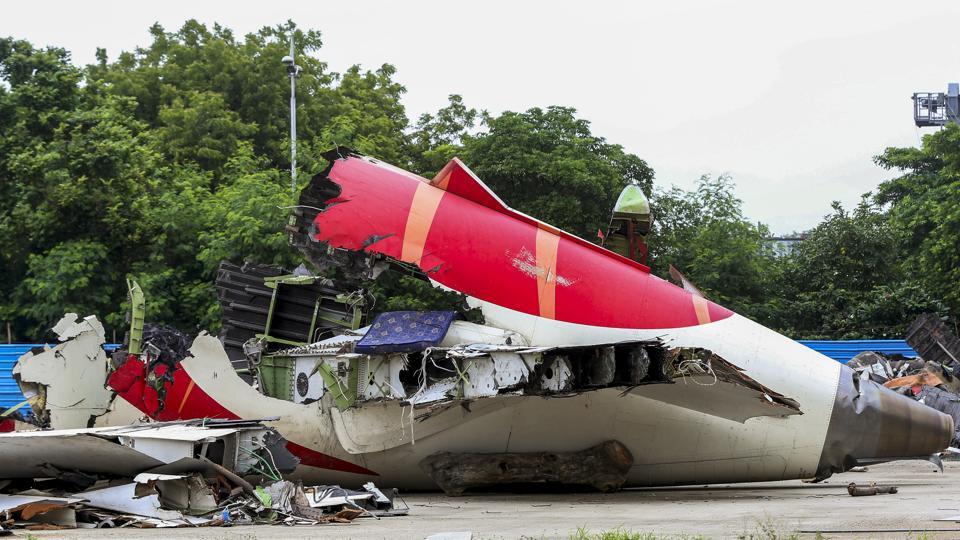
Wreckage analysis revealed the aircraft’s violent disintegration across a debris field measuring approximately 1,000 by 400 feet. The vertical stabilizer separated early in the sequence, coming to rest 200 feet from the initial impact point – the rooftop of the hostel mess of BJ Medical College. Major components scattered across vast distances, with the flight deck structure found 650 feet from first contact with buildings.
The aircraft initially struck trees and an incineration chimney before impacting the medical college hostel’s northeast wall at an eight-degree nose-up attitude with wings level. The right engine separated and came to rest on the roof, having struck a concrete tank, while the left engine was catapulted farther ahead, striking one of the hostel buildings at ground level.
Closed-circuit television captured the deployment of a ram air turbine—an emergency windmill that provides backup power—confirming complete engine shutdown. The device appeared in airport footage almost immediately after lift-off, indicating both engines had lost power generating capability.
Flight recorders documented Engine 1 showing signs of recovery during restart attempts while Engine 2 managed to relight but could not arrest its core speed deceleration. The Full Authority Digital Engine Control systems automatically managed restart sequences once fuel flow resumed, but insufficient altitude and time prevented successful recovery.
Other key findings ruled out alternative explanations: flap handle found in correct 5-degree takeoff position, landing gear lever in “DOWN” position, thrust levers found near idle but flight data shows they remained forward until impact, good weather conditions with light winds, aircraft weight within normal limits and no evidence of bird strike.
The report noted fuel samples from airport bowsers tested satisfactory, though very limited fuel samples recovered from the aircraft are still being analysed.
The report states there are “no recommended actions to B787-8 and/or GE GEnx-1B engine operators and manufacturers” at this stage, suggesting investigators found no systemic issues affecting the global fleet of over 1,100 Dreamliners.


