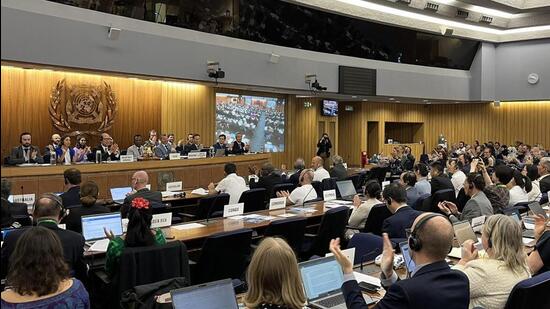
The global shipping industry has agreed on tougher climate targets at the United Nations’s International Maritime Organisation (IMO) conference that concluded Friday in London. In the first scheduled revision of the IMO’s greenhouse gas (GHG) strategy, member countries agreed to reach “net-zero GHG emissions by or around 2050”.
The shipping industry, responsible for 1 billion tonnes of CO2 emissions annually or 3% of global greenhouse emissions, is targetting to reach net zero emissions by 2050 with intermediate milestones, said people familiar with the matter.
Maritime countries, including India have agreed on indicative checkpoints of reducing emissions by at least 20%, striving for 30%, by 2030 compared to 2008 levels and at least 70%, striving for 80%, by 2040, reaching net-zero around 2050 depending on national circumstances. IMO currently has 175 member states.
IMO’s previous target was to reduce emissions by at least 50% by 2050, with no outright targets for 2030 and 2040. However, its new strategy is guided by various interventions such as “reducing carbon intensity of ships through further improvement of the energy efficiency for new ships; reducing the carbon intensity of international shipping; using near-zero GHG emission technologies, and fuels; and reducing GHG emissions from international shipping to net zero around, i.e., close to, 2050, taking into account different national circumstances.”
Observers noted that the issue of carbon levy on shipping to raise climate finance for developing countries which was being demanded by various environmental organisations was deferred during the negotiations.
{{/usCountry}}Observers noted that the issue of carbon levy on shipping to raise climate finance for developing countries which was being demanded by various environmental organisations was deferred during the negotiations.
{{/usCountry}}According experts, the new goals are not aligned with the Paris Agreement goal of limiting global warming to well below 2°C and pursuing efforts to limit it to 1.5°C.
Harjeet Singh, head of global political strategy for Climate Action Network International, said that the strategy put forth by the UN International Maritime Organisation charts a course towards emission reduction. But unfortunately, falls short of expectations, adding that there is a clear disparity between its goals and those set by the Paris Agreement’s crucial 1.5C target, a divergence that we can ill afford.
He added, “The meeting broached the critical issue of a shipping levy to finance capacity building, research, and assistance for developing nations grappling with climate change. Unfortunately, the decision has been deferred, pushing this crucial financial mechanism further down the road.”
IMO adopted its new goals following four consecutive days, July 3 to 6 , that each, and in turn, set records for the highest global average air temperature recorded. On July 6, the global average air temperature was 17.23 °C, a 1.02°C above the 1979-2000 mean.
Climate scientists have raised concerns that global warming and the onset of El Nino will lead to accelerated warming and record-breaking temperatures globally this year.
The World Meteorological Organisation has said there is a high likelihood that the annual average global temperature between 2023 and 2027 will temporarily be more than 1.5°C above pre-industrial levels for at least one year.
“By our estimates, international shipping will exceed its 1.5°C carbon budget by approximately 2032 under this agreement. Shipping can stay within a budget aligned with well below 2°C if it can manage to hit the strategy’s 2030 and 2040 emissions reduction targets and achieve net-zero GHG emissions by 2050,” said Bryan Comer, Marine Program Lead, International Council on Clean Transportation.
The Pacific Island countries, supported by Canada, the US, and the UK, fought hard for a 1.5°C- aligned action till the last moment, but were opposed by China, Brazil, Argentina and others, according to observers at the IMO meeting between July 3 and 7.
A global carbon price on shipping, publicly supported by over 70 developing and developed countries, has been moved forward as an “economic measure” under the IMO’s basket of measures.
According to a note by the United Nations Conference on Trade and Development released last year, several decarbonisation solutions have emerged. These include energy technologies (like alternative fuels and improved energy efficiencies onboard ships), regulatory and financial measures (such as carbon pricing), and integrative solutions (like just-in-time arrivals).