Developing nations should join hands to set the global agenda by revamping political and financial governance to ensure that they aren’t excluded from development at a time when the world is in a “state of crisis”, Prime Minister Narendra Modi said on Thursday as he hosted a virtual summit of leaders of the Global South.
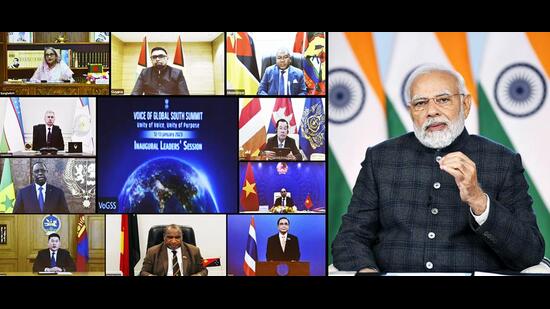
The Voice of Global South Summit, a new initiative of the Indian government which started weeks after it took on the presidency of the G20, brought together the leaders of Bangladesh, Cambodia, Guyana, Mozambique, Mongolia, Papua New Guinea, Senegal, Thailand, Uzbekistan and Vietnam for the inaugural session. Several other countries were expected to join sector-specific sessions. India has emphasised it will act as the representative of developing countries in its G20 presidency.
Modi, in his televised opening remarks, said most of the challenges facing the world — such as the Covid-19 pandemic, the climate crisis, terrorism, and the Ukraine conflict — weren’t created by the Global South, and yet developing countries are excluded from the process of finding solutions.
“People of Global South should no longer be excluded from the fruits of development. Together, we must attempt to redesign global political and financial governance. This can remove inequalities, enlarge opportunities, support growth, and spread progress and prosperity,” he said.
The world, he said, is in a “state of crisis” after “another difficult year” that saw war, conflict, terrorism and geopolitical tensions, rising food, fertiliser and fuel prices, climate change-driven natural disasters, and the economic fallout of the Covid-19 pandemic. “It is difficult to predict how long this state of instability will last,” he added.
{{/usCountry}}The world, he said, is in a “state of crisis” after “another difficult year” that saw war, conflict, terrorism and geopolitical tensions, rising food, fertiliser and fuel prices, climate change-driven natural disasters, and the economic fallout of the Covid-19 pandemic. “It is difficult to predict how long this state of instability will last,” he added.
{{/usCountry}}Modi proposed a new global agenda based on “respond, recognise, respect and reform”.
“Respond to the priorities of the Global South by framing an inclusive and balanced international agenda, recognise that the principle of common but differentiated responsibilities applies to all global challenges, respect the sovereignty of all nations, rule of law and peaceful resolution of differences and disputes, and reform international institutions, including the UN, to make them more relevant,” he said.
The Global South has the “largest stakes” in the future as it accounts for three-fourths of humanity and it should have an “equivalent voice”. He added, “Hence, as the eight-decade-old model of global governance slowly changes, we should try to shape the emerging order.”
India has always stood for a greater role for developing countries in determining their future, and it will highlight their priorities and challenges at the G20 presidency by amplifying the voice of the Global South, he said.
India’s development partnerships also cover all regions and diverse sectors, and it supplied medicines and vaccines to over 100 countries during the pandemic.
Despite the challenges facing developing countries, Modi said he remains optimistic that “our time is coming”. The Global South requires scalable and sustainable solutions to transform economies and address challenges such as poverty, universal healthcare and building human capacities.
He added, “In the last century, we supported each other in our fight against foreign rule. We can do it again in this century to create a new world order that will ensure the welfare of our citizens. As far as India is concerned, your voice is India’s voice, your priorities are India’s priorities.”
The discussions between the leaders at the inaugural session were held behind closed doors. At the end of the session, Modi said the observations by the other leaders indicated human-centric development is a priority. Common challenges highlighted by them revolve around the lack of resources for development and “increasing instability both in the natural climate and the geopolitical climate”.
“The Voice of the Global South needs to set its own tone. Together, we need to escape the cycle of dependency on systems and circumstances which are not of our making,” he added.
The Voice of Global South Summit will have eight ministerial sessions on priority areas. The Indian side plans to channel the ideas and inputs generated by the summit into the G20 process. Modi will chair another session of heads of state and government at the conclusion of the summit on Friday.
Indian officials had said that some 120 countries were invited to the summit though there was no word on confirmed participants. People familiar with developments said some 50 representatives of various countries participated in the four sessions on Thursday.
Thailand’s Prime Minister Prayut Chan-o-cha, in his statement at the inaugural session, appreciated India’s efforts to place the development agenda at the heart of the conversation.
Prayut said the Global South “must remain united now more than ever” to address challenges such as climate change and global geopolitical tensions that result in soaring inflation and food and energy crises. He suggested three ideas to leverage India’s G20 presidency to amplify the position of developing nations — a more holistic development approach to tackle climate change and pollution, working together on universal health coverage, equitable quality education and sustainable food systems, and greater resilience against future uncertainties and crises.