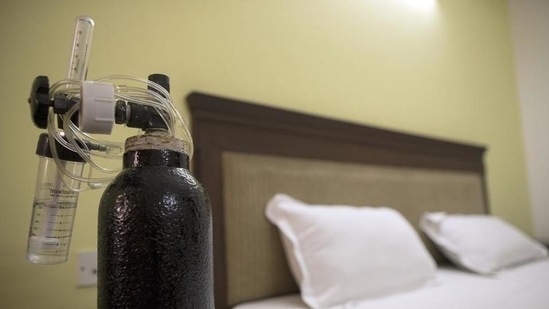
The central government on Wednesday reviewed the commissioning, installation and functional status of oxygen supply equipment supplied by it to states and Union territories, and asked them to conduct mock drills to ensure full functionality of all oxygen-related equipment, people familiar with the matter said.
In the mock drill, states have been asked to ensure that the oxygen with the required quantity, pressure and purity reaches the patients at their bedside. (Agencies/Representative use)
{{^htLoading}} {{/htLoading}}
Union health secretary Rajesh Bhushan on Wednesday held a meeting with states and UTs to review the status and preparedness regarding medical oxygen devices and systems (pressure swing adsorption plants, liquid medical oxygen plants, oxygen concentrators, medical gas pipeline system), through a video conference. “Medical oxygen is an essential public health commodity and its uninterrupted supply in sufficient quantity is of critical importance to tackle the pandemic,” Bhushan said, while addressing states and UTs.
As part of the preparedness exercise to deal with any surge in cases due to the heavily mutated Omicron variant of the Sars-Cov-2 virus that causes Covid-19, states were asked to review and monitor the status of equipment on a daily basis to ensure that the gap between the gadgets and systems delivered to the districts and installed at the healthcare facilities is reduced to zero.
In the mock drill, states have been asked to ensure that the oxygen with the required quantity, pressure and purity reaches the patients at their bedside. The health ministry has directed states to complete these drills by the end of December. The report to this effect is to be submitted to the health ministry through designated portals.
Rhythma Kaul is the national health editor of the Hindustan Times. She has been reporting on public health, medicine, and medical research, with a particular focus on how government decisions and health system reforms shape people’s lives. Rhythma has over 25 years of journalistic experience. She joined Hindustan Times in 2008, and has since covered everything from pandemics and infectious diseases to cutting‑edge medical research and climate‑related health challenges. Her stories routinely track the work of the Ministry of Health and Family Welfare, department of pharmaceuticals, and key national health programmes, making complex medical science and policy accessible to a wide audience. One of her prominent news breaks has been the 2012 Baby Falak case: A two-year-old brutally battered baby girl was admitted to AIIMS-Delhi with severe head injuries, multiple fractures, human bite marks, and burns. The police investigation revealed this to be a case of multi-state human-trafficking racket. She was profiled by The Wall Street Journal for breaking this story. Rhythma holds a Master’s degree from Jawaharlal Nehru University, Delhi. Prior to Hindustan Times, she worked with the India Today Group. Rhythma can be contacted at rhythma.kaul@hindustantimes.com. Her X handle is @RamblingBrook.
{{^usCountry}}{{/usCountry}}
Get the latest India News, breaking headlines and real-time updates from across the country. Stay informed about politics, government policies, crime, weather major national developments and Karnataka Bandh LIVE.
Get the latest India News, breaking headlines and real-time updates from across the country. Stay informed about politics, government policies, crime, weather major national developments and Karnataka Bandh LIVE.