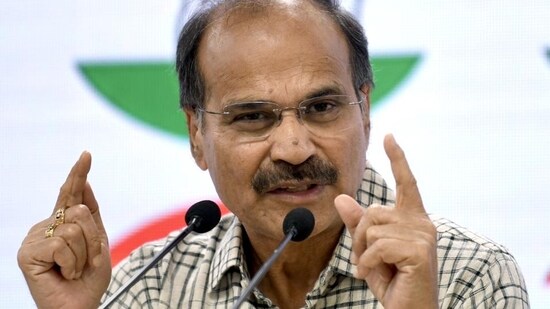
The Union government on Saturday formally announced the committee that will study the feasibility of having simultaneous elections across the country, notifying the names of home minister Amit Shah from the government and Congress lawmaker Adhir Ranjan Chowdhury, though the opposition leader later declined to join the panel.
The committee will have eight members in all, headed by former President Ram Nath Kovind, and the notification set out its terms of reference. The panel has been mandated to commence functioning “immediately” and make “recommendations at the earliest”.
In addition to Shah and Chowdhury, who is the leader of the single largest party in Opposition in the Lok Sabha, the names included that of former Congressman Ghulam Nabi Azad; the former chairman of the 15th Finance Commission, NK Singh; former secretary-general of Lok Sabha, Subhash C Kashyap; senior advocate Harish Salve; and former chief vigilance commissioner Sanjay Kothari.
Union law minister Arjun Ram Meghwal will attend the meetings of the committee as a special invitee while Niten Chandra, secretary in the department of legal affairs, will act as the secretary to the committee.
“I have no hesitation whatsoever in declining to serve on the committee whose terms of reference have been prepared in a manner to guarantee its conclusions. It is, I am afraid, a total eyewash,” Chowdhury said in a letter addressed to Shah.
{{/usCountry}}“I have no hesitation whatsoever in declining to serve on the committee whose terms of reference have been prepared in a manner to guarantee its conclusions. It is, I am afraid, a total eyewash,” Chowdhury said in a letter addressed to Shah.
{{/usCountry}}Chowdhury, as well as his Congress party that issued a statement hours earlier, criticised the absence of party president Mallikarjun Kharge, who is the leader of opposition in the Rajya Sabha, in the list of names.
The notification outlined seven items as part of its agenda, or terms of reference. These include examining and making recommendations for holding simultaneous elections to Lok Sabha, state legislative assemblies, municipalities and panchayats, examining and recommending the specific amendments to the Constitution that may be needed, whether states will need to approve it and analyse and recommend possible solutions in a scenario where elections emerge out of a hung House, a successful no-confidence motion, or defection.
The committee will also need to suggest a framework for synchronisation of elections and specifically, suggest the phases and time frame within which simultaneous polls may be held if they cannot be held in one go.
To ensure the continuity of the cycle of simultaneous elections, it has also been tasked to recommend necessary safeguards and amendments to the Constitution so that the cycle of simultaneous elections is not disturbed.
Among the issues that will also be considered for feasibility of the plan — which Prime Minister Narendra Modi has described as an important electoral reform — will be to go into the logistics of manpower and electronic voting machines (EVMs) required.
While the BJP-led NDA government has been vociferously pushing for the roll-out of simultaneous polls, referred to as “One Nation, One Election” by Modi, opposition parties have criticised the suggestion.
If implemented in some measure ahead of the 2024 general elections, simultaneous polling could result in the terms of a few assemblies being extended while others may have to forego their terms by four to six months, based on the past ideas that have been circulated about how elections can be synchronised.
The panel has been set up ahead of the five-day special session of Parliament starting September 18, the announcement for which prompted speculation that Lok Sabha polls might be brought forward and a bill paving the way for simultaneous or synchronised elections may be tabled. The government is yet to announce any agenda.
In a post on X, formerly Twitter, Congress leader KC Venugopal said, “We believe that the High Level Committee on Simultaneous Elections is nothing but a systematic attempt to sabotage India’s parliamentary democracy. In a shocking insult to Parliament, the BJP has appointed a former LOP to the Committee instead of Rajya Sabha LOP Sh Mallikarjun Kharge ji.”
“First, they bring this gimmick to distract from the Adani Mega Scam, unemployment, price rise and other pressing issues of the people. Then, to make matters worse, they try to tilt this committee’s balance by excluding fierce opponents,” he said.
Seeking to know the reason for Kharge’s exclusion, he said, “Is a leader who has risen from such a humble background to the top post of India’s oldest party, leading the entire opposition in the Upper House, an inconvenience for the BJP-RSS?”
The suggestion to have simultaneous polls to save money and prevent the model code of conduct from impeding government business has been backed by a parliamentary standing committee, the federal think-tank Niti Aayog, and the Law Commission.
A 2016 Niti Aayog paper on the feasibility of simultaneous polls suggested holding elections in two cycles with an interregnum of 30 months. A parliamentary standing committee on personnel, public grievances, law and justice in 2015 recommended that elections to some assemblies be held during the midterm of Lok Sabha and polls to the remaining be held at the end of Lok Sabha’s term.
In 2018, the draft report of the Law Commission said holding simultaneous elections would be ideal as well as desirable and will not alter the federal structure. The same year, the election commission, while not dismissing the idea, underlined the financial implications to meet the added requirement for EVMs and security personnel.