New Delhi: India ushered in its 73rd Republic Day on Wednesday in the shadow of the Covid-19 pandemic with an imposing display of its military strength and rich cultural diversity during a 90-minute parade that included soldiers on horseback, elite commandos, tanks, infantry combat vehicles, missiles and artillery guns, with fighter jets roaring across the sky in the grand finale.
The parade began with President Ram Nath Kovind posthumously awarding Ashok Chakra to assistant sub inspector Babu Ram of the Jammu & Kashmir Police, India’s highest peacetime gallantry honour. Babu Ram’s wife, Reema Rani, and son, Manik, received the award. The police officer killed three terrorists during an operation in Srinagar on August 29, 2020.
Earlier, Prime Minister Narendra Modi led the country in paying tribute to India’s fallen braves at the National War Memorial (NWM), a monument dedicated to soldiers killed in post-Independence wars and operations.
“On Republic Day, we recall the great women and men who worked towards the making of our Constitution. We also reiterate our commitment to fulfil their dreams for our nation,” the PM tweeted.
One of the highlights of the parade was the display of modern weaponry alongside vintage military equipment.
{{/usCountry}}One of the highlights of the parade was the display of modern weaponry alongside vintage military equipment.
{{/usCountry}}The weapons showcased included the surface-to-air Akash missile system, main battle tank Arjun, BMP-II infantry combat vehicles and Dhanush artillery guns, with the PT-76 and Centurion tanks, OT-62 Topas armoured personnel carrier, 75/24 towed gun and the Tiger Cat missile system offering a refreshing throwback to the 1960s and 1970s.
Some of the marching contingents that followed were also themed on old and new, once again seeking to demonstrate the army’s evolution over the decades.
If the elite warriors of the Parachute Regiment sported the army’s new battledress and marched down Rajpath with their Israeli Tavor TAR-21 assault rifles, the contingent of the Rajput Regiment was barely recognisable in its 1940s uniform and the vintage .303 rifles.
The men from Assam Regiment and Jammu & Kashmir Light Infantry Regiment also looked different in their 1960s and 1970s uniforms as they marched with aplomb carrying their .303s and 7.62mm self-loading rifles respectively.
The parade formation included 25 tableaux of various states, government departments, and the armed forces.
The tableau segment was a reminder of a political row that erupted in the run-up to the parade after the chief ministers of West Bengal, Tamil Nadu and Kerala lodged protests with the central government over the rejection of their proposals.
The states represented at the parade were Arunachal Pradesh (theme Anglo-Abor wars), Haryana (No. 1 in Sports), Chhattisgarh (Godhan Nyay Yojana: A new path to prosperity), Goa (Symbols of Goan heritage), Gujarat (Tribal revolutionaries of Gujarat), Jammu & Kashmir (Changing face of Jammu and Kashmir), Karnataka (The cradle of traditional handicrafts), Maharashtra (Biodiversity and state bio-symbols of Maharashtra), Meghalaya (50 years of statehood and its tribute to women-led cooperative societies and self-help groups), Punjab (Contribution to freedom struggle), Uttar Pradesh (One District One Product and Kashi Vishwanath Dham) and Uttarakhand (Pragati Ki Aur Badhta Uttarakhand).
Flight Lieutenant Shivangi Singh, the country’s first Rafale pilot, was a part of the Indian Air Force (IAF) tableau. She joined the IAF’s fighter stream in 2017 and flew the MiG-21 Bison aircraft before being posted to a Rafale squadron.
The tableau of the Central Reserve Police Force paid tribute to 10 of its personnel killed in an ambush by the Chinese People’s Liberation Army at Hot Springs in Ladakh in October 1959. India and China are currently locked in a border standoff and Hot Springs is one of the friction points along the Line of Actual Control.
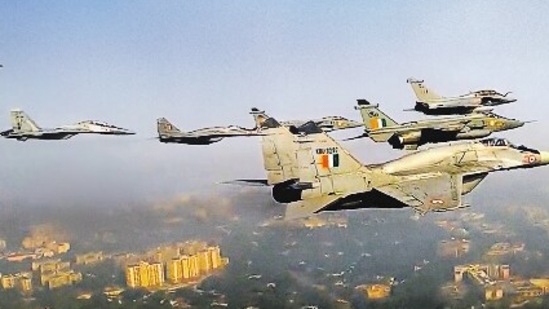
As many as 75 different aircraft from the Indian Air Force, army and navy -- India is celebrating the 75th year of its Independence -- took part in the flying display.
Also Read | Rare on-board footage adds to flying display
The aircraft included Rafales, Sukhoi-30s, Jaguars, C-130J special operations aircraft, Mi-35 gunships, CH-47F Chinook helicopters, Mi-171V choppers, MiG-29K maritime fighters and P-8I maritime surveillance aircraft.
The air show featured flying formations to commemorate some glorious moments of India’s decisive victory over Pakistan in the 1971 war, including the historic Tangail airdrop and the Meghna operation, apart from showcasing IAF’s combat capabilities. What added to the pomp was aerial footage that showed the aircraft flying alongside each other, and overlooking the national capital as they raced past the newly renovated Central Vista Avenue at RajPath.
Also Read | How DD got visuals of fly-past on live TV
The parade began at 10.30am, instead of the traditional 10 am, for better visibility to the parade and the fly past.
Huge scrolls, measuring 75 metres by 15 feet each, served as view cutters in the spectator stands along Rajpath --- 10 scrolls were prepared drawing inspiration from the unsung heroes of India’s freedom struggle.
Also, this year, the government had reserved seats for people who usually do not get an opportunity to witness the parade, including auto-rickshaw drivers, construction workers, safai workers, and front line health workers.
For the first time, the 480 dancers who took part in the cultural segment were selected through a nationwide competition called “Vande Bharatam”.
The invitation cards were also different, with seeds of medicinal plants such as ashwagandha, aloe vera, and amla embedded in them.
Fewer spectators attended the parade due to Covid-related restrictions --- less than 8,000 people were allowed entry to the venue. The parade was attended by around 25,000 spectators amid the ebbing first wave last year, compared to around 125,000 people who would usually show up at Rajpath to watch the event in the pre-pandemic era.
The parade did not have a chief guest. Reports suggested that India initially invited the leaders of the five Central Asian states --- Kazakhstan, Kyrgyzstan, Tajikistan, Turkmenistan and Uzbekistan --- to be chief guests at the celebrations, though no formal announcement was made in this regard.
The spread of the Omicron variant of the Coronavirus in the past few weeks and recent violent protests in Kazakhstan, which resulted in the death of more than 220 people, were likely factors that went against the participation of the Central Asian leaders.
Last year, India went ahead with truncated Republic Day celebrations without a chief guest after UK Prime Minister Boris Johnson called off his visit at the last minute because of the rapid spread of a strain of the Coronavirus in Britain. It is extremely rare for the Republic Day celebrations, seen as a high point in the country’s diplomatic calendar, not to have a chief guest.
Also Read | ‘Bonds that span over decades’: UK PM Boris Johnson greets India on Republic Day
Prior to 2021, the last time the celebrations didn’t have a chief guest was in 1966, when Indira Gandhi was sworn in as prime minister on January 24, days after the death of Lal Bahadur Shastri on January 11.
“It was a breathtaking parade that captured the essence of a resurgent India…a country that is a regional power and a global leader,” said former director general of military operations Lieutenant General Vinod Bhatia (retd).