It is 1.10pm and Congress candidate Jignesh Mevani is running an hour late on a blistering afternoon in Vadgam constituency in Gujarat’s Banaskantha district. A loudspeaker atop a jeep announces his arrival. Clad in a grey kurta and white pyjama, Mevani descends from an SUV, looking visibly tired. With hands folded, he moves towards some chairs under a banana tree, asking people to come and sit on a green tarpaulin sheet, where some people are already sitting with three clear divisions. The first section is for upper caste men, the second for upper caste women and the third for lower-caste people.
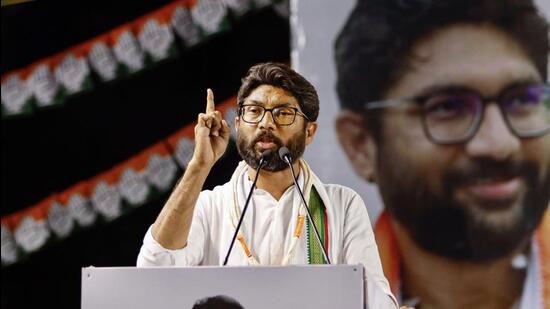
Speaking in Gujarati, the Dalit leader attacks inflation and blames the Bharatiya Janata Party (BJP). In the same vein, he speaks about high fuel prices and cooking gas cylinder costs, saying that while the cost of living has gone up, people’s incomes have stagnated.
The 42-year-old firebrand leader, who aims to retain Vadgam, recalls the dams built and the development done by Congress governments in the past to counter the BJP campaign that the party did nothing. “The BJP provides no justice to the poor and has done nothing for them in the past 27 years. In Morbi, 135 died in the bridge collapse and no case was registered against the rich person responsible for the tragedy,” he says.
As more people join in to listen, Mevani attacks the BJP for the release of 11 people convicted in the Bilkis Bano rape case. “They gang raped Bilkis and killed her three-year-old child. Now, the BJP has released the accused and is projecting them as sanskari (cultured). Is this right? If your daughter asks you in future whether you voted for the party that released them, what will you tell her?” he asks.
Also read: 'Can there be crasser comment': Congress reminds PM remark on Manmohan Singh
{{/usCountry}}Also read: 'Can there be crasser comment': Congress reminds PM remark on Manmohan Singh
{{/usCountry}}Mevani refutes speculation that the Congress has shied away from criticising the release of the 11 men, and says only the BJP hasn’t condemned the incident. “I have seen sympathy for Bilkis in the eyes of Hindu women and the issue has touched them,” he says.
References to Prime Minister Narendra Modi are few, and limited to his own arrest earlier this year by Assam Police for a tweet.
Mevani won the 2017 assembly election as an independent candidate after the Congress and Aam Aadmi Party (AAP) did not put up a candidate and the Congress changed the seat of its sitting lawmaker, Manibhai Vaghela, to neighbouring Idar. Vaghela lost and joined the BJP in November 2021. He is now the BJP’s candidate from Vadgam .
In 2017, Mevani – along with Patidar agitation mascot Hardik Patel and Thakor Sena leader Alpesh Thakor – was part of the young troika of the Congress that propelled the party to its best results in a generation. After the elections, Patel was appointed Gujarat Congress working president and Thakor became Congress national secretary in-charge of Bihar.
Thakor was the first to leave the Congress in 2019, when he resigned as an MLA from Radhanpur. He lost the bypolls and is now contesting on a BJP ticket from Gandhinagar South, a BJP bastion. Hardik left the Congress for the BJP in June and is contesting his first election from Viramgam, which the Congress won in the last two assembly polls.
Mevani was among seven Congress working presidents named in July. He says it “obviously hurts” that young leaders quit the Congress that provided them a political platform. “Congress has a base in all villages and there is a silent wave in its favour. Hopefully, we will bounce back this time.”
Vadgam has a sizable population of Muslims, Dalits and Thakors, who backed the Congress, helping it win in 2012 and 2017, when Mevani won with a margin of around 20,000 votes.
“He cannot repeat that (2017) winning margin this time,” says Satishbhai Chaudhary at Sagrosana village, who has come to hear Mevani. He accuses Mevani of being absent from the constituency after winning.
“We see him only during elections,” adds Dalipbhai Jatiya, who runs a hardware business in Vadgam town but adds that he may win because of the Muslims, Dalits and Thakor votes in the constituency.
“People here vote on caste lines and not on the candidate’s performance,” Chaudhary says.
Not far away, Vaghela is addressing a meeting in Badarpura village. “I know the constituency well and every village here. I am a local whereas Mevani is an election tourist. He (Mevani) was not seen here when Covid-19 was spreading in 2020 and I provided Covid kits to people. He has failed to carry out any development work,” Vaghela says.
Also read: ‘Will you cook fish for Bengalis?’ Paresh Rawal's Gujarat speech draws flak. He clarifies
The AAP has nominated a popular local Dalit leader, Dalpat Bhatiya, as its candidate.
Vadgam is a reserved seat for Scheduled Caste.
“As Vadgam has a high population of Dalits and Muslims and there are sizeable Chaudhary votes, Jignesh may win. But there is some resentment among people over Jignesh missing from his constituency during Covid-19. However, a large number of young voters are attracted towards him because of his firebrand style of politics,” Palanpur-based journalist Sanjay Joshi says.