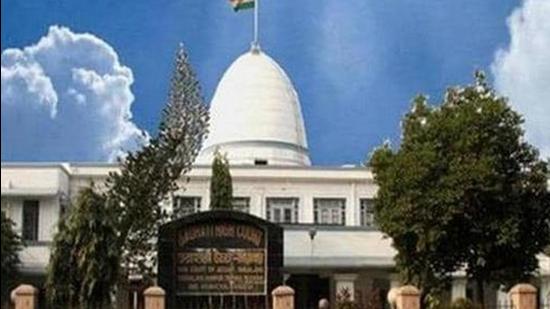
The Gauhati high court has declared a woman as an Indian, setting aside an order of a foreigners’ tribunal in Assam’s Bongaigaon that in November 2017 said she is a foreigner. A division bench of justices N Kotiswar Singh and Malasri Nandi passed the order last week in Puspa Rani Dhar’s favour.
The tribunal said the documents Dhar produced failed to establish her link with her father Hirendra Nath Paul while declaring her as “foreigner and deportable”. Dhar moved the high court in 2018 against the order.
The tribunal based its “finding and opinion” primarily on a certificate issued to Dhar’s late husband, Mrinal Kanti Dhar, by railway authorities in January 2003. The certificate showed the petitioner’s husband served in the Northeast Frontier Railways from 1962 till his retirement in 2003. It also mentioned Puspa Rani, born in January 1952, as his wife. But the foreigners’ tribunal termed the document as irrelevant and rejected it.
“We fail to understand, how the said document can be said to be irrelevant and liable to be rejected. Rather it shows that the petitioner who was married to the aforesaid Mrinal Kanti Dhar, was serving in the Indian Railways and as such, there is a remote possibility of the petitioner being a foreigner and this document will show, in absence of any contrary proof, that in probability the petitioner would be an Indian as an Indian is most unlikely to marry a foreigner,” the high court order said.
Also Read: 2 women journalists, arrested for reporting on Tripura violence, granted bail
{{/usCountry}}Also Read: 2 women journalists, arrested for reporting on Tripura violence, granted bail
{{/usCountry}}The court said the tribunal accepted a certificate issued in Calcutta by Bengal Medical Union in 1966 to the petitioner’s father. “This document would indicate that if her father was in Bengal in 1966, this will be strong corroborative evidence that the petitioner is an Indian,” the order said. “...the petitioner has been able to produce sufficient evidence before the learned tribunal to show that she is an Indian citizen and not a foreigner.”
Anita Verma, the special counsel for foreigners’ tribunals, argued even if she was declared an Indian, the petitioner should first register herself with the local foreigners’ registration office. But the court rejected this saying the petitioner was “not a foreigner at any point of time”.