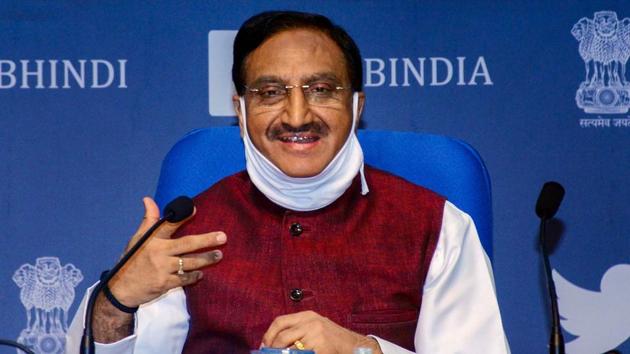
New Delhi: The Union human resources development minister Ramesh Pokhriyal Nishank spoke to Amandeep Shukla about reopening schools after the lockdown, CBSE board exams for students in containment zones, and the new education policy, among other issues. Edited excerpts of an email interview:
The HRD ministry has initiated a consultation with states on the process of reopening schools. What is the progress on this?The ministry has only initiated the consultation with states and Union Territories for preparing guidelines and SOPs -- for school health and hygiene, safety protocols, and academic and administrative matters -- to be taken into consideration when states and UTs decide to reopen schools. It is not for deciding the dates for reopening schools. The decision for reopening of schools will be taken by the concerned state government or UT administration as and when they find it safe to reopen schools following the guidelines of the MHA and the ministry of health.
Has the ministry prepared a road map for opening of schools? Is there a possibility that the schools may open in some states or areas while those with high rates of COVID-19 incidence may teach online?Education is on the concurrent list. It is for the state government or UT administration to prepare the road map for reopening of schools and also decide the dates for reopening of schools in their respective regions. MHRD will be coming out with broad parameters to ensure uniformity across the nation
Several reports suggest that many parents may not be comfortable to send their children to schools. How will you address those concerns?I understand the apprehensions of parents. The concerns of the parents and other stakeholders will be considered by the state government or UT administration before deciding to open the schools. I want to assure every parent that the health, safety and security of each and every students is of utmost importance to the government. I am sure that the decision will be undertaken in the student’s best interest after assessing the situation.
{{/usCountry}}Several reports suggest that many parents may not be comfortable to send their children to schools. How will you address those concerns?I understand the apprehensions of parents. The concerns of the parents and other stakeholders will be considered by the state government or UT administration before deciding to open the schools. I want to assure every parent that the health, safety and security of each and every students is of utmost importance to the government. I am sure that the decision will be undertaken in the student’s best interest after assessing the situation.
{{/usCountry}}The CBSE is to conduct Class X and XII board exams from July 1 to July 15. What measures will be put in place to ensure these exams are conduct safely?To address the issue of safe conduct of examinations, CBSE has taken two decisions in consultation with the HRD ministry: the examinations would now be conducted in the respective schools of the candidates instead of the examination centre already allotted; and CBSE will allow change of examination centre in respect of candidates who have shifted and are residing in some other district in the country than the place of their school. CBSE has also started a helpline (1800-11-8002) to address all the concerns of parents and students. The services are available between 9.30am and 5pm on all working days.
In case a student finds it difficult to take the exam, as in states like Delhi the number of cases being reported are high, will there be a redressal mechanism? For instance, a student from a containment zone or a student who is in isolation may not be able to take the exam.In the containment zone, no examination centre will be permitted. In case of schools falling in containment zones as on date, examination centre of the students of these schools will be allotted outside the containment zone.
For the preventive measures, directives issued by Union government and CBSE will be duly followed by the schools.
What is the status of the New Education Policy? There have been several measures like starting of class-wise channels planned by the HRD ministry. Are any of the lessons learnt during the Covid-19 phase going to be included?
The ministry is coherently working at a faster pace on the New Education Policy. We will submitting it to the Cabinet soon.
Given that the Covid-19 pandemic has presented unique challenges to learning around the world. More than 35 crore students and 1.08 crore teachers across 15 lakh schools, 1,028 universities, 41901 colleges and 10 726 stand-alone institutes are unable to attend the classes due to nationwide closure of the education institutes as India prepares to fight against the pandemic. The crisis definitely needed to be converted into an opportunity. It became imperative from India to take steps to mitigate the immediate risks and continue to provide education to all children; and build education resilience as a strategic imperative across the sector. The pandemic gave me an opportunity to build a resilient and sustainable education for all the students. E–learning definitely has a long way to go. We are devising strategies to reach the farthest student.
You have said that mid-day meals be provided to children during the current phase. How much has been possible in terms of providing meals? Are you planning to introduce any immunity-building food items in the scheme?India has taken various measures to prevent the spreading of this pandemic in the country. In these difficult crisis times, the poor vulnerable sections of the society with loss of livelihood leading to inadequate reserves of food are severely affected and children are bearing the brunt. Consequent undernourishment or malnourishment may lower their immunity against Covid-19. Thus, it becomes even more important to provide food especially to the poor and needy children to meet their nutritional requirements and thereby to safeguard their immunity.
To meet the nutritional requirements of the eligible children, states and UTs have been advised to provide mid-day meal or its equivalent food security allowance inclusive of foodgrains and cooking cost.