
 E-Paper



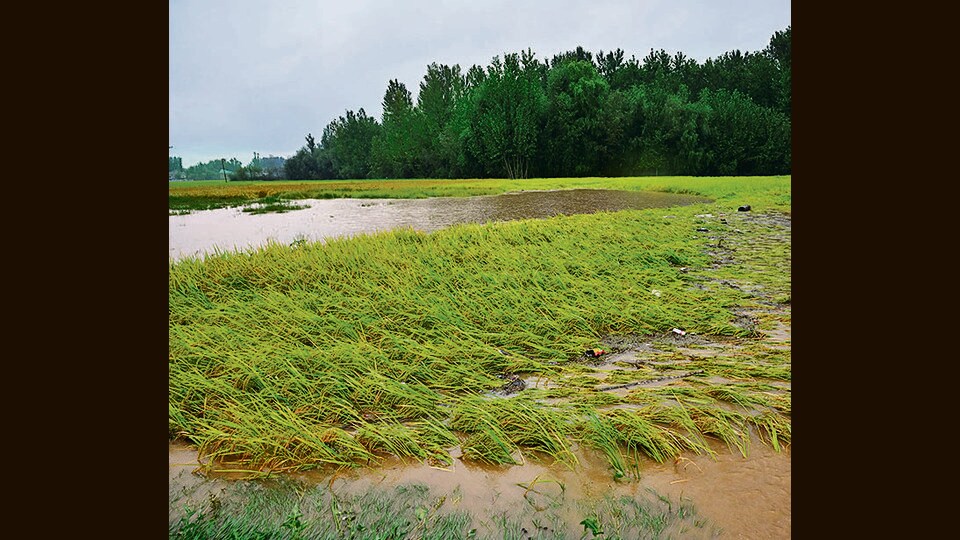
Heavy rains destroy crops in Punjab, fuel food price volatility
Nearly 14 states have activated their state disaster response forces for rescue and evacuation, an official in New Delhi said, adding that enumerating farm losses can only happen when rain ceases.

 Prefer HTon Google


Torrential rains across key food-bowl states, including in Punjab, have inundated thousands of hectares of farmland, destroying crops, some weeks away from harvest.
Rains disrupt supply lines, making food prices, especially of perishables, volatile. And because food prices make up 24.38% of the country’s basket for measuring wholesale inflation, continuing rough weather could cause price pressures to build up again, analysts said.
On Thursday, Union food minister Prahlad Joshi is slated to launch retail sales of onions purchased and stocked by the government to stave off vegetable inflation.
Flooding and storms this summer are sure to ruin a lot of food crops in many states, and in Punjab, heavy rain in upper catchment areas of the Beas and Ravi rivers has impacted agriculture in at least 8-10 districts of a total of 23, said Harvir Singh of Rural Voice, which tracks the agri economy.
Union agriculture minister Shivraj Singh Chouhan is set to tour Punjab on Thursday and he spoke with the state’s chief minister Bhagwant Mann on Wednesday. Nearly 14 states have activated their state disaster response forces for rescue and evacuation, an official in New Delhi said, adding that enumerating farm losses can only happen when rain ceases.
The monsoon, which sets off in June in Kerala and travels up the heartland through its four-month journey, has dumped 8.3% more rain than the average of 50 years, bringing deadly cloudbursts, storms and flooding.
Nearly half the population of the world’s fifth-largest economy depends on a farm income. Already, Trump’s 50% tariff on India’s exports weighs heavily on the sector, among other areas of the economy.
“This season, places like Jammu has seen the highest rainfall since 1950 of over 612mm,” Mukhtar Ahmad, director at the India Meteorological Department (IMD) for Jammu and Kashmir said.
Episodes of western disturbances, which are storm systems, have increased from four or five to about 12 this year, increasing the amount of rainfall, across the grain baskets of Punjab, Haryana, Uttar Pradesh and Madhya Pradesh.
“My cotton crop was weeks away from harvest but storms blew them away. I’m ruined,” said Satyadev Patel from Gujarat’s Vadodara. Saurashtra and Kachchh regions of Gujarat have been forecast to receive heavy rain until the weekend, the IMD has said, with a depression still gripping its coast.
In Punjab alone, the losses to farmers have been estimated to touch ₹1,000 crore, said Rural Voice’s Singh, due to damage to maize, paddy and cotton.
Scientists have found evidence that the intensity and timing of summer storms are becoming more erratic and severe, and linked to climate change. This not only endangers hundreds of millions of farmers whose livelihood depends on farming but could also raise the spectre of inflation.
Consumer prices dipped to an eight-year low of 1.55% in July as food inflation swooned downward by -1.76%. However, rainfall deviations raise vegetable inflation by about 1.24 percentage points, according to a recent study by the Reserve Bank of India.


