E-Paper



‘Held on for 2 hours’: Morbi survivors recount horror
Morbi bridge collapse: Milan Baida, a local resident who lost his uncle, aunt, niece and nephew, said the incident reminded him of the Gujarat earthquake in 2001.


“I don’t know what happened… the bridge suddenly collapsed. With whatever little swimming I knew, I managed to catch hold of one of the cables and clung to it for two hours…”
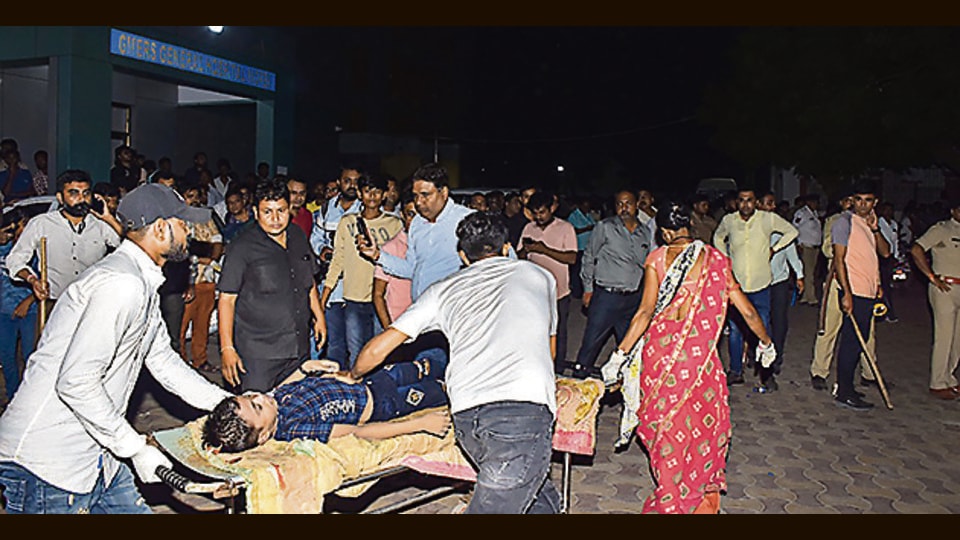
For Tushar Chudasama the two hours on Sunday evening he spent hanging on the edge of the Jhulta Pol in Gujarat’s Morbi district, with the support of a cable, seemed like forever. He and his cousin had come to visit the newly-renovated bridge that was reopened to the public after several months. While he survived in the tragic bridge collapse, his cousin could not be saved.
“I don’t know what happened. The bridge was shaking. It suddenly caved in. I found myself in the water. I found a cable and clung to it for two hours. It was not until the fire safety guys arrived that I was rescued,” he said.
“While I was hanging there, I tried to find my cousin. We both had come together. We wanted to bring our other family members too. What can I say now…,” he added.
Also read: ‘Three sounds and then…’: Morbi bridge collapse survivor recounts horror
On Monday afternoon, Chudasama visited a Morbi crematorium to pay homage to his cousin.
Milan Baida, a local resident who lost his uncle, aunt, niece and nephew, said the incident reminded him of the Gujarat earthquake in 2001.
“If the people who were managing the ticket counter were a little careful or if the visitors acted with some restraint, this could have been avoided,” he said.
Dr Parth Barasara was on his way to the bridge when he was stopped by a train crossing a nearby track. “As soon as the train passed and I crossed the track, the bridge came down in front of my eyes,” he said.
Lok Sabha member from Rajkot, Mohan Kundariya, lost 12 of his relatives in the accident.
“Four daughters of the brother-in-law of my elder brother, the husbands of three of them and five children were killed in the accident,” he told news agency PTI.
All of them belonged to different villages in Tankara taluka and were settled in Morbi, he said. “As it was Sunday, they had gone to the picnic spot where the tragedy occurred. I reached here half-an-hour after the incident took place and have been at the spot since yesterday, helping in the rescue work,” the MP said.
“So many people have been killed. We will take strict action against those responsible for the incident,” he added.
There were so many dead in the tragedy that their families had to queue up to bury them. Relatives dug graves for their kin with the help of staff, as mourners tried to comfort each other and volunteers offered the grieving families water.
Also read: Statewide mourning in Gujarat on Nov 2 for Morbi victims; search op continues | Top 10 points
Around 50 Hindu cremations were held and 37 Muslim funerals were carried out at the only Islamic cemetery in the district.
“It was mayhem,” local businessman Rafiq Gaffar said after burying his two nephews.
“People were crying and wailing. It was a scene from doomsday. There were bodies floating on the water everywhere and people trapped on the bridge were frantically calling for help,” he said.
The graveyard in-charge, Mohammad Toufeeq, said his staff could not step out for a break. “We haven’t slept or eaten anything since Sunday night. The entire area is in mourning. There are no words to describe the loss and I think there’s nothing which will ease our pain,” he said.