New Delhi : Scientists spotted two hilsa in the Ganga along Ghazipur town in Uttar Pradesh earlier this week, decades after they were believed to have disappeared from the upper and middle stretches of the river, a sighting that scientists said may be an indication that the waters were once again conducive for the species.
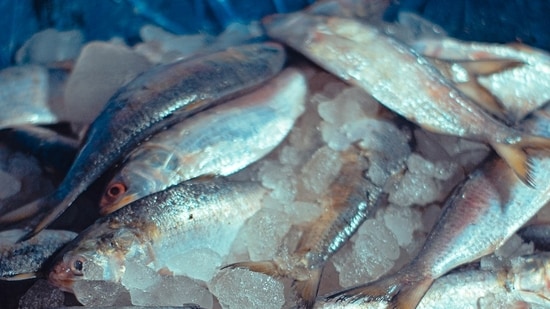
A senior Namami Gange official in Ghazipur confirmed the sighting.
“Some more hilsas were reportedly spotted by the locals in two more riverine villages on Saturday. However, their details have not yet come to the district headquarters,” said the official, who asked not to be named.
The sighting was also confirmed by officials at the Central Inland Fisheries Research Institute (CIFRI).
The two together weighed 740g, said officials.
{{/usCountry}}The two together weighed 740g, said officials.
{{/usCountry}}Officials said the finding was significant not because two fish alone can establish a population, but because Ghazipur lies well upstream of the Farakka Barrage in West Bengal that has disrupted the hilsas’ travel and migration patterns since the 1970s.
The species was once known to travel towards the Ganga’s upper reaches, with historical records showing its presence as far upstream as Prayagraj and parts of the Ganga-Yamuna system.
Hilsas spend much of their adult life in the sea and along coastal waters before entering rivers to breed. This adaptability has helped the fish survive and fend off the adverse impacts of shifting aquatic conditions.
But that cycle was shattered after the Farakka Barrage opened in 1975. Changes in river flow, obstruction of migration, pollution, habitat degradation and increasing human pressure together contributed to the disappearance of hilsa from large portions of the upper and middle Ganga.
Barrage that stonewalled their journey
Farakka was built primarily to divert water towards the Hooghly river in West Bengal to improve navigation and maintain the river’s navigability near Kolkata. At the same time, it reshaped the ecology of its waters.
For hilsa, the problem was particularly acute. Unlike fish that can complete their life cycle within a limited stretch of water, hilsa requires open channels between the marine environment and freshwater spawning grounds.
Scientists have regarded the species as an important indicator of river health because its presence depends on several ecological dovetailing – adequate flow, suitable dissolved oxygen, appropriate temperature and accessible breeding habitats.
The Ghazipur finding also comes in the backdrop of attempts to rebuild the lost hilsa population. In January, the National Green Tribunal (NGT) issued directions to Delhi and other states along the Yamuna to restore native fish populations and control exotic species in the river as a priority.
The January 29 order asked Delhi, Uttarakhand, Himachal Pradesh, Haryana, and Uttar Pradesh to all implement and consider recommendations submitted in an earlier report by the ICAR-CIFRI, which listed measures which could be adopted to stem the count of exotic species in the river.
HT on August 6 also reported the Upper Yamuna River Board (UYRB) asked Delhi, Haryana and Uttar Pradesh to develop “fish ladders” at the Wazirabad, Okhla and Hathnikund barrages respectively to allow native fish species in the river to migrate. A fish ladder is a stepped water structure that helps fish bypass obstacles – such as dams and barrages – during their migration upstream.
Ranching gives the Ganga another chance
CIFRI and NMCG have been working on hilsa conservation through a combination of fish ranching, tagging, monitoring and habitat-related interventions. Ranching is the practice of breeding fish in controlled environments before releasing them into open waters.
Earlier experiments have provided encouraging evidence, said experts involved in the project. Tagged hilsa released near Farakka have been detected hundreds of kilometres away, including in Uttar Pradesh. But scientists urged caution and underlined that last week’s sighting was not a reliable barometer of success.
Himanshu Thakkar, Coordinator at South Asia Network on Dams, Rivers & People (SANDRP) said a more positive indicator would be if the fish were to breed and “complete a life cycle or two”.
“At present, other evidence -- including water quality parameters through government data related to the river shows the water’s increasingly deteriorating situation,” he said.
Neeta Sehgal, senior professor (fish biology) at the zoology department at Delhi University, said the discovery was only a start.
“Hilsa are migratory fish, which migrate upstream to breed.The barrage altered water flows in the river and the pollution and habitat degradation have disrupted hilsa migration into the upper Ganga. Hilsa can travel hundreds of kilometres upstream. But breeding in freshwater is the most important.
“Two fish do not prove population recovery. True restoration would require evidence of natural migration, spawning, survival and successful reproduction,” she said, calling for sustained monitoring. “Evidence of natural breeding will eventually determine whether hilsa is genuinely reclaiming its historic migration route,” she added.