D Gukesh made his way down the stairs of the Great Hall in downtown Toronto on Sunday night, and outside its heavy doors, a bright sliver of stardom awaited. A throng of Indian chess fans, holding up phones and cameras, greeted him with chants of his name. The Chennai boy, all of 17, strode into the blinding lights, resembling a UFC fighter’s walkout, engulfed by people jostling for selfies and videos as security personnel escorted him into a waiting mini van.
It was a rare sight in chess. And one that he will have to get used to.
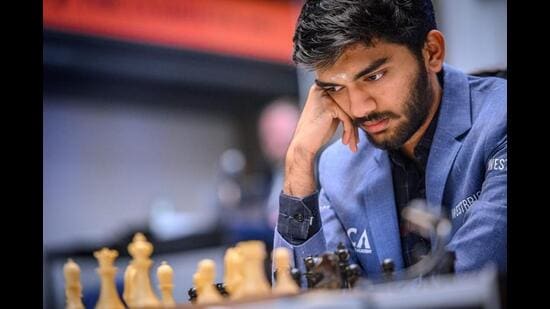
Gukesh made history by becoming the youngest-ever player to win the Fide Candidates tournament. He smashed former world champion Garry Kasparov’s record (20 years, 11 months) by over three years, and became the only Indian other than his mentor Viswanathan Anand to win the Candidates. He will face Ding Liren later this year in the biggest match of his young life.
The World Championship clash will be the first time in a decade that an Indian will be in a fight for the world title since Anand at Sochi in 2014. Gukesh was eight years old at the time. In a Chessbase India interview in 2017, when Gukesh was asked what he wants to become when he grows up, without missing a beat the 11-year-old replied: “I want to be the youngest world champion!” He’ll be 18 at the time of the match. Should he win, he’ll become the youngest undisputed world chess champion in history.
Far from a favourite going into the tournament, through three weeks and 14 rounds of classical chess, Gukesh remained unruffled against some of the world’s best and most experienced names in his first Candidates appearance. He lost only one game in a time scramble, and went into the final round as the sole leader ahead of two of the world’s top three players and a two-time Candidates winner. A draw with black pieces in Round 14 against world No. 3 Hikaru Nakamura was enough for the Indian while the must-win game between two members of the chasing pack, Ian Nepomniachtchi and Fabiano Caruana, turned into a mad jangle of nerves and errors before ending in a marathon 109-move draw.
{{/usCountry}}Far from a favourite going into the tournament, through three weeks and 14 rounds of classical chess, Gukesh remained unruffled against some of the world’s best and most experienced names in his first Candidates appearance. He lost only one game in a time scramble, and went into the final round as the sole leader ahead of two of the world’s top three players and a two-time Candidates winner. A draw with black pieces in Round 14 against world No. 3 Hikaru Nakamura was enough for the Indian while the must-win game between two members of the chasing pack, Ian Nepomniachtchi and Fabiano Caruana, turned into a mad jangle of nerves and errors before ending in a marathon 109-move draw.
{{/usCountry}}“Right now I’m just so happy and relieved about winning the tournament,” Gukesh told FIDE after the tournament. “I don’t care about the youngest and all these records…but it’s a nice thing to say.” With this performance, Gukesh moved up to world No 6 in the live ratings, one spot above reigning world champion Ding Liren. Gukesh is no stranger to “youngest-ever” tags either. In 2019, he became the world’s second-youngest Grandmaster, missing Sergey Karjakin’s record by just 17 days.
What’s been striking about Gukesh at the Candidates is his calm, nerveless approach to the biggest tournament of his career. He’s managed to surprise opponents with his tenacity and spunk, and hold his own against formidable names through torrid game situations. He would typically walk into the playing hall, arrange his pieces on the board, and sit with his eyes closed for a few moments before the start of the games. Dignitaries were called in to make the ceremonial first move, and while players would chip in the applause, Gukesh would sit with his arms crossed across his chest, detached from the proceedings. He didn’t dazzle with flash and frenzy right away. But as the tournament wore on, Gukesh slowly revealed his cool genius.
Since the pandemic, the pack of Indian chess prodigies have been on an upswing. Gukesh had a terrific 2022 Olympiad with a flawless 8/8 score. But despite some stellar performances, he ended up flying a bit under the radar. No sponsors were making a beeline for him, and somehow, some of his biggest moments appeared to be eclipsed by fellow prodigies. He was the first player to displace Anand in the published ratings and became India’s top-ranked chess player during the World Cup last year. He went as far as the quarterfinals, where he lost to world No. 1 Magnus Carlsen. But Praggnanandhaa had a terrific run in the same World Cup, going into the final & finishing runner-up to qualify for the Candidates. “He’s (Gukesh) not as high-profile as some of the other youngsters, which is confusing,” Carlsen said on the chess24 stream during the final round, “But he’s proven in this tournament that he’s very strong.”
Five-time world champion Anand has had a significant role to play in the accelerated growth of these prodigies through the Westbridge Anand Chess Academy set up in 2021. For the first time, a record number of five Indian players qualified for this year’s Candidates. Three of them, Gukesh, Praggnanandhaa and R Vaishali,are his mentees.
“A huge part of a long, high-pressure tournament such as the Candidates is having the right mentality; to be able to detach yourself from the result and just play your best chess. Gukesh did this by finding a right mixture of chess and some degree of fitness,” said Anand.
Just before the start of the Candidates, at a dinner with Anand, Gukesh said that his favourite country was Spain because of his results there. But one can be sure that, after Sunday, Toronto and Canada have more than forced their way into that argument.