The Japanese News Agency on Thursday announced the death of Mr Subhas Chandra Bose in a Japanese hospital from injuries received in an air crash, says a London message.
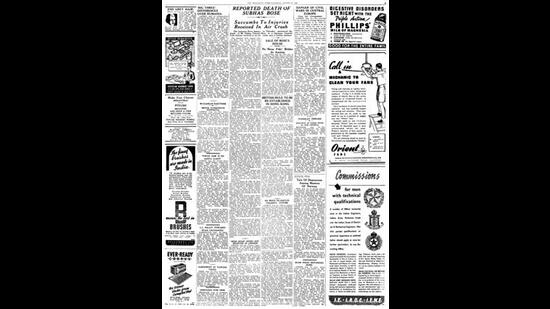
The Japanese News Agency said: “Mr Bose, head of the ‘Provisional Government of Azad Hind,’ left Singapore on August 16 by air for Tokyo for talks with the Japanese Government. He was seriously injured when his plane crashed at Taihoku airfield at 14.00 hours on August 18. He was given treatment in a hospital in Japan, where he died at midnight. Lieut.-Gen. Tsunamasa Shidi was instantly killed and Colonel Habibur Rahman, Mr Bose’s adjutant. and four other Japanese officers were injured in the crash.”
Last reports of Mr Bose’s activities from Japanese sources stated that he left Rangoon on the last day of its evacuation by the Japanese and had transferred his ‘Government’ to Bangkok.
The death of Mr Subhas Chandra Bose reported by the Japanese has - if true-relieved the British authorities of a difficult problem, but has undoubtedly caused new pain in the hearts of millions of Indians, writes Preston Grover, Associated Press of America staff correspondent.
Regardless of the fact that Mr Bose went over to the Axis side and opposed the Allies first from Berlin and later from Japan, he has remained something of a hero to many Indians. The report of his death came as a genuine shock to a number of Indians I to whom this correspondent talked after the death report was broadcast by the Japanese.
At the same time many questioned whether he is actually dead or whether the Japanese had co-operated in giving him an opportunity to “go underground” and escape punishment for opposing Allied forces.
{{/usCountry}}At the same time many questioned whether he is actually dead or whether the Japanese had co-operated in giving him an opportunity to “go underground” and escape punishment for opposing Allied forces.
{{/usCountry}}Indian attitude towards Mr Bose and army’s patriotism were disclosed in comments which Pandit Jawahar1al Nehru made during the past two days in speeches and interviews in Kashmir in which he pleaded for a lenient attitude towards him. Speaking particularly of what he estimated I as 20,000 Indian soldiers who had I been captured while operating under Mr Bose’s banner, Pandit Nehru pleaded that nothing should be done to them “which will lead to an additional festering sore in India’s mind and heart.”
Pandit Nehru said that these men had taken a wrong position “but they were brave men and they were prompted by the love of their country. It would shock us deeply if their lives are perished.”
Mr Subhas Bose, former President of the Indian National Congress, and founder of the Forward Bloc, was put under arrest in 1941 in Calcutta, from where he escaped. He made way across India and concealed himself in a bullock cart to enter Afghanistan. In 1942 he was reported broadcasting from Berlin and later that year appeared in Tokyo, where the Japanese promised to put him at the head of the army of Indians ready to march back into India and drive the British out. Nothing important ever came out of the effort, although for a long time his name was forbidden to appear in the Indian Press.
While a number of Indians like Pandit Nehru considered Mr Bose had made a mistake in going over to the Japanese, there were extremely few, this correspondent ever encountered, who doubted his patriotism.
When on March 28, 1942, Mr Bose was reported killed in an air crash on the coast of Japan, Mahatma Gandhi sent a message to Mr Bose’s mother saying, “The whole nation mourns with you in the death of your brave son. I share your sorrow to the full. May God give you courage to bear the unexpected loss.”
Maulana Abul Kalam Azad, President of the Congress, issued a statement on that same occasion saying, “In spite of differences with him as regards means of attaining India’s freedom, it must be recognized that he lived and died for the cause to which he had dedicated his life.”
When the report proved unfounded, Gandhiji and Maulana Azad jointly sent a telegram to Mr Bose’s mother saying, “Thank God, what purported to be authentic has proved to be wrong. We congratulate you and the nation.”
Mr Bose’s removal from the Indian political scene will spare the British authorities a difficult problem of handling him. Undoubtedly his case would have become a terrific political issue at a time when the British are 1 trying to iron out difficulties and bring I about the formation of some form of National Government. Had it been necessary to bring him to trial, much bitterness would have been created in India.