The seven-day debate on the Press Laws Bill came to a close today in Parliament with a powerful two-hour defence of the measure by the Home Minister, Mr Rajagopalachari, assuring the Press that it is thee in every sense of the term but at the same time warning it that certain safeguards are necessary against “ abuse of freedom and the degeneration of freedom into licence for scurrility and incitement to chaos.”
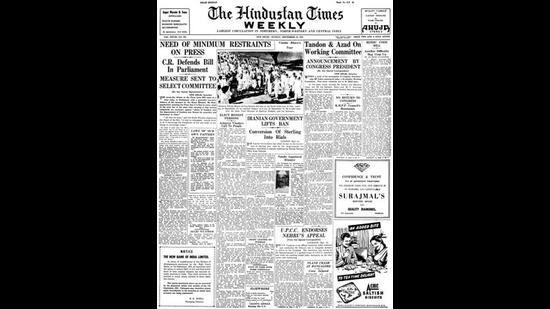
“ All that we want,” said the Home Minister explaining the object of the Bill, “ is that no newspaper should write so as to encourage the breakdown of law and order or say things to encourage crime.”
He made it clear that the Bill was aimed not at the Press as a whole, but against those “ few who may commit the serious breaches referred to.” He added in his characteristic way: “ I do want it to scare away bad people.”
The Home Minister’s speech, impressive in its eloquence and scintillating with good humour, will go down in Parliamentary history as the most brilliant exposition of the philosophy of Press freedom and the law governing the written word. At the end of the debate the House passed the motion for referring the Bill to a select committee with almost a unanimous voice.
Mr Rajagopalachari said he was only anxious to ban a law comprising the essential “ don’ts for printed stuff.” He told the House: “ If it is there, with courts to guard the canons of just and fair interpretation of whatever is printed or complained about, a code of conduct for all sections of the Press of our country will grow out of it.”
{{/usCountry}}Mr Rajagopalachari said he was only anxious to ban a law comprising the essential “ don’ts for printed stuff.” He told the House: “ If it is there, with courts to guard the canons of just and fair interpretation of whatever is printed or complained about, a code of conduct for all sections of the Press of our country will grow out of it.”
{{/usCountry}}ANSWER TO CRITICS
The Home Minister replied sharply to those who opposed the Bill as unnecessary. “ These editors,” he said, “ will not themselves or cannot control their erring colleagues. and they will not also allow Parliament and the courts when occasion arises to warn them, not to speak of punishing them. This is the meaning of opposition to the Bill.” Be reminded the House that in all civilized countries, certain minimum restraints were cheerfully accepted by the free Press in the interests of order and peaceful progress.
Explaining the need for a special law. he declared with firmness: “We cannot afford to let people’s minds be poisoned.” He explained in detail why the ordinary law was “ inadequate and inapplicable in such cases.”
The Home Minister also replied to those who complained that as a result of the Bill, the credit of India abroad was being damaged.
“No one is led to think that the Press in India is less free than the Press in any other country,” be said. Facts spoke for themselves They had only to look at newspapers in the country to judge and see for themselves that “ the Press in India is today freer than at any time before and freer than the Press in most other countries.”
“I may make it clear that no fair comment or bona fide criticism of the system of Government. of Government measures of the administration, of the laws passed or even of the Constitution would come within the terms of any of the items of objectionable mater dealt with in the Bill,” he declared.
The Home Minister asked the House: “Are we to trust no one in the world but a free Press ? It we do not trust a High Court, a tribunal or a jury, I say positively, I cannot trust you -a free Press. I maintain my point as quite sound.”
Mr Rajagopalachari said the Government had not abandoned the idea of appointing a Press commission, but it had nothing to do with the subject-matter of the Bill. The Commission would take a year if not more, to complete its task.