The otherwise somnolent Safdarjang Aerodrome came alive this morning with a steady stream of tiny propeller-driven aircraft taking off at short intervals for an air race to mark the golden jubilee of the Indian Air Force.
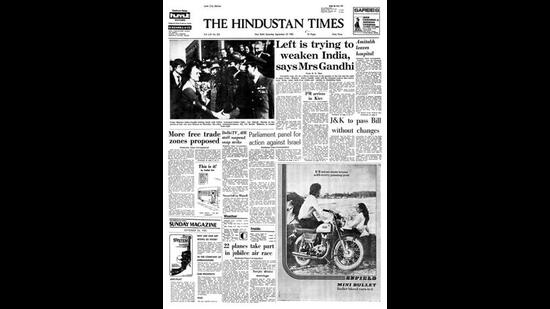
In all, 22 planes of seven different types joined the point-to-point race that took them to Agra and to Jaipur before returning to Safdarjang. All the aircraft safely arrived in the afternoon and it was a smooth course all through.
Today’s event was the first phase of the race. In the second and concluding one tomorrow, the competitors will be put through a “ton-stop triangular run”, expected to last three to four hours. Performance in both the phases will determine the overall results.
Even though the race, as conceived, was devoid of any real thrills, a large number of people turned up at the aerodrome well in time for the flag-off by Deputy Defence Minister K. P. Singh Deo at 8 a.m. Many took position on the Safdarjang flyover for a grand view of the take-off of the aircraft at two-minute intervals. Originally, 29 aircraft had been entered for the race. Seven withdrew, mostly on technical grounds. Swami Dhirendra Brahmachari’s Maule M-5, which was to be pilot ed by Mr Gurdev Singh Cheema and Miss Anita Bhatia, pulled out at the eleventh hour.
Miss Bhatia, 20, was the only wo man participant. When the Maule aircraft was withdrawn, she joined fellow-fller Capt A. M. Gurney of the Karnal flying club. The two flew a Pushpak.
{{/usCountry}}Miss Bhatia, 20, was the only wo man participant. When the Maule aircraft was withdrawn, she joined fellow-fller Capt A. M. Gurney of the Karnal flying club. The two flew a Pushpak.
{{/usCountry}}Fourteen of the 22 participating aircraft were Pushpaks. The other types entered included three Bonanza A-35 one Rallye 180 GT, one HPT-32. one Piper PA-12 and one Piper J 3C.
Since the various aircraft have different speeds, the IAF and the Aero Club of India, have evolved a system of handicaps. Accordingly, weightages be provided to the low speed aircraft.
It was because of this complicated tabulation, as well as the differences in the performances in the three legs (Delhi-Agra, Agra-Jaipur, and Jaipur-Delhi), that no trends about the leading aircraft were discernible this evening.
An IAF officer pointed out that Bonanza A-35 could fly at double the speed of Pushpaks. The maximum prescribed speeds of the different participating aircrafts were: Bonanza (160 nautical miles per hour), HPT-132 (135 miles), Rallye (124 miles). Piper PA-12 (100 miles), Pushpak and Piper J 3C (78 miles).
The largest number of entries for the race was from the Delhi and Patiala flying clubs. Each of these clubs has entered five aircraft.
The first aircraft to be flagged off was a Bonanza (Skylab-79), piloted by Dr S. V. Bhave from Pune. Dr Bhave’s aircraft was the first to land back at Safdarjung. The plane touched down at 2.42 p.m. This, however, does not ne cessarily imply that he is in the lead, considering the handicaps The clear picture would be available only at 11 a.m. tomorrow, an IAF officer said.
Air Marshal LM Khatre, briefing newsmen after the flag-off in the morning, said the handicapping of the different types of air craft had been done according to recognised norms so as to balance disparities of speed and built-in advantages.
Besides adherence to flying schedules, the pilots were also being tested for adherence to specific routes. For these, they were provided with nine photographs of specific sites over which they should pass at different points on the course.
Only small twin-seater aircraft could take part in the race as the organiser had stipulated that the all-up weight of any plane should not exceed 3,700 kg. The competition had been restricted to those Indian nationals who had a minimum flying experience of 200 hours, at least 100 of them in cross-country flying.
A notable entry at today’s race was the HPT-32, which has been designed and manufactured by the Hindustan Aeronautics Limited. for induction into the IAF as a basic trainer. The aircraft was piloted by Wg. Cdr. M. W. Tilak (Retd.). His co-pilot was S. H. Apre
In the second phase of the race tomorrow, the same aircraft would be put on the non-stop tri angular course. The aircraft will start taking off from 7 am. at two-minute intervals. They will proceed on the same course of Delhi-Agra-Jaipur-Delhi, but this time they would not be permitted to stop anywhere. All the aircraft are expected to return by 11 am.
The combined winner of today’s and tomorrow’s races will be presented the IAF Golden Jubilee Air Race Cup. The sponsors of the race, Indian Oil Corporation and the Hindustan Aeronautics Limited, have announced cash prizes of ₹20.000, ₹15,000 and ₹7,000 for the top three winners, and a consolation prize of ₹2,500 to every participant.
Besides the non-stop race, eliding and aeromodelling display will also be put up by the Nation al Cadet Corps at Safdarjang tomorrow. The hour-long aerobatic and skydiving show will begin at 12 noon.
JAIPUR: It was big fun at the Sanganer Airport. With security arrangements relaxed, thousands of enthusiasts, including Chief Minister Shiv Charan Mathur and his wife, had turned up to witness the race. The first plane to arrive from Agra was the Bonanza (Sky lab-79) As the plane landed at 11.35 a.m; the eagerly-awaiting crowd broke into cheers. People were thrilled to learn that the lightest (15 HP) and oldest Piper cub (1939 model) was in the competition. A slim and energetic Anjit Singh was piloting it. He has 18 years of flying experience.
Jimmy Sukhia, from Pune, found the visibility very good and wind direction helpful. Thundershowers and cloudy weather had been forecast for today in Jaipur.
For Miss Anila Bhatia, the only woman pilot, the flight was “thrilling”. She has 440 hours of flying experience. Anita has ambitions to pilot Indian Airlines planes.