Less than two weeks after assuming office, and even before it has presented the Union Budget, the PV Narsimha Rao government has made a big economic policy decision by a sharp devaluation of the rupee.
The Reserve Bank of India (RBI) has devalued the rupee by more than 20% against various currencies in two back-to-back devaluations over July 1 and 3. As a result of the decision, the dollar has gone from ₹21.01 to 25.98. The rupee has also been depreciated by a broadly similar magnitude against currencies such as the Pound Sterling and Japanese Yen. The latest devaluation is the sharpest since the 36% devaluation by the Indira Gandhi government in 1966.
RBI’s devaluation decision comes in the wake of a serious balance of payments and macroeconomic crisis in the economy over the previous year. India had to ship 20 tonnes of its official gold reserves in May to raise $234 million worth of foreign exchange reserves to tide over the balance of payments crisis. This move came after a ratings downgrade by S&P in March. Foreign exchange reserves have fallen each month from January to June this year from $6.4 billion to $4.7 billion.
In December 1990, India started discussions with the International Monetary Fund (IMF) for a large loan to prevent a balance of payments crisis when foreign exchange reserves fell to levels where they could cover less than three weeks of imports on the commitment of structural reforms in the economy.
{{/usCountry}}In December 1990, India started discussions with the International Monetary Fund (IMF) for a large loan to prevent a balance of payments crisis when foreign exchange reserves fell to levels where they could cover less than three weeks of imports on the commitment of structural reforms in the economy.
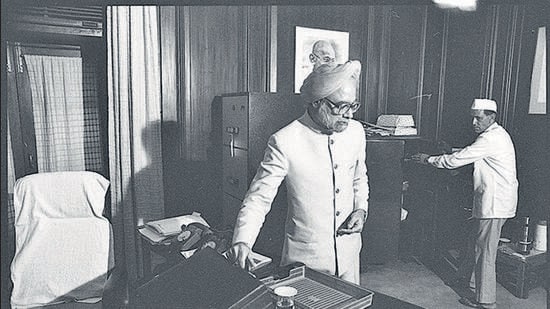
{{/usCountry}}To be sure, both RBI and the government have denied any relation between the latest rupee devaluation and the ongoing negotiations with the IMF. Finance minister Dr Manmohan Singh, while repudiating the suggestion that the rupee had been discreetly devalued under pressure from IMF, said: ‘We are in a world of floating currencies and terms like devaluation have lost their meaning”. He observed that RBI had the authority to adjust the value of the rupee according to day-to-day rates of a basket of currencies to which the rupee is pegged.
RBI officials clarified in Bombay that the downward revision of Indian rupee against four major international currencies was a part of the daily adjustments made in the exchange rates and not devaluation. However, they admitted that the downward revision of the rupee was sharper than usual.
While the government and RBI have been trying to emphasize that the devaluation decision is a sovereign one, they have also argued that it is beneficial for the economy. The finance minister assured that the exchange rate of the rupee had now been placed at a realistic level and he hoped that there would not be any need for any large depreciation in future and the rupee would stabilise. Dr Singh explained that the first cut of 8.7%-9.7 % on Monday was intended to test the impact and he was satisfied that the decision was welcomed and it had a positive impact on the foreign exchange reserves position. The Government through this large depreciation of the Indian rupee had sent the right signals to the international community and he has been assured by the donor countries and the international agencies that since India has started the process of following the right policies in economic spheres, they would support the government to the hilt, Dr Singh added.
Elaborating on the impact of the devaluation, Dr Singh said the market has absorbed the measure and so far as the budget was concerned it would have a positive effect since India is a net importer of capital. He agreed that there would be an increase in rupee costs, but taking into account a total view of the economy, he was confident that the economy would start on the road of revival.
RBI governor S. Venkitaramanan maintained that the adjustment would help reduce current account and fiscal deficits. Asked about the World Bank’s influence on the rupee devaluation, Mr. Venkitaramanan said the adjustment was made for the benefit of the Indian economy which was not only suffering from a liquidity crunch, but also inefficiency inherited over several years. He also ruled out any further heavy devaluation of the rupee in the near future. Today, the country had a current account deficit of $ 7 billion and there was an annual gap of $3-4 billion in the export and import trade, he added.
Dr Singh disclosed that during his talks with the Opposition leaders, everyone agreed with him that there was a need for a drastic action to save the economy and no leader, whether of the Left or the Right, objected to his suggestions. He was confident that he would be able to get his reforms proposal approved by the Left leaders like Mr Indrajit Gupta, Mr Jyoti Basu as also the Janata Dal. He said that former finance minister Prof Madhu Dandavate had told him that India should have gone to the IMF earlier.