The India Meteorological Department (IMD) on Sunday said India is likely to receive above-normal rainfall in September, even as the monsoon season has already caused several rain-related disasters across the country, PTI reported.
The weather agency has predicted that the monthly average rainfall for September will exceed 109 per cent of the long-term average of 167.9 mm.
The forecast suggests that most regions will receive normal to above-normal rainfall. However, according to the agency, a few areas in the northeast and east, as well as many parts of extreme southern peninsular India and some pockets of northwest India, could experience below-normal rainfall.
Landslides and Flash floods in Uttarakhand
Addressing an online press conference, IMD Director General Mrutyunjay Mohapatra warned that heavy rainfall could trigger landslides and flash floods in Uttarakhand in September.
He also warned that heavy rainfall could potentially disrupt normal life in south Haryana, Delhi and north Rajasthan.
Also Read | 5 killed, 11 missing as cloudbursts, flash floods, mudslides hit Uttarakhand
"Many rivers originate in Uttarakhand. So, heavy rainfall means many rivers will be flooded, and it will impact cities and towns downstream. So, we should keep this in mind," he said, according to PTI.
{{/usCountry}}"Many rivers originate in Uttarakhand. So, heavy rainfall means many rivers will be flooded, and it will impact cities and towns downstream. So, we should keep this in mind," he said, according to PTI.
{{/usCountry}}He added that heavy rainfall is also expected in the upper catchment areas of the Mahanadi River in Chhattisgarh.
Rainfall in August, highest in northwest India since 2001
According to the IMD, northwest India recorded 265 mm of rainfall in August, the highest for the month since 2001 and the 13th highest since 1901.
Rainfall in June was 111 mm, which is 42 per cent above the normal level, while July recorded 237.4 mm, exceeding the normal by 13 per cent.
Also Read | Chennai sees heavy rain, red alert in Manali area after cloudburst
August experienced 265 mm of rainfall, compared to the usual 197.1 mm, marking a 34.5 per cent increase, according to IMD.
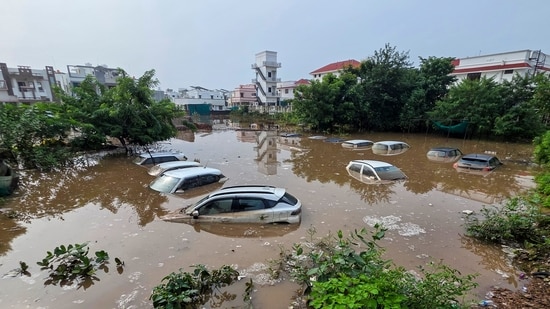
The unusually high rainfall coincided with a series of extreme weather events. Punjab faced its worst flooding in decades, as swollen rivers and breached canals flooded thousands of hectares of farmland and displaced hundreds of thousands of people.
In the Himalayan states of Himachal Pradesh, Uttarakhand and Jammu and Kashmir, cloudbursts and flash floods triggered landslides and caused widespread damage to life and property.
The IMD has attributed the surplus rain to active monsoon conditions supported by frequent western disturbances that enhanced rainfall over the region.