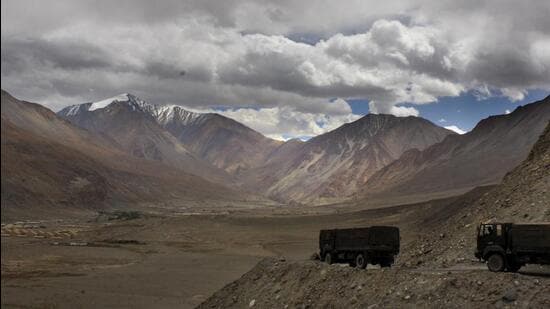
NEW DELHI: India and China on Thursday announced that their frontline troops have kicked off disengagement from Patrol Point-15 (Gogra-Hot Springs area) in eastern Ladakh where the Indian Army and the People’s Liberation Army (PLA) have been locked in a lingering standoff for over 28 months, with the breakthrough coming after the 16th round of military talks to cool tensions in the sensitive sector, officials familiar with the matter said.
This is the fourth round of disengagement between the two armies.
“On September 8, 2022, according to the consensus reached in the 16th round of India China corps commander-level meeting, Indian and Chinese troops in the area of Gogra-Hot Springs (PP-15) have begun to disengage in a coordinated and planned way,” said a brief joint statement.
The development is conducive to peace and tranquillity in the areas along the Line of Actual Control (LAC), it added.
Disengagement of Indian and Chinese soldiers from friction points on LAC in the Ladakh sector had been stuck for over a year, with the last breakthrough coming in August 2021 when the two armies pulled back their forward deployed troops from the Gogra sector (PP-17A). Resolution of outstanding problems at the border appeared elusive until now, the officials said.
The two sides withdrew their soldiers from the Gogra sector, which was one of the friction points on LAC, to their permanent bases days on August 4-5 after the 12th round of military talks held between corps commander-ranked officers on July 31, 2021.
{{/usCountry}}The two sides withdrew their soldiers from the Gogra sector, which was one of the friction points on LAC, to their permanent bases days on August 4-5 after the 12th round of military talks held between corps commander-ranked officers on July 31, 2021.
{{/usCountry}}While the joint statement issued on Thursday gave no details of the troop pull back from PP-15 near Kongka La, the August 2021 disengagement process involved the dismantling of temporary structures and allied infrastructure built by the two sides. The latest development has raised hopes for disengagement of troops from other flashpoints too, said one of the officials cited above.
Military affairs expert Lieutenant General DB Shekatkar (retd) said this was a positive development provided the Chinese are sincere about resolving the border standoff. “Given the experience of dealing with China, we have to be cautious. Over the last three decades, India has signed several agreements with China for border peace, but it has always betrayed us,” Shekatkar added.
Indian and Chinese armies have been locked in a tense standoff since May 2020. Despite 16 rounds of military talks held so far, problems at Depsang Bulge in the Daulat Beg Oldie sector and Charding Nullah Junction (CNJ) in the Demchok sector are still on the negotiating table.
The two armies held eight rounds of talks in 2020 with the first held in June of that year, five rounds in 2021, and have held three rounds of talks so far this year.
After the 16th round of talks on July 17, India and China said they would stay in close contact and maintain dialogue through military and diplomatic channels for a mutually acceptable resolution of problems along LAC at the earliest.
Despite four rounds of disengagement from Galwan Valley, Pangong Tso, Gogra (PP-17A) and now PP-15, the two armies still have around 60,000 troops each and advanced weaponry deployed in the Ladakh theatre.