A day after Prime Minister Justin Trudeau’s allegation of Indian involvement in the killing of Khalistani leader Hardeep Singh Nijjar triggered a diplomatic row, India advised its citizens in Canada to exercise utmost caution due to growing anti-India activities and “politically-condoned hate crimes”.
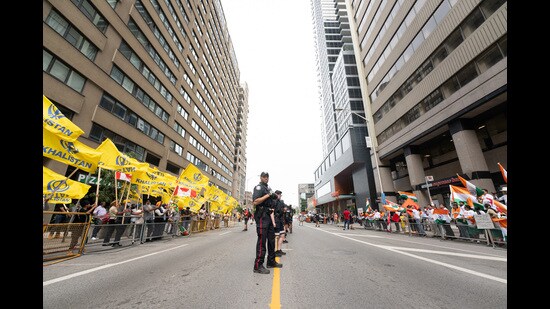
Trudeau’s claim of a “potential link” between Indian government agents and the murder of Nijjar in June has already been dismissed by India as “absurd and motivated”. The allegation severely impacted bilateral ties that are already at an all-time low and both countries resorted to tit-for-tat expulsions of senior diplomats.
In an advisory aimed at Indian nationals and students in Canada as well as citizens planning to travel to the country, the external affairs ministry said there were threats against members of the Indian community who “oppose the anti-India agenda”.
The advisory reflected the fraught state of the bilateral relationship, which has deteriorated in recent years over Canada’s perceived indifference to India’s calls for action against pro-Khalistan elements operating from Canadian soil.
“In view of growing anti-India activities and politically-condoned hate crimes and criminal violence in Canada, all Indian nationals there and those contemplating travel are urged to exercise utmost caution,” the advisory said.
{{/usCountry}}“In view of growing anti-India activities and politically-condoned hate crimes and criminal violence in Canada, all Indian nationals there and those contemplating travel are urged to exercise utmost caution,” the advisory said.
{{/usCountry}}“Recently, threats have particularly targeted Indian diplomats and sections of the Indian community who oppose the anti-India agenda,” it added. The advisory cautioned Indian nationals to “avoid travelling to regions and potential venues in Canada that have seen such incidents”.
People familiar with the matter said the reference to “politically-condoned hate crimes” in the advisory pointed to the reluctance of the Canadian government to crack down on the activities of groups and individuals espousing the cause of Khalistan or an independent Sikh homeland.
“These actions appear to be politically condoned by the people in power in Canada,” one of the people cited above said on condition of anonymity.
The Indian side has warily watched the escalation in the activities of pro-Khalistan elements, which have included the targeting of Indian diplomats and diplomatic facilities, rallies with secessionist banners and posters and the holding of a so-called referendum on Khalistan in several cities.
The advisory further said the Indian high commission in Ottawa and consulates in Toronto and Vancouver will continue to be in contact with Canadian authorities to ensure the safety and well-being of the Indian community.
“Given the deteriorating security environment in Canada, Indian students in particular are advised to exercise extreme caution and remain vigilant,” it said.
There are 230,000 Indian students and 700,000 non-resident Indians in Canada, according to the website of the Indian high commission in Ottawa.
Indian nationals and students in Canada “must also register” with the high commission or the consulates through their websites or the MADAD portal (madad.gov.in), the advisory said. Registration would enable the missions to connect with Indian citizens in the “event of any emergency or untoward incident”.
Meanwhile, Trudeau said Canada wants “to work with the government of India to lay everything clear and to ensure that there is proper cooperation”
Some of Canada’s allies in the Five Eyes intelligence alliance – which includes Australia, the UK, the US and New Zealand – have expressed concern about Trudeau’s allegations and said the perpetrators should be brought to justice.
Australian foreign minister Penny Wong said on Wednesday the issue had been raised with Indian counterparts, while US ambassador Eric Garcetti called for space for the Canadian investigation to proceed “before anybody leaps to judgement”. However, Garcetti also said Washington would act against any elements behind activities that target Indian diplomats or diplomatic facilities in the US.
Garcetti acknowledged that countries have different interpretations of freedom of speech but said the US takes the protection of diplomatic personnel “incredibly seriously”. Referring to an act of arson by pro-Khalistan activists at the Indian consulate in San Francisco, he said, “We’re working on this, on the protection of Indian diplomats and taking seriously investigations of incidents like what we saw in San Francisco.”
He added that “threats are threats, and when anybody threatens, that isn’t just free speech.”
Garcetti further said it was too early to talk about a US role in the diplomatic row between India and Canada. The US has a growing relationship with India while its ties with Canada are long-standing. “I think it is critical for us to return to two or three principles – one, sovereignty and non-interference, two, allowing criminal justice investigations to take their course, and third [for] there to be accountability for that. I think it’s too early to know exactly how it plays out,” he said.