The Gephang Gath lake in Himachal Pradesh is a disaster waiting to happen, glaciologists warned earlier this year. The lake is at high risk of breaking its banks and causing a flashflood because of its increasing size, local topography and melting permafrost, they warned in a scientific journal, a situation similar to the glacial lake outburst flood downstream of the Lhonak lake in Sikkim.
Read here: Glacial lake outburst, excess rainfall led to Sikkim flash floods, says NDMA
Gepang Gath has grown over the years to become the largest lake in the state, according to a paper published in American Geophysical Union journal in February that was led by the Divecha Centre for Climate Change at the Indian Institute of Science, Bengaluru.
“Gephang is in a very similar situation as Lhonak. It is at high risk. In fact, Himachal Pradesh and Uttarakhand in the western Himalayas and Sikkim in the eastern Himalayas have glacial lakes that are at high risk of GLOFs in view of climate change, so careful monitoring and timely mitigation efforts are needed,” said glaciologist Anil Kulkarni, a scientist at the Divecha Centre and co-author of the paper.
The lake may grow more than double its size in the future and warming permafrost in the surrounding steep slopes makes it susceptible to failure, the paper warned. If the water level in Gepang Gath can be brought down artificially, it would significantly reduce the risk of a outburst flood, the researchers found.
{{/usCountry}}The lake may grow more than double its size in the future and warming permafrost in the surrounding steep slopes makes it susceptible to failure, the paper warned. If the water level in Gepang Gath can be brought down artificially, it would significantly reduce the risk of a outburst flood, the researchers found.
{{/usCountry}}There are many ways to reduce volumes in glacial lakes, which include controlled breaching, construction of an outlet control structure, pumping or siphoning out the water, and making a tunnel through the moraine barrier or under an ice dam, according to an assessment by the International Centre for Integrated Mountain Development.
“We further evaluated mitigation options, including lake level lowering by 10 and 30 m, to evaluate the changes in the GLOF intensities downstream of the lake. It is seen that there is a significant reduction in the GLOF impact downstream when the lake levels are lowered, but the risk from very large events is not eliminated,” said authors of the paper, which included scientists from the University of Zurich, University of Dayton and University of Graz.
The highest risk is to infrastructure downstream, which includes the Sissu helipad, with severe implications for evacuations and other emergency response action, according to the paper.
Kulkarni and his team had informed the Centre and Sikkim state government in 2015 about the precarious state of Lhonak glacial lake and how hydropower projects downstream stood at risk. A working group constituted by the department of science and technology had recommended installation of an early warning system and lowering of water levels at Lhonak. HT has seen a copy of the report.
The recommendations were not implemented.
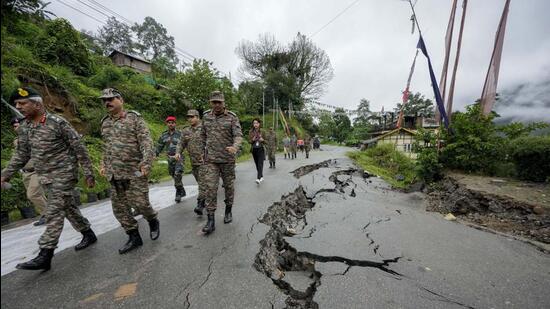
The Lhonak lake in Sikkim burst its banks on October 4 after heavy rainfall, leading to the deaths of at least 55 people, with 143still missing. It also washed away a dam on the Teesta river, damaged highways and stranded thousands of tourists.
“We had warned about the Teesta flood and GLOF in the Sikkim Human Development Report earlier in 2001 released by former Prime Minister Atal Bihari Vajpayee and then in 2012,” Mahendra P Lama, founding vice-chancellor of Sikkim University, said in a statement.
Read here: ‘Darkness and chaos’: Sikkim flood victims share ordeal; rescue op halted
Although people are not entirely against the building of hydropower projects, they are aggrieved at the way these projects are implemented, the casualness with which the environmental impact assessment is conducted and clearances are given, and the way project developers are selected, Lama said.
“The location, size and scale of these projects, the knowledge and experience of these project developers, the capability of project regulating agencies and the way projects have been designed and the technology used have been questioned all across the fragile Himalayan ecology,” he said. “Unfortunately, in many cases, these issues come up for public discussion only in the aftermath of disasters.”