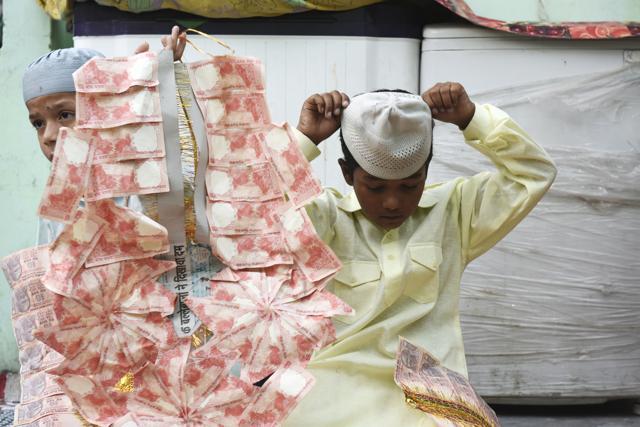
Amaan and Mohd Zaid hold centre stage on the occasion of their Roza kushai -their first ever Roza during Ramzan. The day is one of joy for the entire family with relatives over to participate in the celebrations. Aunts, uncles and cousins have gathered in the house as the boys play with garlands of 10 and 20 rupee currency. The 10 year-old boys are told they have grown up now.
This family of 18 lives in a lean 3 storey house in an unauthorised colony of Old Delhi. For all the years that they have been living here, all members of the house break the fast together at iftar time.
The iftar spread for the occasion is elaborate. There are the customary dates, accompanied by kachaaloo (spiced fruits), pakodas, daal, chholey, wafers and sharbat (flavoured drink), laid out on the terrace to accommodate the guests. After the iftar, everybody disperses for the Maghrib prayers and soon enough are back waiting impatiently for the biryani.
{{/usCountry}}The iftar spread for the occasion is elaborate. There are the customary dates, accompanied by kachaaloo (spiced fruits), pakodas, daal, chholey, wafers and sharbat (flavoured drink), laid out on the terrace to accommodate the guests. After the iftar, everybody disperses for the Maghrib prayers and soon enough are back waiting impatiently for the biryani.
{{/usCountry}}How do they manage to keep the Roza in this heat, I ask. “Will”, “power” and “faith” are the unanimous replies.
At a distance, near Jama Masjid the male members of Haji Miyan’s family lay the meal on an archaic table at the Haji Hotel and wait for Iftar time. Ever since childhood, Suhail Qureshi, an oncologist at a private hospital in Delhi has been observing iftar here with his uncles, one of whom owns the hotel.
He tells me, “We have always been told that water has no taste. But when you don’t eat for 15 hours and take the first sip, you realise that water does have a taste, and it is in fact water which gives taste to everything else.”
Tahira, a housewife, shared with me that Ramzan is observed with more or less the same traditions everywhere. However, at her father’s house, they make an extra effort to distribute food at iftar time to shopkeepers and vendors around them who can’t go home for breaking the fast. It is the idea of giving that Ramzan stands for, she explains.
Faraz Mirza, a public relations manager at a hospital in Noida, is not a religious man. He confesses that Ramzan for him is a way to connect to Islam and to know it better. This month also compels him to be more observant of his own behaviour.
I wonder how the month of Ramzan has changed over the years?
Dr Qureshi remains in awe of Ramzan in Old Delhi. It has an aura that few places have. Till last year he explains, ‘a sound bomb was used to announce the breaking of the fast, but with the ban on firecracker manufacturing this year, the tradition has been discontinued. I feel as if something is missing’. This year, the lights of Jama Masjid come up at Iftar time and Dr Qureshi quickly makes a call home to tell everyone to eat.
Faraz joins his brother in law Abrar Ahmed, a businessman living in Nizamuddin for Iftar. As the family prepared for the meal, a few minutes had already passed beyond the time for iftar. “This is the difference when there are no elders in the house and we young people have to manage everything,” Faraz jokes. Duas are quickly recited and iftar commences with the dates.
I am easily accepted into the families as they perform these seemingly simple and repetitive rituals. I photograph them taking their first bite of a date, and I am torn between my work and the repeated requests of my hosts to join them in their meals. In their faith they eat, in mine, I photograph. As they empty their plates, I take to mine, rushing in anticipation of catching my hosts right in time for Maghrib prayer.
The sight of men and women offering namaz in their flowing dupattas and kurtas, despite the bustle in the house, the melodious namaz led by the imam at Haji Hotel in the backdrop of Jama Masjid, and the 85-year-old Badar Jehan offering the prayer while her grandson fiddles with the phone are poignant moments that for me depict the beauty and tolerance of the month of Ramzan.