
 E-Paper



India rethinks buying US armed drones
The Indian Air Force has raised concerns about an armed drone surviving in a contested air space like PoK or along the LAC.

 Prefer HTon Google


Last month’s downing of the US Global Hawk drone by Iran in the Persian Gulf has prompted a rethink within the Indian military establishment, led by the air force, over the acquisition of American-made armed drones on account of their cost and questions over their survivability.
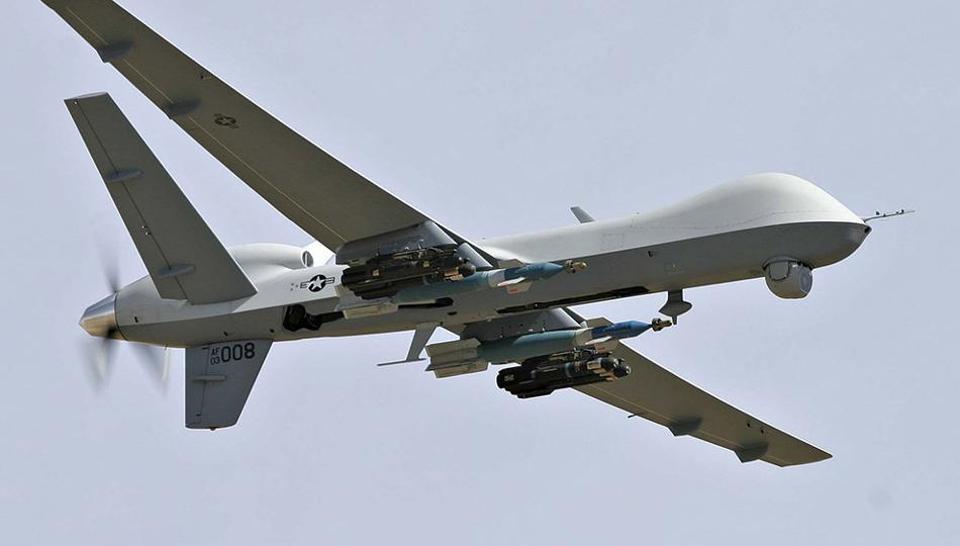
India’s three services had planned to buy 30 drones from the US at a cost of $6 billion. While the tri-services have not yet approached the defence minister for “acceptance of necessity,” or AoN, to procure the drones, the plans were for the air force and the army to acquire 10 Predator-B drones each and the navy to buy long-distance surveillance versions.
According to the military brass, the IAF has internally raised questions about an armed drone surviving in a contested air space like over Pakistan-Occupied Kashmir (POK) or along the Line of Actual Control (LAC) — the disputed de facto border between India and China — with both potential adversaries equipped with top of the line surface-to-air missile (SAM) systems .
“The armed drone has been successfully used by US in Afghanistan, Pakistan, Iraq and Syria as the skies are dominated by their air force. Pakistan is the only country that has counter-capabilities but will think 100 times before it decides to take a US drone down by a SAM or beyond visual range air-to-air missile,” said a senior military commander on condition of anonymity.
ALSO WATCH | Successful test firing of DRDO’s indigenous anti-tank missile ‘NAG’
The US’s top of the line RQ-4 Global Hawk was shot down by Iran’s S-300 missile system on June 20 in Persian Gulf airspace.
The rethink on US drones has nothing to do with US President Donald Trump’s Kashmir recent mediation faux pas; the Narendra Modi government has decided to cut out the Trump noise over Kashmir and concentrate on building India-US ties for times to come.
Trump said after meeting Pakistan Prime Minister Imran Khan earlier this month that Modi had asked him to mediate on the Kashmir issue — a claim India immediately and firmly denied.
The other significant reason behind the Indian rethink is the prohibitive price of armed drones like the Predator-B. According to the military establishment, the cost of a bare drone platform will be to the tune of $100 million and a full complement of weapons like laser-guided bombs or hell-fire missiles will cost another $100 million.
“This means that an armed drone with full complement of weapons will be more expensive than Rafael multi-role fighter with all weapons and missiles on board. Under the circumstances, the IAF will give preference to acquiring more multi-role fighters with long-range air-to-air missiles and the Indian army will be looking towards replacing its dated T-72 tanks. The Indian navy needs more surface combatants at sea rather than an armed drone for projecting itself as an Indo-Pacific power,” said a senior South Block official.
After the shooting down of Wing Commander Abhinandan Varthaman’s MiG-21 fighter by a Pakistani F-16 in an aerial skirmish on February 27 in the Rajouri sector, the air force has become interested in longer-range air-to-air missiles and the army wants equipment for its battle groups like tanks and howitzers for a faster response to the western adversary.
When asked to comment on the drone acquisition plans, a senior defence ministry official said, requesting anonymity, that a decision on whether or not to acquire armed drone from the US or any other country will only be taken once the three services approach the government with a proposal.


