Nepal’s lower house on Tuesday evening made a strong pitch in favour of the constitution amendment bill to redraw Nepal’s political map that could lead to a freeze in relations between Kathmandu and New Delhi.
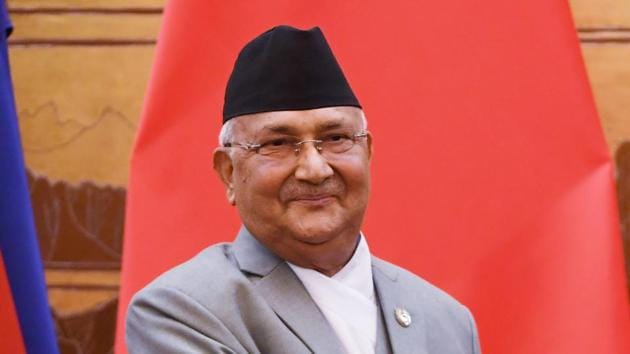
The new political map pushed hard by the KP Sharma Oli government is set to clear the first legislative hurdle in the lower house. The constitution amendment bill will next go to the 59-member National Assembly where the ruling Communist Party of Nepal has an overwhelming majority.
The map, cleared by the Oli Cabinet last month, counts Indian territories of Kalapani, Lipulekh and Limpiyadhura as its own. Its passage by the cabinet on May 18 had angered India that asked Nepal to “refrain from such unjustified cartographic assertion” for an “artificial enlargement of territorial claims”.
That message from New Delhi appeared to have gone unheard in Kathmandu.
The new map was Prime Minister Oli’s effort to whip up ultra-nationalistic sentiments at India’s cost and consolidate his weakening hold on the government and the ruling Communist Party of Nepal. It appeared to have bought PM Oli time.
{{/usCountry}}The new map was Prime Minister Oli’s effort to whip up ultra-nationalistic sentiments at India’s cost and consolidate his weakening hold on the government and the ruling Communist Party of Nepal. It appeared to have bought PM Oli time.
{{/usCountry}}Also Read: The costs of anti-Indian nationalism in Nepal | HT Editorial
Opposition parties that have been attacking the Oli government for his handling of the economy and Covid-19 found themselves coming around to back PM Oli in the lower house on Tuesday. PM Oli needs a two-third majority in both houses of Nepal’s Parliament.
It was supported by political parties across the spectrum - 83 MPs spoke at Tuesday’s meeting - but the formal approval could take some time as the proposal for consideration of the bill “was adopted with lawmakers given 72 hours to file an amendment to the bill”. It would be passed once the chief whips of political parties agree that no amendment is required.
There has been no formal response from New Delhi to Tuesday’s development. “There may be one later to set the record straight, a senior government official told Hindustan Times.
Also Read: Decoding the India-Nepal dispute | Opinion
New Delhi is furious at Nepal’s political leaders creating a boundary dispute with India to serve their respective domestic political interests and is expected to cold shoulder requests for a dialogue.
“Once Nepal cabinet and then parliament backed changes to its map to incorporate Indian territory, there isn’t a lot to talk about,” a senior government official said hours after Nepal’s foreign minister Pradeep Gyawali spoke of his country’s desire to talk to New Delhi to resolve the boundary issue.
“We have expressed time and again that Nepal wants to sit at the table to resolve this problem,” Pradeep Gyawali had told news agency Associated Press on Tuesday.
The foreign minister’s boss PM Oli had ignited the row after India reissued its map to incorporate changes in Jammu and Kashmir that had been carved into two union territories. Like in all previous maps, this one too continued to count Lipulekh, Kalapani and Limpiyadhura as part of the Indian state of Uttarakhand.
Also Read: The past, present and future of the Nepal-India stand-off | Analysis
The two countries planned to hold a round of discussions at the foreign secretary’s level to address Nepal’s concerns but the meetings couldt be scheduled for one reason or the other.
PM Oli’s government, however, renewed the attacks after India inaugurated an 80-km road in Uttarakhand that almost goes up till Lipulekh Pass at the India-China border. This project essentially involved building a metalled road connecting Dharchula town in Uttarakhand to the Lipulekh pass.
New Delhi was surprised when Kathmandu protested over the road that had been built in indian territory.
This area, spread over 330 sq km near Nepal’s western tri-junction with India and China, had always been part of India in every map that had been issued for more than a century and in terms of the ground situation, a senior official said. This claim was also accepted by the Chinese when it inked a pact with India to trade via Lipulekh pass back in 1954. When the two sides mentioned LipuLekh as a bilateral trade route in a 2015 joint statement sixty years later, Nepal registered its protest.
Behind the sharp rhetoric from Kathmandu over the road and Covid-19 in recent weeks, Indian officials said PM Oli appeared to be aiming to immortalize himself in Nepal’s history as the prime minister who stood up to its big neighbour. Quite like Prime Minister Kirtinidhi Bista who persuaded Indira Gandhi in 1969 to wind up Indian military posts along the Nepal frontier. When former foreign secretary Shyam Saran was India’s ambassador to Kathmandu, Bista told him that he counted his conversation with Gandhi as his life’s “greatest moment”.
In recent years, Indian officials said Nepal politicians had found themselves unable to take a stand on India and found it politically expedient to lay the blame at India’s doors.
Prime Minister Narendra Modi, in contrast, had gone an extra mile to accommodate the himalayan nation.
Like when the two countries were looking at a new pact to replace the 1950 Treaty of Peace and Friendship between the two countries, PM Modi had messaged early in his first stint as prime minister that Kathmandu could put together the first draft of the new treaty which the two sides could discuss.
When Nepal had reservations over the 50:50 funding format proposed for the Pancheshwar dam project, PM Modi had again asked Nepal to contribute what it could and promised to pool in the rest.