New Delhi: India and Thailand on Thursday upgraded their relations to a strategic partnership as Prime Minister Narendra Modi and his Thai counterpart Paetongtarn Shinawatra explored ways to enhance trade and investment and bolster cooperation in defence, security and countering cyber-crimes and human trafficking.
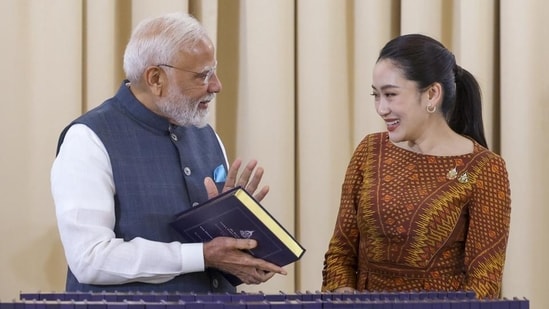
The two leaders met in Bangkok a day ahead of the Bimstec Summit to be hosted by Thailand on Friday. Thailand is among India’s key partners in the Association of Southeast Asian Nations (Asean) and bilateral defence and security cooperation has grown steadily within the framework of India’s “Act East” policy.
Modi conveyed India’s deepest condolences for the loss of lives in the earthquake that hit Myanmar and Thailand on March 28 at a joint media interaction with Shinawatra and said: “Thailand has a special place in India’s ‘Act East’ policy and our Indo-Pacific vision. Today we have decided to give our relations the form of a strategic partnership.”
Also Read: India-Thailand leadership can reinvigorate Bimstec
Speaking in Hindi, he added, “We also discussed the establishment of a strategic dialogue between our security agencies.”
{{/usCountry}}Speaking in Hindi, he added, “We also discussed the establishment of a strategic dialogue between our security agencies.”
{{/usCountry}}With an eye on China, Modi said India fully supports Asean unity, and that the two countries back a free, open, inclusive and rules-based order in the Indo-Pacific. In the Asean region, as maritime neighbours, both sides have shared interests in regional peace, stability and prosperity.
“We believe in the policy of development, not expansionism,” Modi said, in a tacit reference to China’s increasingly assertive posture in the South and East China Seas. He added in a social media post that India’s “Act East” and Thailand’s “Act West” policies complement each other and open possibilities for cooperation.
Modi said in the social media post the two sides discussed cooperation in strategic areas such as defence, security, maritime safety and hydrography. “We also reiterated our commitment to working together to overcome the challenges of terrorism, money laundering and more,” he said in the post.
Also Read: New world order will be regional, agenda-specific: Jaishankar at Bimstec meet
Expressing gratitude to the Thai government for its assistance in repatriating Indian citizens who were victims of cyber-crime, Modi said at the media interaction that the two sides agreed their security agencies will work together to combat human trafficking and illegal migration.
Last month, Thailand played a key role in the repatriation of nearly 550 of its citizens who were freed from cyber-crime centres located along its border with Myanmar. The Indians had been lured to Thailand or Myanmar with false promises of jobs in the IT sector and were trafficked to cyber-crime centres, mostly run by Chinese criminal gangs, in lawless border regions of Myanmar.
Modi said the two sides also emphasised cooperation in tourism, culture, education between India’s landlocked northeastern states and Thailand. They discussed ways to boost trade and investment and business exchanges.
Also Read: Modi leaves for Thailand, Sri Lanka, says visit to bolster ties, benefit region
“We have decided to increase cooperation in renewable energy, digital technology, e-vehicle, robotics, space, biotechnology and start-ups. Along with physical connectivity, work will be done to increase fintech connectivity between the two countries,” he said. India has begun issuing free e-visas to Thai tourists to promote people-to-people exchanges.
Two-way trade between India and Thailand, which is Asean’s second biggest economy, was worth $16 billion in 2023, with imports from Thailand accounting for $10.11. Within the Asean region, Thailand is India’s fourth largest trade partner after Singapore, Indonesia and Malaysia.
Besides a joint declaration on establishing the strategic partnership, the two sides signed a memorandum of understanding (MoU) on cooperation in digital technologies, an MoU for developing the National Maritime Heritage Complex at Lothal, and an MoU on cooperation in micro, small and medium enterprises.
Also Read: Formal Modi-Yunus meet unlikely at Bimstec summit
The two sides also finalised two agreements related to India’s northeastern states, including one between India’s ministry of development of the northeastern region and the Thai foreign ministry and another between the North Eastern Handicrafts and Handlooms Development Corporation and Thailand’s Creative Economy Agency.
Modi also highlighted the age-old cultural and religious ties between India and Thailand and said: “There has been an exchange of scholars from Ayutthaya to Nalanda. The story of Ramayana is deeply embedded in Thai folk life and the influences of Sanskrit and Pali are still reflected in languages and traditions.”
He noted that holy relics of the Lord Buddha sent from India to Thailand last year were visited by more than four million people. He announced that sacred relics found in the Aravallis in Gujarat in 1960 will also be sent to Thailand.
Also Read: On East Asian Summit sidelines, Modi meets Thai PM Shinawatra, Laos’ President
He expressed his gratitude to the Thai government for issuing a special stamp based on 18th century Ramayana mural paintings to mark his visit and for presenting him a special edition of the Tripitaka, a collection of Buddhist scriptures, that was published in 2016 to commemorate the reign of Thai King Rama IX.