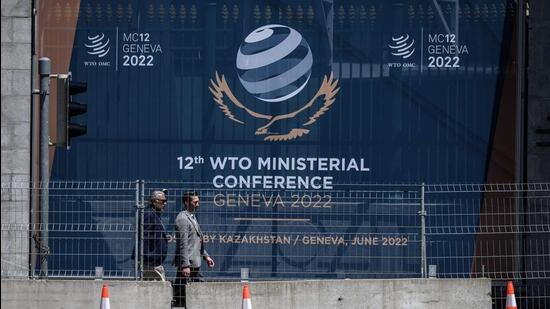
The 12th WTO Ministerial Conference is all set to begin on Sunday in Geneva, after a gap of almost five years. The position of India, which will be represented by a delegation led by Union Minister Piyush Goyal, on three key areas -- agriculture , fisheries, and e-commerce -- is very clear, and focused on protecting small farmers and fisherfolk, and the country’s interests, three people familiar with matter said ahead of the 12th ministerial of WTO.
On agriculture
India will push for a new method to calculate food subsidies for a permanent solution to its public grain stockpiling programme, one of the prickliest issues at the ministerial conference starting June 12 in Geneva.
According to current WTO rules, a member country’s food subsidy is capped at a ceiling of 10% of the value of production based on 1986-88 prices. India will propose amendments in the formula to calculate the food subsidy limit with support from G33, which, despite its name, is a grouping of 48 nations.
Last year, India invoked a so-called peace clause it enjoys (for third time in case of rice) at the WTO for exceeding the 10% ceiling on the subsidy it offers to its farmers, critical for the country’s food security.
India’s stand has been that public stockpiling is critical for its food security and total subsidies given by the US and EU far exceed those offered by India, based on India’s updated calculations.
{{/usCountry}}India’s stand has been that public stockpiling is critical for its food security and total subsidies given by the US and EU far exceed those offered by India, based on India’s updated calculations.
{{/usCountry}}One of the proposals India is likely to advance is to recommend a re-calibration of the “external reference price”, adjusting it for current global inflation rates, to arrive at the minimum support price ceiling of 10% of the total value of crop production.
Another critical stand of India will be to include all subsidized food programmes introduced after 2013, which are currently not recognized by the WTO, as well as food aid given under the World Food Programme.
“India’s proposal is to update the outdated 1986-88 external reference price and base it on current global prices,” a government official said, asking not to be named.
Further, India will push for subsidy calculations to be based on “actual procurement and not all eligible production”, the official said. This shift will benefit all developing countries who have public stock-holding programmes. “Our proposal is to calculate subsidies with a more relevant method that is fair to all countries.”
According to the existing method of calculations, India has told the WTO that the value of rice subsidies in 2019-20 was $6.31 billion, which is 13.7% of its value of rice production in that year, which stood at $46.07 billion.
“India currently carries out its procurement under a so-called peace clause. India will make these proposals for a permanent solution,” the official added.
Several countries are looking for a permanent solution to the issue of public stockholding (PSH) programme. China and African nations are part of the G33 which have common ground with India on this issue.
Last year at the WTO, G-33 countries stated that government procurement made under minimum support price would not be used for exports. On the stockholding issue, the G-33, the African Group, and the ACP (Africa, Caribbean, and Pacific) have submitted a joint proposal to the WTO’s Committee on Agriculture, while advanced economies want the topic to be deferred.
The ‘peace clause’ was adopted at the Ninth Ministerial that was held in Bali in December 2013. It was an “interim solution” to avoid raising disputes under various provisions on WTO Agreement on Agriculture (AoA) with respect to PSH for food security purposes instituted before December 7, 2013 even if countries exceeded their permissible subsidy limits. It was also agreed to negotiate a permanent solution by the Eleventh Ministerial in 2017.
Subsequently, in November 2014, the validity of interim solution was extended till a permanent solution was agreed upon. The same was noted at the Nairobi ministerial declaration in December 2015.
India and like-minded nations now want a permanent solution with “improved outcome” without paying any price for it, which is being resisted by developed nations. “Else, India and like-minded countries do have standalone mandate from Bali and Nairobi and a peace clause available to them in perpetuity,” one of the three people cited in the first instance said.
On issues such as agricultural subsidies and agricultural special safeguard mechanism against import surge, customs duty and export restrictions, India wants differential and equitable treatment because there is a huge disparity between developing and developed countries. “You cannot treat them equally when agricultural subsidy in developed world is as high as $60,000 per farmer per annual compared to $260 in developing countries,”this person added.
On fisheries
India’s position on negotiations for fisheries subsidies at the WTO is that it wants support for low income countries where people fish for their livelihoods. Aquaculture and inland fisheries are excluded from the scope of the negotiations. There are WTO members who want curbs on subsidies in this sector to discourage overfishing or unregulated/illegal fishing.
“India is not a demandeur of disciplines on fisheries subsidies. In a developing country like India, where a large number of small, resource-pool fishermen depend on fishing activity as a source of livelihood, suitable special and differential (S&D) treatment provisions would need to be built in while framing disciplines,” the second person said.
“The MC11 decision on fisheries subsidies clearly mandates that there should be an appropriate and effective special and differential treatment for developing countries,” he said. It is important for developing countries and LDCs to collectively work for a fair and equitable agreement on disciplines in fisheries subsidies, he added.
On E-commerce and electronic transmission
The global growth of e-commerce is asymmetrical with massive advantage to developed countries that control almost the entire space. Developing countries required to preserve flexibility of implementing policies to catch up with the develop countries in the digital arena, the third person said.
“We first need to focus on improving domestic physical and global infrastructure, creating supportive policy and regulatory framework, and developing our digital capabilities,” he said. Accordingly, India has not joined the Joint Statement Initiative (JSI) on e-commerce as it believes that multilateral avenues are best suited to achieve inclusive and development-oriented outcomes, he added. JSI on e-commerce was launched in 2017 by 86 countries to negotiate trade rules such as electronic authentication, non-discriminatory treatment of digital products, free-flow of cross-border data, and permanent e-commerce moratorium.
“India believes negotiation on rules and disciplines in e-commerce would be premature given the highly asymmetrical nature of existing global e-commerce space and lack of understanding on the implications of the multi-faceted dimensions of issues related to e-commerce,” he said.
India also wants the moratorium on imposition of customs duty on electronic transmissions to not be extended further because it is one-sided, favouring developed countries and leading to huge revenue losses to the developing countries. ‘
WTO members agreed not to impose customs duties on electronic transmissions in 1998 and the moratorium has been periodically extended at successive ministerial Conferences. At MC11, the moratorium was extended for another two years and in December 2019, it was further extended till MC12. While JSI member countries want to make this moratorium permanent, MC12 may likely to push this concession up to MC13. “The move will, however, be opposed by India and South Africa at MC12,” he said.
Without naming the global tech giants and e-commerce majors, the person said big tech firms based in developed countries are lobbying to continue the moratorium, making countries like India – their markets – are bleeding revenue. “India is losing minimum $500 million annually because goods and services can enter the country through big tech firms’ ecommerce platform and bypass levies. For example, a book can come to India in physical form. It can also come in electronic form,” he said.