...
...
Next Story

Nuke capable Rafale-M tested for INS Vikrant in Goa

The marine version of the Rafale jet has a reinforced undercarriage and nose wheel, a bigger arrester hook, an integrated ladder, and other minor differences from the Rafale currently in use in the Indian Air Force.

Updated on: Jan 7, 2022, 10:19:59 IST
Advertisement

India on Friday, will test the Rafale-M (Marine) jet for use on its Vikramaditya aircraft carrier as well as the indigenous aircraft carrier 1 (IAC1), which will be deployed as the INS Vikrant, at the INS Hansa in Goa, a shore-based test facility. The aircraft for the test arrived Thursday.
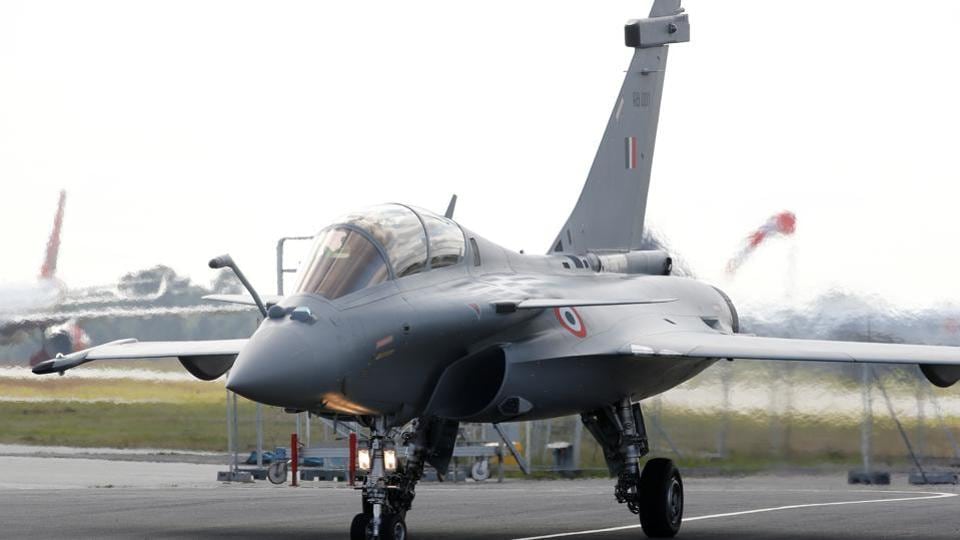
According to people familiar with the matter, the Rafale M is better suited for use on the aircraft carriers than the F18 Hornet fighter from the US for several reasons.

The Rafale-M aircraft is the F4 equivalent standard naval version of the Rafale. The marine version of the Rafale jet has a reinforced undercarriage and nose wheel, a bigger arrester hook, an integrated ladder, and other minor differences from the Rafale currently in use in the Indian Air Force.

According to people familiar with the matter, the Rafale-M is better suited for use on the aircraft carriers than the F18 Hornet fighter from the US for several reasons. They pointed out that it can fit into the lift bay of the Vikramaditya, unlike the F18 which cannot fit the lift of the Vikramaditya even with folded wings. The Rafale-M's dimensions also mean more of them (14) can fit onto the deck of the Vikramaditya as compared to 10 or 11 F18s.

The Rafale-M can carry up to four-five tonnes of external load (with full internal fuel) for a ski take-off. With lesser internal fuel, it can carry more weapons depending upon mission requirements. Thus it can carry out all roles, including combat air patrol, intercept, AD escort, as well as sea and land-strike with full internal fuel.

Officials familiar with the matter also added that unlike the F18s, which requires the carriers to be fitted with a new carrier optical landing system, the Rafale M’s can work with the existing one on the Vikramaditya.

There’s also the benefit of a common platform across the navy and the Air Force, one of the people said. Apart from synergies in logistics and maintenance, this person added, Indian Navy pilots could be trained on IAF’s Rafales for “faster induction”.

The navy will likely test the F18s at the same facility in March, HT learns.

The Vikrant is likely to be commissioned by August 15, and if the Rafale-M is chosen, India may seek to lease four or five of the aircraft for immediate deployment. The Vikramaditya is currently equipped with two squadrons of aging MiG-29.

The Rafale-M sent for testing is the latest version of the fighter with India-specific enhancements. It is nuclear-capable, carries Meteor air-to-air missiles, SCALP air-to-ground missiles, and Hammer precision guided ammunition.

 
ABOUT THE AUTHOR
Shishir Gupta

Shishir Gupta is Executive Editor at Hindustan Times and one of India's top journalists covering national security, strategic affairs, foreign policy and geopolitics. Over the past three decades, he has extensively reported on India's military, diplomatic and security landscape, covering every major conflict and national security challenge, from the 1999 Kargil War and the 2020 East Ladakh standoff to Operation Sindoor in 2025. He has also covered major terror attacks, including the IC-814 hijacking, the 26/11 Mumbai attacks and the 2025 Pahalgam terror strike, along with numerous Pakistan-backed terrorist incidents in the Kashmir Valley and across India. He has reported on national and state elections for more than three decades. A recognised authority on strategic affairs, Gupta has covered India's nuclear programme since the Pokhran-II (Shakti series) tests in May 1998 and has written extensively on global nuclear issues, Indian diplomacy and the country's expanding global outreach. He has also reported widely on international conflicts and terrorism, with a special focus on the Indian subcontinent. Gupta has interviewed Prime Minister Narendra Modi more than four times, including Modi's first interview with the print media after becoming Prime Minister in May 2014. His other interviews include three with the Dalai Lama, as well as conversations with Benjamin Netanyahu, Amit Shah, Yogi Adityanath, S. Jaishankar, Nirmala Sitharaman and Piyush Goyal. He is the author of Indian Mujahideen: The Enemy Within (Hachette, 2011) and Himalayan Face-off: Chinese Assertion and Indian Riposte (Hachette, 2014). He was awarded the Chevening-Wolfson Joint Scholarship at Wolfson College, University of Cambridge, UK, in 1998 and participated in the International Visitor Leadership Program (IVLP) of the US State Department in 2006. He received the Ben Gurion Prize from Israel in 2011 and the K. Subrahmanyam Prize for Strategic Studies in 2015 from the Manohar Parrikar Institute for Defence Studies and Analyses (MP-IDSA). Since 2024, he has hosted Point Blank, Hindustan Times' weekly YouTube show on global geopolitics.

Get the latest India News, breaking headlines and real-time updates from across the country. Stay informed about politics, government policies, crime, weather major national developments and Karnataka Bandh LIVE.
SHARE THIS ARTICLE ON
Hindustantimes wants to start sending you push notifications. Click allow to subscribe