NEW DELHI: Russia on Monday welcomed the understanding between India and China on disengagement of troops on the Line of Actual Control (LAC), with Russian envoy Denis Alipov saying the amicable resolution of the border dispute would require determination and trust from both countries.
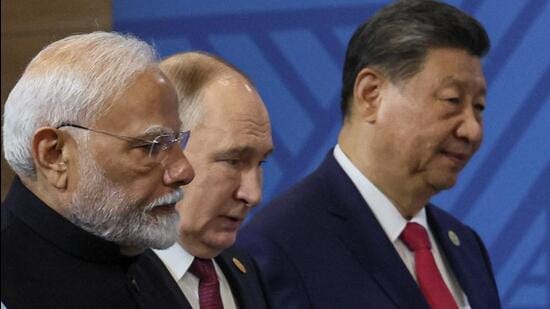
India announced an agreement with China on patrolling arrangements on the LAC two days before Prime Minister Narendra Modi and President Xi Jinping met on the margins of the Brics Summit in the Russian city of Kazan on October 23. The two leaders agreed to revive several mechanisms to resolve the border dispute and to normalise bilateral relations.
“We have welcomed and are happy that the first meeting between the leaders of China and India took place in Kazan after a gap of five years. We believe this is a very positive development in the bilateral relations between India and China,” Alipov said at a media briefing at the Russian embassy.
Alipov acknowledged that the India-China border dispute is a “very complicated issue” that will require a “difficult and lengthy process of negotiations”. However, he pointed to a border dispute between Russia and Chinese that lasted more than 40 years and said the two countries had been able to reach a mutually acceptable solution.
{{/usCountry}}Alipov acknowledged that the India-China border dispute is a “very complicated issue” that will require a “difficult and lengthy process of negotiations”. However, he pointed to a border dispute between Russia and Chinese that lasted more than 40 years and said the two countries had been able to reach a mutually acceptable solution.
{{/usCountry}}“I don’t have any doubts that India and China will eventually be successful on the border problems between them, but it would require determination, an open-hearted approach [and] trust, [which] is probably the main prerequisite for an amicable resolution,” he said while responding to questions.
Russia, Alipov added, did not play any role in organising the meeting between Modi and Xi in Kazan.
“For Russia, it has always been important and desirable that India and China maintain stable and good relations [and] a dialogue between themselves. That would only be favourable and indispensable for the security situation in the Eurasian space and for the world at large,” he said.
Russia sees India and China as the “main economic drivers” in this region, and has “always endorsed the trust between the two countries” without in any way advising them on bilateral negotiations or interfering in contentious issues such as the border dispute, Alipov said.
“But we have always stood for and openly spoken about the necessity for better relations, for a close relationship between the two majors on this continent...We hope the improvement on the border and such high-level interactions like the one that took place at Kazan would facilitate and open new ways to a closer [and] trusted dialogue between the two countries and eventually the resolution of contentious issues,” he said.
Russia continues to be India’s largest supplier of military hardware, accounting for almost 60% of all the equipment held by the Indian armed forces. It has also emerged as one of the largest sources of crude oil following the imposition of Western sanctions after Russia invaded Ukraine in 2022.
India has not publicly censured Russia’s actions in Ukraine and has called for dialogue and diplomacy to end the conflict, saying a solution can’t be found on the battlefield. However, policymakers in India have watched Russia’s growing strategic ties with China with concern.
Alipov said Russia believes it is necessary for India and China to “speak in one voice” for the resolution of global security and financial issues, especially those that affect the countries of the Global South.