Indian and Chinese soldiers clashed along the contested Line of Actual Control (LAC) in Arunachal Pradesh’s Tawang sector last week, leading to injuries on both sides, the Indian Army said on Monday. The clash, which took place on December 9, came in the midst of ongoing border tensions between the Indian Army and the Chinese People’s Liberation Army (PLA) in the sensitive Ladakh sector.
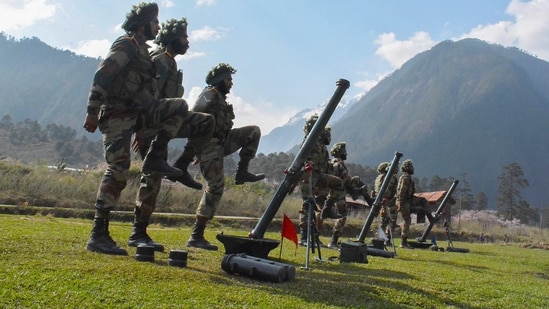
The Indian troops responded resolutely to the Chinese provocation, the army said.
“PLA troops contacted the LAC in Tawang sector which was contested by own troops in a firm and resolute manner. This face-off led to minor injuries to few personnel from both sides,” the army said in a statement. The army did not elaborate on the details of the face off, the number of troops involved or the nature of injuries sustained by the rival soldiers.
The clash took place in the Yangtse area of the Tawang sector where Indian and Chinese soldiers were involved in a face-off last year too, officials familiar with the matter said, asking not to be named. More than 300 Chinese soldiers were present in the area where the latest incident took place, HT has learnt. While at least six Indian soldiers were injured in the brawl, the number of wounded Chinese soldiers was likely higher, the officials said.
The Indian Army and PLA have been locked in a standoff along LAC in eastern Ladakh since May 2020. That standoff is in its third year, with a full resolution still not in sight even though the two sides have had partial success in disengaging front-line soldiers from some friction areas on LAC and talks are on to end the deadlock that has cast a shadow over the bilateral relationship. In June 2020, Indian and Chinese troops clashed violently in Galwan in the Ladakh sector, in a scrap that left 20 Indian soldiers dead. The Chinese have claimed there were four casualties on their side although the numbers are believed to be significantly higher.
{{/usCountry}}The Indian Army and PLA have been locked in a standoff along LAC in eastern Ladakh since May 2020. That standoff is in its third year, with a full resolution still not in sight even though the two sides have had partial success in disengaging front-line soldiers from some friction areas on LAC and talks are on to end the deadlock that has cast a shadow over the bilateral relationship. In June 2020, Indian and Chinese troops clashed violently in Galwan in the Ladakh sector, in a scrap that left 20 Indian soldiers dead. The Chinese have claimed there were four casualties on their side although the numbers are believed to be significantly higher.
{{/usCountry}}There was no further escalation after the latest face off in Arunachal Pradesh. The army said on Monday that both sides immediately disengaged from the area. The Indian commander in the area held a flag meeting with his Chinese counterpart to discuss the issue in accordance with structured mechanisms to restore peace and tranquillity, statement said.
“In certain areas along the LAC in the Tawang sector, there are areas of differing perception, wherein both sides patrol the area up to their claim lines. This has been the trend since 2006,” the statement added.
While Ladakh has been at the centre of the current border tensions between India and China, PLA has ramped up its activities in the eastern sector too. PLA has intensified patrolling in sensitive areas across the contested border in Arunachal Pradesh, and increased area domination patrols. The Chinese claim large parts of the Indian state of Arunchal Pradesh, including Tawang.
“PLA needs to be conscious of pushing too aggressively along LAC, particularly in the eastern sector which has generally been quiet. That’s because the Indian Army will respond in equal measure and that can lead to local incidents flaring up into a bigger confrontation. Opening up new areas along the LAC not good for border peace,” said former Northern Army commander Lieutenant General DS Hooda (retd).
Scores of Indian and Chinese soldiers were involved in a tense face-off in a contested area in Arunachal Pradesh last year too. The October 2021 face-off took place when rival patrols came face-to-face near Yangtse, with the soldiers asking each other to retreat to their respective sides. The face-off lasted a few hours before the matter was resolved at the level of local commanders.
The Indian Army has heightened surveillance along LAC and in Chinese depth areas in the eastern sector using satellites, long-range unmanned aerial vehicles, high-tech intelligence, surveillance and reconnaissance (ISR) systems, superior network of radars and modern night vision systems.
The Indian Army, which was focused on counter-insurgency operations in the Northeast for decades, has also carried out an overarching reorientation of its forces to sharpen its focus on LAC, even as induction of new weapons and systems, capability building and a strong infrastructure push form the bedrock of its strategy to counter challenges along the border with China.
Infantry battalions guarding LAC in Arunachal Pradesh have been equipped with several new weapons and systems to sharpen their combat edge, with the capability upgrade encompassing light machine guns, assault rifles, rocket launchers, unmanned aerial vehicles, all-terrain vehicles and high-tech surveillance gear,
Construction of helipads for operating Chinooks that can carry the army’s newest US-origin M777 howitzers to forward bases is also in full swing,
As far as eastern Ladakh is concerned, despite four rounds of disengagement from Galwan Valley, Pangong Tso, Gogra (PP-17A) and Hot Springs (PP-15), the Indian and Chinese armies still have more than 60,000 troops each and advanced weaponry deployed in the sector. The Indian and Chinese armies have held 16 rounds of talks so far, but problems at Depsang in Daulet Beg Oldi sector and Charding Nullah Junction (CNJ) in Demchok sector are still on the negotiating table.