E-Paper



Indian scientists discover 28 new Milky Way stars
The brightness of variable stars fluctuates with time due to change in emitted light, with the periodic swelling and shrinking of stars changing the quantum of light reaching earth.

 Prefer HTon Google


A team of scientists at Aryabhatta Research Institute of Observational Sciences (ARIES) in Nainital has identified 28 new variable stars in the halo or outer part of the Milky Way galaxy, nearly 60,000 light years away in the constellation Coma Berenices, visible in the northern night sky.
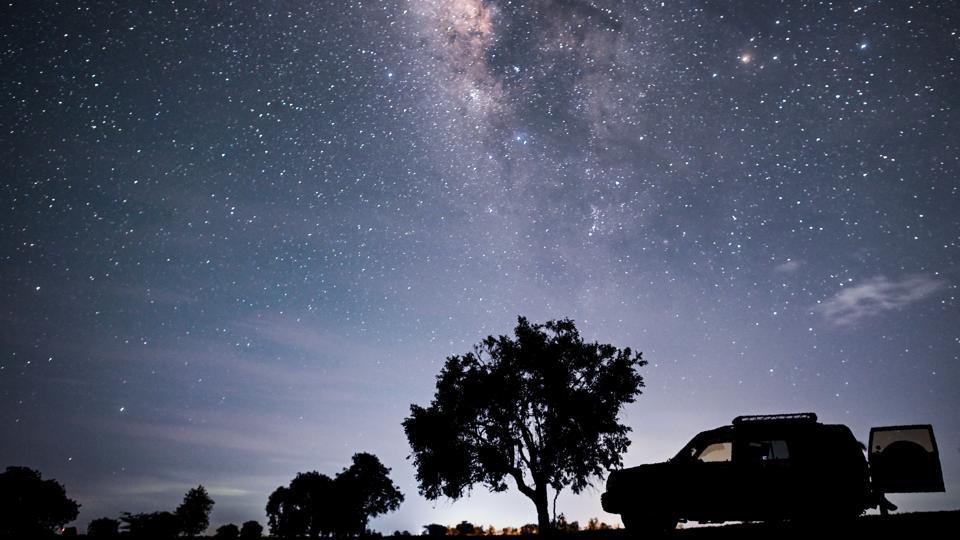
The brightness of variable stars fluctuates with time due to change in emitted light, with the periodic swelling and shrinking of stars changing the quantum of light reaching earth.
Using a powerful 3.6-metre optical telescope, the Devasthal Optical Telescope (DOT), the scientists conducted photometric observations to discover the stars.
The stars were found in globular cluster NGC 4147; a globular cluster is a large but compact cluster of stars around a galactic core and is spherical in shape. Typically a globular cluster has very old stars.
The detailed findings are to be published in next month’s Astronomical Journal.
The findings were published on May 20 on arXiv, a respected and well-used online archive for research.
The DOT telescope has made it possible to study the magnetic field structure of stars and the evolution of the Milky Way, and search for extra solar planets and stars in the outer region and the halo of the Milky Way.
“The halo of a galaxy is a nearly spherical region surrounding the galaxy like diffuse light when seen from a distance. Only about 1% of a galaxy’s mass resides in its halo area, and coupled with low brightness, the observation of stars in halos is very difficult. This is why our finding holds much significance. Also, due to the old age of stars in the halo area of our galaxy, studying stars in this area helps scientists to figure out the evolutionary history of the Milky Way,” said Sneh Lata, a scientist at ARIES who worked on the project.
“We are proud of our team for making this discovery,” said Wahab Uddin, director, ARIES.
ARIES, located on a hill near Nainital, conducts research on solar, planetary, stellar, galactic and extragalactic astronomy.
The first successful Indian optical observation of the afterglow of the gamma-ray burst was carried out from ARIES in 1999.