
 E-Paper



As wrestlers demand action, impasse takes a toll on key events before Asiad, Olympics
Players are caught in limbo between WFI chief who still looms over the sport, and an ad-hoc committee that is grappling with how to effectively manage things.

 Prefer HTon Google


At a time when India’s top wrestlers are fighting for action against former Wrestling Federation of India (WFI) chief Brij Bhushan Sharan Singh for alleged sexual harassment, a series of decisions (or the lack thereof) by the sport’s administrators in the wake of the crisis are taking a heavy toll on India’s top Olympic sport.
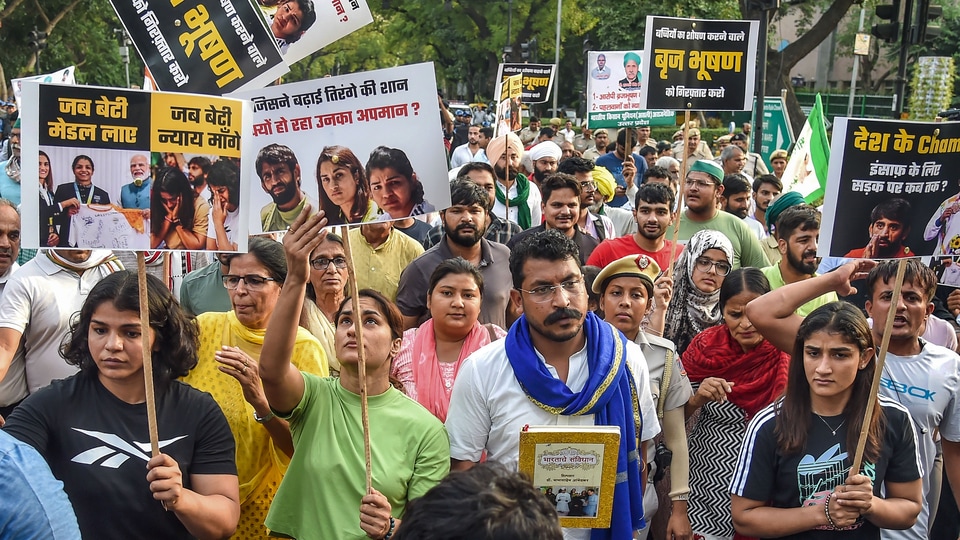
Coming up later this year is the Asian Games in Huangzhou (China), and the Paris Olympics follow next year. India’s biggest medal hopefuls should be hard in training, not having to sit on an indefinite protest in the national capital. And it’s not just these wrestlers — the stars in the forefront and their proteges in the background — that the standoff is taking a toll on. Across India, players are caught in the limbo between an all-powerful WFI chief who still looms over the sport, and an ad-hoc committee that is grappling with how to effectively manage things at a crucial juncture in the global calendar.
Also read: Funds running out, wrestlers resort to crowdfunding
Here are a few examples of the mess Indian wrestling finds itself in.
On Wednesday, trials for the under-17 and under-23 Asian championships (in Bishkek, Kyrgyzstan this June) will begin in Patiala and Sonepat respectively. These events normally have 8-10 wrestlers for every weight category, picked based on their performances in domestic events over the past few months. This time, with no age-group domestic events held since January, a total of 1,700 wrestlers have sent their entries across weight categories.
So, what should have been a selection camp has effectively turned into a national open championships -- not the way Indian teams are normally picked for any international event.
To put this in context, at the trials for the senior Asian Championships in April, there were 161 competitors across 30 weight categories (because the senior nationals were held last December) — roughly five per event. For the junior trials, this will translate to about 30 wrestlers per event.
In fact, India almost missed the deadline for sending entries for the Bishkek tournament. The original cutoff was Monday (May 15) but United World Wrestling extended it till next Monday (May 22) after an urgent request from India.
“The juniors have been waiting for last the four months for domestic tournament to start but in absence of that they are on their own. As the trials are open any wrestlers can participate. It can lead to injury if you fight so many bouts,” said a coach whose trainees will compete in the event.
Another fallout of the crisis is that no national camp has been organised for senior wrestlers — the original plan was to have a non-stop training programme for India’s elite grapplers from January till the Asian Games in September— leaving them to practice in their respective akhadas or academies without any oversight by the national coaches.
This means that India’s wrestling contingent — which could in any case miss the services of Olympic medallists Bajrang Punia and Sakshi Malik, world championships medallist Vinesh Phogat, and another dozen national-level wrestlers who are a part of the protest in Delhi — will converge only at international events rather than sparring together as they usually do.
“When you don’t have preparation for a big event, it is bound to affect the performance of the wrestlers,” said a national-level coach on condition of anonymity. “The national camps should be happening regularly. We have Olympics berths at stake in world championships. The first five months of the year are already gone,” he added.
A third problem is that the women’s team chief coach, Jitender Yadav, who was removed after the protest as allegations surfaced against Brij Bhushan and some of the members of the staff, has not been replaced even though three months have passed.
Experts and former players warn that several issues require immediate attention — the selection of teams for international tournaments, and organising national camps and exposure tours — principal among them.
Dronacharya awardee coach Mahavir Prasad said the situation looks bleak.
“It is a very busy year and the wrestlers need to prepare with a target in mind which is not happening. Naturally. their performance will come down. Under the circumstances, we don’t know how many medals will come at the Asian Games and how many berths for Paris from world championships.”
The problems flagged earlier come down to the ad-hoc panel which comprises people who don’t have any wrestling background. On the two-member committee, Bhupinder Singh Bajwa, who is also an Indian Olympic Association executive council member, is the president of the Wushu association. The other, Suma Shirur, is India’s national rifle coach in shooting. Not surprisingly, she was in Baku with the Indian team for the shooting World Cup from May 8-15.
The ad-hoc panel was appointed on April 27 and given the mandate to run WFI’s day-to-day affairs and conduct elections to the new executive body. A third member — a retired high court Judge — was to be added later for overseeing WFI’s election.
The members say they are trying to streamline things.
“The first priority was to hold the trials because the date of sending entries was nearing. We kept it open because we wanted to give everyone a chance. We will be looking to streamline things in the coming days,” Bajwa told HT on Tuesday.
Shirur could not be reached for comments.
All these problems come in the face of a calendar packed with pre-Olympics events — starting with the world championships in Serbia from September 16 — and at a time when India’s junior wrestlers were starting to show tremendous promise.
Also read: Delhi police forms SIT to probe Singh, wrestlers welcome move
India’s young grapplers have improved their showing in junior and U-23 world championships, considered the stepping stone for the senior international circuit, and have bagged 17 medals in the five editions of under-23 worlds since 2017.
“My son has been working hard for the last 10-12 years and he was looking to qualify for the Paris Olympics but the future looks uncertain now,” said father of a junior world medallist.
“The protests can go on. We are not judging who is right or wrong. At the same time the wrestlers need to be in camp and get proper training. We don’t even know whether my son has been selected for the next international ranking tournament. There is no information on Asian Games, World Championships selection trials. How do you prepare?” he asked.
Wrestling is India’s most successful sport at the Olympics since hockey rush ended in the 1960s. It has fetched the country seven medals, including at the last four Olympics. At Tokyo 2020, Ravi Dahiya and Bajrang Punia, who is part of the protests at Jantar Mantar, won silver and bronze medals respectively. But the inability to deal with the demands of the wrestlers is now starting to cast a long shadow — one that might consume the sport that has become the toast of the nation.


