Principal Secretary to the Prime Minister, Dr PK Mishra, on Saturday delivered the keynote address at the plenary session, 'A World Priced for Risk', at the 5th Kautilya Economic Conclave in New Delhi, underlining the growing importance of resilience, diversification and strategic preparedness in an increasingly uncertain global economy.
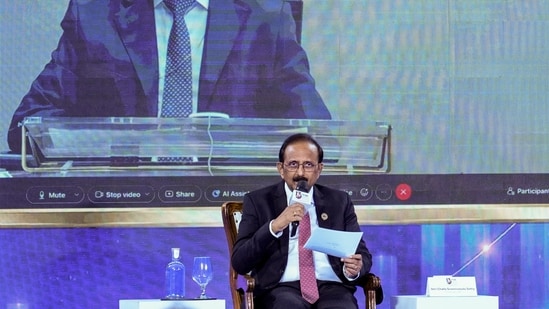
Dr Mishra said the nature of economic risk has changed significantly, with the world increasingly confronting not merely calculable risks but uncertainty that cannot be reliably assigned probabilities. The pandemic, geopolitical conflicts, supply-chain disruptions, trade restrictions and rapid technological changes, he said, have brought this distinction into sharp focus.
He observed that geography, which technology was once thought to have made less relevant, has returned to the centre of economic decision-making. Disruptions to shipping routes can affect energy prices thousands of kilometres away, while the concentration of critical minerals and their processing creates new vulnerabilities. The clean energy transition, he added, also brings new forms of strategic dependence that need to be addressed.
Also Read | Global debt, AI risks among 5 financial stability threats, says RBI Governor Malhotra
Resilience comes with a cost, says PK Mishra
Dr Mishra said uncertainty changes economic behaviour, with firms diversifying suppliers, maintaining inventories and developing alternative production capacity, while governments strengthen reserves, fiscal buffers and strategic capabilities. “Resilience is not free,” he said, adding that the key economic question is whether the premium paid for resilience is justified by the potential cost of the disruption being avoided.
{{/usCountry}}Dr Mishra said uncertainty changes economic behaviour, with firms diversifying suppliers, maintaining inventories and developing alternative production capacity, while governments strengthen reserves, fiscal buffers and strategic capabilities. “Resilience is not free,” he said, adding that the key economic question is whether the premium paid for resilience is justified by the potential cost of the disruption being avoided.
{{/usCountry}}He said the emerging global response does not represent a retreat from globalisation, but a reassessment of how it should be organised in a world of greater uncertainty. Countries are seeking to combine domestic capabilities with diversified international partnerships, strategic reserves, alternative supply chains and deeper economic cooperation.
Speaking about India’s experience, Dr Mishra said resilience cannot mean insulation from the world. “It has to mean the ability to remain open to the world without becoming excessively vulnerable to it.” He highlighted energy security, critical minerals, strategic industrial capabilities and diversification of external economic relationships as important elements of India’s response.
Dr. Mishra stressed that resilience must be accompanied by productivity and competitiveness. Building domestic capability, he said, should not mean replacing imports at any cost, but creating capabilities that are competitive, scalable and ultimately capable of serving global markets. He cited the transformation underway in electronics, semiconductors, pharmaceuticals and other strategic sectors.
Also Read | Geopolitical tensions, high crude may fuel India's imported inflation, says government report
Macro resilience key to tackling external shocks
He also underlined the importance of macroeconomic resilience, noting that fiscal space, adequate foreign exchange reserves, a sound financial system and credible institutions provide countries with the capacity to respond to external shocks. He added that security and sustainability are increasingly converging, with energy, food, technology and environmental security becoming closely interconnected.
Concluding, Dr Mishra said resilience is not a choice between self-sufficiency and globalisation. “The more rational approach lies between the two: domestic capability where vulnerability is strategic; diversification where concentration is risky; and openness wherever global integration strengthens productivity and competitiveness.”
Referring to the larger meaning of Atmanirbharta, he recalled Prime Minister Narendra Modi’s observation that it is not about being closed to the world, but about being self-sustaining and self-generating