After 21 bombs exploded in a span of 70 minutes, claiming the lives of 56 people, the Gujarat police found itself with one of its biggest investigative challenges, with a trail that lay cold for five days.
“We did not sleep for five days after the blast. It was a very challenging time; people were dying in front of us and there was no lead. On the fifth day, (Abhay) Chudasama got the big information that the terror attackers had their base near Bharuch,” said Jitendra Yadav, assistant commissioner of police of the crime branch and one of the investigators, referring to the then deputy commissioner of the department, Abhay Chudasama.
The police team travelled to Bharuch, where the tip-off was verified although the attackers had escaped. But team found some mobile numbers from the area, which began leading to trails, and eventually suspects, being picked up from Vadodara and Ahmedabad.
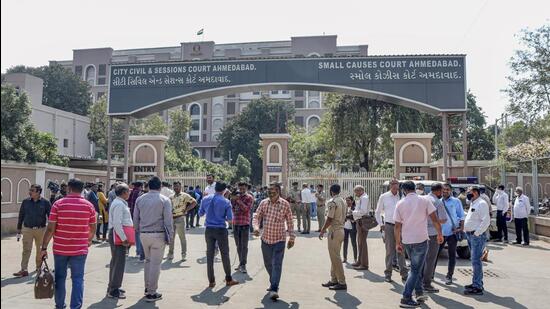
A special court in Gujarat on Friday handed the death penalty to 38 of the 47 convicts.
“The blasts (in Ahmedabad) were part of a conspiracy against our country. There were blasts at Jaipur, Delhi and similar attempts were made at Surat. Members of SIMI (Students Islamic Movement of India) were trying to regroup as Indian Mujahideen (IM). Not a single culprit has escaped. IM is finished in the country today,” said Yadav, who along with another police official Jugal Purohit, headed field operations and the technical team for investigating the 2008 blasts case.
At the time, the Ahmedabad police coordinated with their counterparts in Mumbai, Delhi and Uttar Pradesh. The sharing of intelligence lead to information about meetings organised in Ahmedabad, Vadodara and Jaipur to plan the attacks.
{{/usCountry}}At the time, the Ahmedabad police coordinated with their counterparts in Mumbai, Delhi and Uttar Pradesh. The sharing of intelligence lead to information about meetings organised in Ahmedabad, Vadodara and Jaipur to plan the attacks.
{{/usCountry}}“We came to know that two training camps were organised before the blasts in Ahmedabad. These camps were held at a forest area near Halol. We found out that such training sessions were also held at South Kerala and Karnataka, and we started questioning people from there too.”
Those awarded death sentences include key conspirators in the case ---- Madhya Pradesh resident and then SIMI chief Safdar Nagori and Qumaruddin Nagori, who is said to have provided training to about 50 men for the blasts in a forest in Kerala.
Among other accused given the death sentence were Yasin Bhatkal, one of the masterminds behind the blasts who is lodged in a Delhi jail.
“Abdul and Yasin Bhatkal were among the key conspirators, staying in Pune from where we nabbed them. They were getting instructions from ISI (Inter Service Intelligence, Pakistan’s spy agency) in Pakistan. The Batla House encounter was a result of investigations in Ahmedabad blasts,” said Yadav.
The first arrest was made in fifteen days of the blasts and by November 15, 2008 the Gujarat police had caught most of the culprits, he added.
.