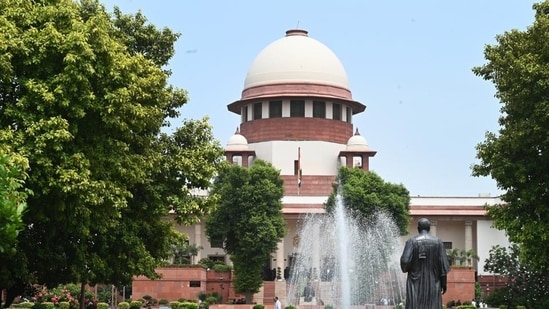
The Supreme Court on Friday held that a man who withdraws from a consensual relationship cannot be later tried for the offence of rape after the relationship turned sour. It noted a worrying trend of criminal law being weaponised to exact revenge after consensual relationships end.
“We wish to note a worrying trend in recent years wherein consensual relationships that have come to an end are retrospectively combed with a fine tooth so as to identify what can post-facto be construed as violence and sexual assault,” a bench of justices BV Nagarathna and R Mahadevan said.
Kerala case triggers observation
The judgment came in a case from Kerala where a man sought discharge in a rape case filed by a woman who lived with him for almost seven years starting 1996.
She was informed that he was already married and both consented to a physical relationship. In 2003 the man decided to walk out of the relationship and the woman filed a case of rape against him eight years later.
Discharging the man of the offence of rape after 15 years, the top court said, “The case at hand is evidently one of consensual relationship that perhaps was camouflaged in a marriage for the sake of avoiding scrutiny or stigma, which eventually came to an end,” the court said.
{{/usCountry}}Discharging the man of the offence of rape after 15 years, the top court said, “The case at hand is evidently one of consensual relationship that perhaps was camouflaged in a marriage for the sake of avoiding scrutiny or stigma, which eventually came to an end,” the court said.
{{/usCountry}}“When every consensual relationship which sours is converted into an accusation of rape, it not only dilutes the gravity of the offence alleged or rather negates the very allegation of crime,” the court said.
Discourage ‘weaponisation of criminal law’
It warned that society and courts must discourage “the weaponisation of criminal law in the aftermath of an emotional discord between two consenting adults.” Justice Nagarathna, writing the judgment for the bench, at the same time clarified that courts must distinguish between cases where there is a genuine absence of consent leading to sexual assault from cases where one of the partners experiences regret of having consented to past sexual acts once the relationship has ended.
“We must emphasise that genuine cases must be pursued with vigour where the facts clearly show sexual assault and violence. But equally, the justice system must not be turned into a tool of vengeance when relationships fail,” the judgment said.
Also Read I ₹77 lakh">78-year-old Bhopal newspaper owner handed 10 life terms for rape of five minors, fined ₹77 lakh
While such distinction will require courts to examine facts in each case, the bench noted that in a scenario where a woman decides to file a rape case against her partner, the male partner is “denuded” of any agency.
“Can it be said that the man had no right to withdraw from the relationship? Clearly not. In such cases, physical intimacy that occurred during the currency of a functioning relationship cannot be retrospectively branded as acts of rape merely because the relationship soured and no longer subsists,” justice Nagarathna said.
The court said that while judicial decisions have deprecated this tendency to use criminal law for settling scores, the judgment notes that this “trend is increasing” which is a “matter of concern” for the courts as ultimately settlement of disputes comes with huge monetary considerations borne by the male accused.