Pakistan expressed its willingness to work with Iran on “all issues” in a call between their foreign ministers on Friday after both countries exchanged drone and missile strikes on militant bases in each other’s territory at a time when the wider West Asia region is roiled by Israel’s war on the Hamas group in Gaza.
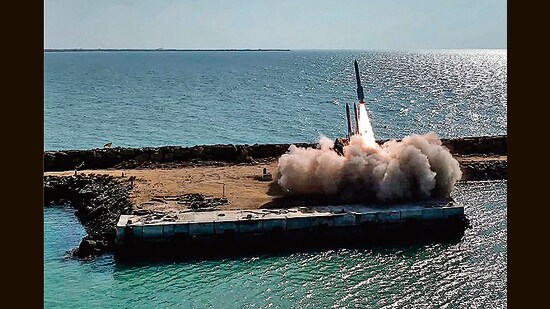
The tit-for-tat strikes by the two countries are the highest-profile cross-border intrusions in recent years and have raised alarm about wider instability in the region since the war between Israel and Hamas erupted on October 7. However, both sides have already signalled a desire to cool tensions, although they have had a history of rocky relations.
A statement from Pakistan’s foreign office said foreign minister Jalil Abbas Jilani had spoken to his Iranian counterpart, Hossein Amirabdollahian, on Friday, a day after Pakistan carried out strikes in Iran.
Iran said Thursday’s strikes killed nine people in a border village in its territory, including four children. Pakistan said the Iranian attack on Tuesday killed two children.
“Foreign minister Jilani expressed Pakistan’s readiness to work with Iran on all issues based on spirit of mutual trust and cooperation,” the statement said. “He underscored the need for closer cooperation on security issues.”
The contact follows a call between Jilani and his Turkish counterpart in which Islamabad said, “Pakistan has no interest or desire in escalation.”
{{/usCountry}}The contact follows a call between Jilani and his Turkish counterpart in which Islamabad said, “Pakistan has no interest or desire in escalation.”
{{/usCountry}}Later, broadcaster Geo TV reported, citing people familiar with the matter, that Pakistan’s cabinet had decided to end a standoff and endorsed a move to re-establish full diplomatic relations with Iran.
Meanwhile on Friday, Pakistan Prime Minister Anwaar-ul-Haq Kakar held an emergency security meeting with military and intelligence chiefs.
“The forum reiterated the unflinching resolve that sovereignty and territorial integrity of Pakistan are absolutely inviolable,” said a summary released by Kakar’s office.
“Any attempt by anyone to breach it on any pretext will be responded with [the] full might of the state.”
But the summit also said Pakistan and Iran should “address each other’s security concerns in the larger interest of regional peace and stability”.
Kakar cut short a visit to the World Economic Forum in Davos and flew home on Thursday.
UN secretary-general Antonio Guterres urged the two nations to exercise maximum restraint. The US also urged restraint although President Joe Biden said the clashes showed that Iran is not well liked in the region.
Islamabad said it hit bases of the separatist Baloch Liberation Front and Baloch Liberation Army, while Tehran said its drones and missiles struck militants from the Jaish al-Adl (JAA) group.
The militant groups operate in an area that includes Pakistan’s southwestern province of Balochistan and Iran’s southeastern Sistan-Baluchestan province. Both are restive, mineral-rich and largely underdeveloped.
The groups struck by Islamabad have been waging an armed insurgency for decades against the Pakistani state, including attacks against Chinese citizens and investment projects in Balochistan.
The JAA, which Iran attacked, is also an ethnic militant group, but with Sunni Islamist leanings seen as a threat by Iran, which is mainly Shi’ite. The group, which has had links to the Islamic State, has carried out attacks in Iran against its powerful Revolutionary Guard Corps.
Against the backdrop of the war in Gaza, Iran and its allies have been flexing their muscles in the region. This week Iran also launched strikes on Syria against what it said were Islamic State sites, and Iraq, where it said it had struck an Israeli espionage centre.
The Iran-aligned Houthi militia in Yemen has targeted shipping in the Red Sea since November, saying it is acting in solidarity with Palestinians.