The fisticuffs between the responding Indian Army and aggressive PLA in the Tawang sector on December 9, additional force deployment and Chinese military activity across the Line of Actual Control (LAC) are clear indications that the Xi Jinping regime will continue to put pressure on both contested sectors of the borders and has little interest in normalising relations with India.
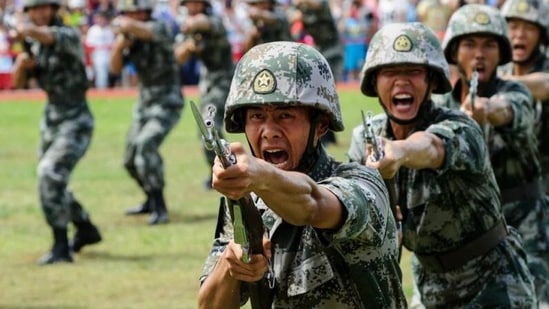
The Chinese belligerence on the border came after PLA inducted three additional combined armed brigades across Arunachal Pradesh and one similar brigade across Sikkim a month before the 20th National Party Congress and is still to move them back to their bases. Just as China wants to impose the India-rejected 1959 cartographic line on the 1597 km East Ladakh LAC, it covets entire Arunachal Pradesh as South Tibet and contests the 1126 km LAC in the eastern sector. China and India have only exchanged boundary maps in the middle sector and defined each other’s positions.
China has also renewed military activity in the India-China-Bhutan tri-junction area near the Doklam plateau---site of the 2017 military face-off--- and is putting pressure on Bhutan to yield to boundary talks.
The December 9 PLA aggression in the Tawang sector involving many more than 300 troopers was unprovoked and perhaps to test the response capacity of the Indian Army, which will have to factor the incident into its winter posture. While the PLA is fully deployed in occupied Aksai Chin and across Karakoram pass in the Tashkurgan area, the PLA military activity and infrastructure upgradation are hectic across Arunachal Pradesh.
{{/usCountry}}The December 9 PLA aggression in the Tawang sector involving many more than 300 troopers was unprovoked and perhaps to test the response capacity of the Indian Army, which will have to factor the incident into its winter posture. While the PLA is fully deployed in occupied Aksai Chin and across Karakoram pass in the Tashkurgan area, the PLA military activity and infrastructure upgradation are hectic across Arunachal Pradesh.
{{/usCountry}}The December 9 skirmish in Tawang also indicates double-speak on part of the Chinese regime as only last November 30 Beijing asked India to adhere to 1993-1996 border agreements in the context of India-US joint military exercises in Auli in Uttarakhand, 100 km from the LAC. Not only did China oppose the joint battalion-level exercises, but it also asked India to jointly uphold peace and tranquillity on the LAC. India and US on their part rejected the Chinese opposition to the joint exercises.
That the Tawang sector incident comes merely a week after the verbal friction on Auli exercises indicates that the Xi Jinping regime wants to teach India a lesson for getting too close to the US bilaterally and multilaterally as part of the QUAD. Historically also China uses military friction with adversaries to divert the attention of the Han population from domestic issues. After being re-elected as President for the third time, Xi Jinping faced unprecedented resistance from the Han population over zero Covid policy and declining economic growth in China.
While China is trying to forge new alliances in the far Pacific and the Middle East to rival the US as alternate power, it will continue to put military pressure on borders with India to remind New Delhi about the fragility of the military situation and put a check on its relations with the US and QUAD. It wants to send a message through its ecosystem in India that the Modi government should only concentrate on its neighbourhood rather than playing big in the global arena.
With China opposed to India expanding its footprint beyond South Asia, there is a strong possibility that Beijing will arm its client state Pakistan with long range submarines to check Modi’s India beyond the Indian Ocean.