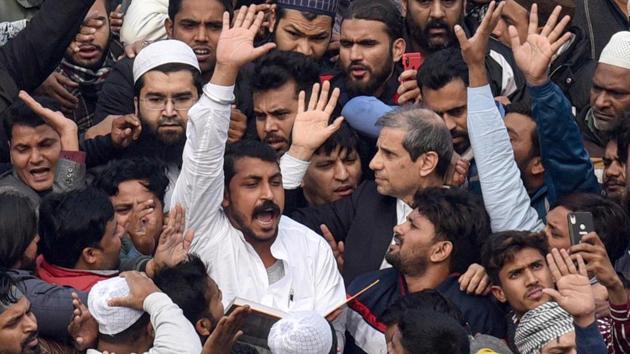
A local court in Delhi rapped the city police on Tuesday while hearing the bail application of Bhim Army chief Chandrashekhar Azad, who was arrested after the anti-citizenship act protests turned violent in Daryaganj.
After the public prosecutor opposed Chandrashekhar Azad’s bail application saying that he had incited violence through his social media posts, Tis Hazari court’s sessions judge Kamini Lau observed that there was nothing violent about them.
Lau questioned whether there was anything wrong with protests and dharnas as she reminded the public prosecutor that “it is one’s constitutional right to protest”. She also asked whether they have read the Constitution.
“You are behaving as if Jama Masjid is in Pakistan. Even if it was Pakistan, you can go there and protest. Pakistan was a part of undivided India,” the judge told the prosecutor, according to Live Law website.
As the prosecutor said that one has to take permission to protest, the judge made a reference to the Supreme Court’s observation on the use of Section 144 of the Code of Criminal Procedure (CrPC) in Kashmir.
“What permission? The Supreme Court has said repeated use of Section 144 is an abuse,” she said.
{{/usCountry}}“What permission? The Supreme Court has said repeated use of Section 144 is an abuse,” she said.
{{/usCountry}}Lau said she has seen many people who had protested outside Parliament who went on to become leaders and ministers. The judge also commented that Azad was a ‘budding politician’ who had the right to protest.
“Which law mentions that there is a prohibition on protest in front of any religious place?” she asked.
Last week, chief metropolitan magistrate Arul Verma had observed that authorities in Tihar Jail authorities kept giving Azad “ordinary medicines” even after being told he was suffering from polycythemia, a rare blood disease in which the body makes too many red blood cells.
The judge also made it clear that he was upset about the way jail officials had handled Azad’s case.
Verma also accepted Azad’s request that he should get proper treatment and ordered jail officials to ensure that he is treated for polycythemia and therapeutic phlebotomy at national capital Delhi’s All India Institute of Medical Sciences, or AIIMS.
Chandrashekhar Azad was arrested on 21 December after he led a march from Jama Masjid against the new citizenship law.
He was charged with rioting, unlawful assembly and inciting the mob to indulge in violence after vandalism in central Delhi’s Daryaganj area. Azad is in judicial custody till January 18.