The Jammu administration has begun the process of enrolling new voters in the electoral rolls by directing all revenue officials to issue certificates of residence to people living in the district for more than a year, the first step towards registering new voters in an ongoing special drive.
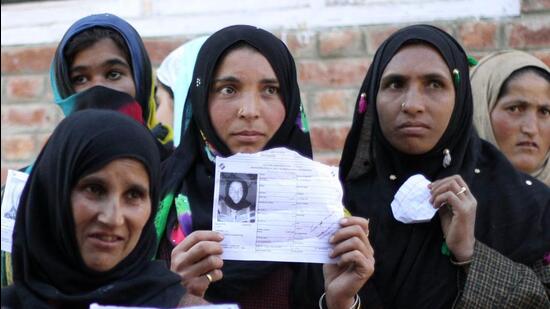
Late on Wednesday, however, ANI reported the order stood withdrawn. It did not specify a reason for the move, and more details were expected on Thursday.
The move is in line with the electoral laws in the rest of the country, where only ordinary residence is enough to obtain a voter card, not permanent residence that was earlier required in Jammu & Kashmir before its special status was scrapped three years ago.
The decision – which is likely to add 2.5 million new voters in Jammu and Kashmir’s electoral rolls – has sparked a political controversy with Kashmir-based parties saying it will alter the nature and demographics of the Union territory.
“There will be a flood of people into Jammu from outside… As outsiders will get a right to vote, it aims to finish the value of vote of residents of Jammu and Kashmir,” said former chief minister Mehbooba Mufti.
But the Bharatiya Janata Party (BJP) pointed out that the move was in accordance to India’s electoral laws which allow people to enlist as voters in a place they’ve been living for a year or more.
{{/usCountry}}But the Bharatiya Janata Party (BJP) pointed out that the move was in accordance to India’s electoral laws which allow people to enlist as voters in a place they’ve been living for a year or more.
{{/usCountry}}The special drive to revise electoral rolls is seen as the first step to holding assembly elections in the region.
In an order on Tuesday, Jammu deputy commissioner and district election commissioner Anvy Lavasa directed all tehsildars to issue certificates of residences, after conducting field verifications, to people residing in the district for more than one year.
“It has been noticed that some eligible voters are facing hardships in registration as Voters for non-availability of documents mentioned,” the order, a copy of which HT has seen, said.
“…keeping in view the urgency involved in the matter and to ensure that no eligible voter is left for registration during the special summary revision, 2022 in district Jammu, all tehsildars are authorised to issue a certificate of residence after conducting necessary field verifications, to the person(s) residing in district Jammu for more than one year, for the purpose,” it added.
As per the order, all eligible residents will need to produce one of the following documents -- water or electricity bills for a year, Aadhaar card, bank passbook, passport, land-owning records, rent or lease agreements, or sale deeds. In the absence of any of the mentioned documents, a field verification must be conducted to issue the certificate, the order said.
“...categories like homeless Indian citizens who are otherwise eligible to become electors but do not possess any documentary proof of ordinary residence, electoral registration officers shall designate an officer for field verification…,” the order said.
The revision exercise began on July 15 and seeks registration of new voters, besides deletion, correction and transposition of voters who have migrated or died since the last summary revision.
This is the first such electoral exercise in the Union territory after Parliament passed the Jammu & Kashmir Reorganisation Bill in 2019 that led to bifurcation of the erstwhile state (into J&K and Ladakh) and the effective abrogation of Article 370 that gave the region its special status.
In August, J&K chief electoral officer Hridesh Kumar Singh said the final electoral roll will be released in November, paving the way for the conduct of assembly elections in the region. Singh also courted controversy after he said the revision is likely to add around 2.5 million voters in the region.
The order triggered a political row.
“The latest order for registration of new voters makes it clear that government of India’s colonial settler project has been initiated in Jammu. They will bear the first blow to Dogra culture, identity, employment and business,” Mufti tweeted.
“First, they tried delimitation to carve constituencies as such which will benefit BJP but as the people went against them, they made this law which is applicable nowhere except in J&K,” she added.
The National Conference (NC) alleged the Centre was going ahead with its plan to add 2.5 million non-local voters.
“BJP is scared of the elections & knows it will lose badly. People of J&K must defeat these conspiracies at the ballot box,” the party said in a tweet.
Ghulam Nabi Azad, who recently launched his Democratic Azad Party, said, “There was always opposition to making a non-resident a voter and that will always remain. That was the biggest benefit of our Article 370 that outsiders cannot not vote here (in assembly elections).”
The order came four days after People’s Alliance for Gupkar Declaration (PAGD) along with Congress and Shiv Sena, formed a 14-member committee, headed by NC leader and member of Parliament Hasnain Masoodi, to look into attempts of ‘manipulation and inclusion of non-locals’ in the revised electoral rolls.
PAGD spokesperson and CPI(M) leader MY Tarigami said: “This latest order is the beginning of a wider plan to give voting rights to non-locals to reduce the weightage of locals & change electoral demographics. All parties and civil society groups must reject this arbitrary inclusion of non- locals. BJP’s designs must be defeated.”
The BJP, however, said the order was issued as per the law.